

hydrogel system from PEGDA and GCS with optogenetic molecules for cytosolic
gene delivery with excellent cell viability and a high efficiency. Neural stem cells
(NSCs) and bacteriorhodopsin D94N-HmBRI (HEBR) plasmids were injected in
chitosan-based (CS) hydrogel system. In situ transfection of HEBR to NSCs was
achieved by seeding NSC in HEBR containing CS hydrogel and filling the mixture
in a barrel and extruding the mixture through a needle. Transfection efficiency was
80% for the CS hydrogel and 20% for gelatin-based hydrogel which was injectable
but not self-healable and was used as a comparison to demonstrate enhanced
transfection. Furthermore, it was reported that the embedded cells proliferated and
specifically differentiated into neurons in vitro and in vivo experiments. Self-healing
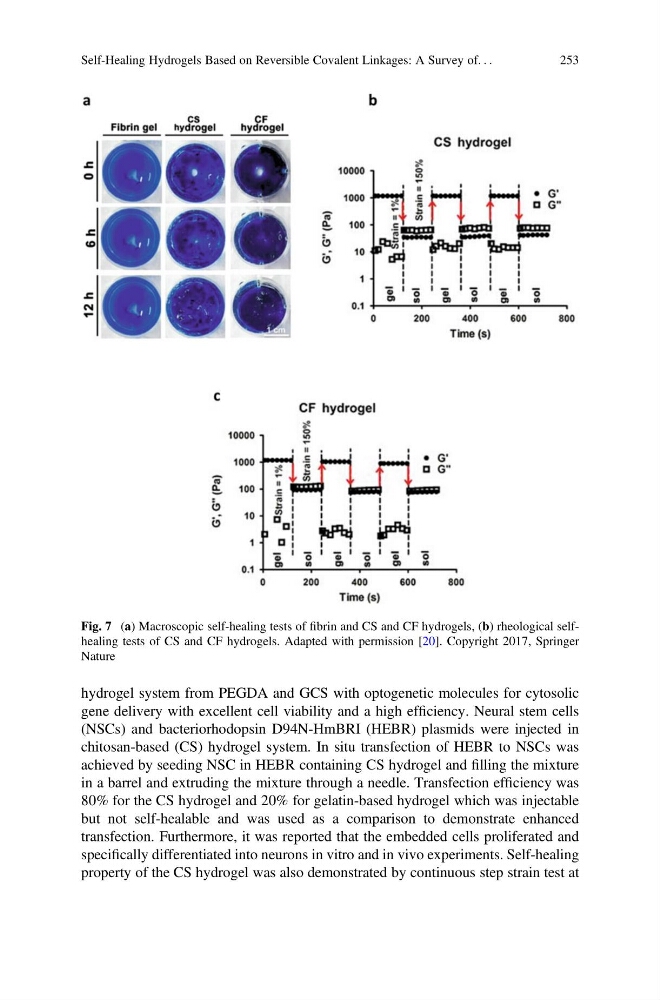
property of the CS hydrogel was also demonstrated by continuous step strain test at
Fig. 7 (a) Macroscopic self-healing tests of fibrin and CS and CF hydrogels, (b) rheological selfhealing tests of CS and CF hydrogels. Adapted with permission [20]. Copyright 2017, Springer
Nature
Self-Healing Hydrogels Based on Reversible Covalent Linkages: A Survey of. . .
253
gene delivery with excellent cell viability and a high efficiency. Neural stem cells
(NSCs) and bacteriorhodopsin D94N-HmBRI (HEBR) plasmids were injected in
chitosan-based (CS) hydrogel system. In situ transfection of HEBR to NSCs was
achieved by seeding NSC in HEBR containing CS hydrogel and filling the mixture
in a barrel and extruding the mixture through a needle. Transfection efficiency was
80% for the CS hydrogel and 20% for gelatin-based hydrogel which was injectable
but not self-healable and was used as a comparison to demonstrate enhanced
transfection. Furthermore, it was reported that the embedded cells proliferated and
specifically differentiated into neurons in vitro and in vivo experiments. Self-healing
property of the CS hydrogel was also demonstrated by continuous step strain test at
Fig. 7 (a) Macroscopic self-healing tests of fibrin and CS and CF hydrogels, (b) rheological selfhealing tests of CS and CF hydrogels. Adapted with permission [20]. Copyright 2017, Springer
Nature
Self-Healing Hydrogels Based on Reversible Covalent Linkages: A Survey of. . .
253