

3.6 Step-Cycle Uniaxial Tensile Tests and Energy Dissipation
Loading-unloading step-cycle extension tests at incremental values of strain were
performed, at a constant stretch rate of _
λ ¼ 0.3 s
À1 . Thirty min of rest time was
applied before each cycle, and the maximum stretch was increased by λ ¼ 0.5 for
each cycle up to the sample rupture.
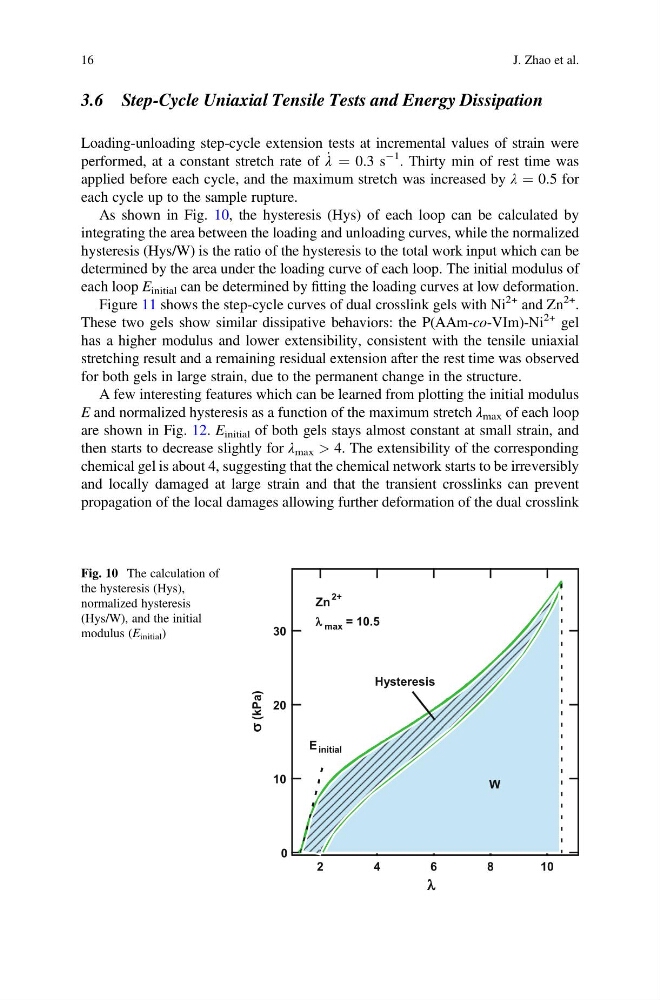
As shown in Fig. 10, the hysteresis (Hys) of each loop can be calculated by
integrating the area between the loading and unloading curves, while the normalized
hysteresis (Hys/W) is the ratio of the hysteresis to the total work input which can be
determined by the area under the loading curve of each loop. The initial modulus of
each loop E initial can be determined by fitting the loading curves at low deformation.
Figure 11 shows the step-cycle curves of dual crosslink gels with Ni
2+ and Zn
2+ .
These two gels show similar dissipative behaviors: the P(AAm-co-VIm)-Ni
2+ gel
has a higher modulus and lower extensibility, consistent with the tensile uniaxial
stretching result and a remaining residual extension after the rest time was observed
for both gels in large strain, due to the permanent change in the structure.
A few interesting features which can be learned from plotting the initial modulus
E and normalized hysteresis as a function of the maximum stretch λ max of each loop
are shown in Fig. 12. E initial of both gels stays almost constant at small strain, and
then starts to decrease slightly for λ max > 4. The extensibility of the corresponding
chemical gel is about 4, suggesting that the chemical network starts to be irreversibly
and locally damaged at large strain and that the transient crosslinks can prevent
propagation of the local damages allowing further deformation of the dual crosslink
30
20
10
0
σ σ (kPa)
10
8
6
4
2
λ
E initial
Zn
2+
λ max = 10.5
Hysteresis
W
Fig. 10 The calculation of
the hysteresis (Hys),
normalized hysteresis
(Hys/W), and the initial
modulus (E initial )
16
J. Zhao et al.
Loading-unloading step-cycle extension tests at incremental values of strain were
performed, at a constant stretch rate of _
λ ¼ 0.3 s
À1 . Thirty min of rest time was
applied before each cycle, and the maximum stretch was increased by λ ¼ 0.5 for
each cycle up to the sample rupture.
As shown in Fig. 10, the hysteresis (Hys) of each loop can be calculated by
integrating the area between the loading and unloading curves, while the normalized
hysteresis (Hys/W) is the ratio of the hysteresis to the total work input which can be
determined by the area under the loading curve of each loop. The initial modulus of
each loop E initial can be determined by fitting the loading curves at low deformation.
Figure 11 shows the step-cycle curves of dual crosslink gels with Ni
2+ and Zn
2+ .
These two gels show similar dissipative behaviors: the P(AAm-co-VIm)-Ni
2+ gel
has a higher modulus and lower extensibility, consistent with the tensile uniaxial
stretching result and a remaining residual extension after the rest time was observed
for both gels in large strain, due to the permanent change in the structure.
A few interesting features which can be learned from plotting the initial modulus
E and normalized hysteresis as a function of the maximum stretch λ max of each loop
are shown in Fig. 12. E initial of both gels stays almost constant at small strain, and
then starts to decrease slightly for λ max > 4. The extensibility of the corresponding
chemical gel is about 4, suggesting that the chemical network starts to be irreversibly
and locally damaged at large strain and that the transient crosslinks can prevent
propagation of the local damages allowing further deformation of the dual crosslink
30
20
10
0
σ σ (kPa)
10
8
6
4
2
λ
E initial
Zn
2+
λ max = 10.5
Hysteresis
W
Fig. 10 The calculation of
the hysteresis (Hys),
normalized hysteresis
(Hys/W), and the initial
modulus (E initial )
16
J. Zhao et al.