

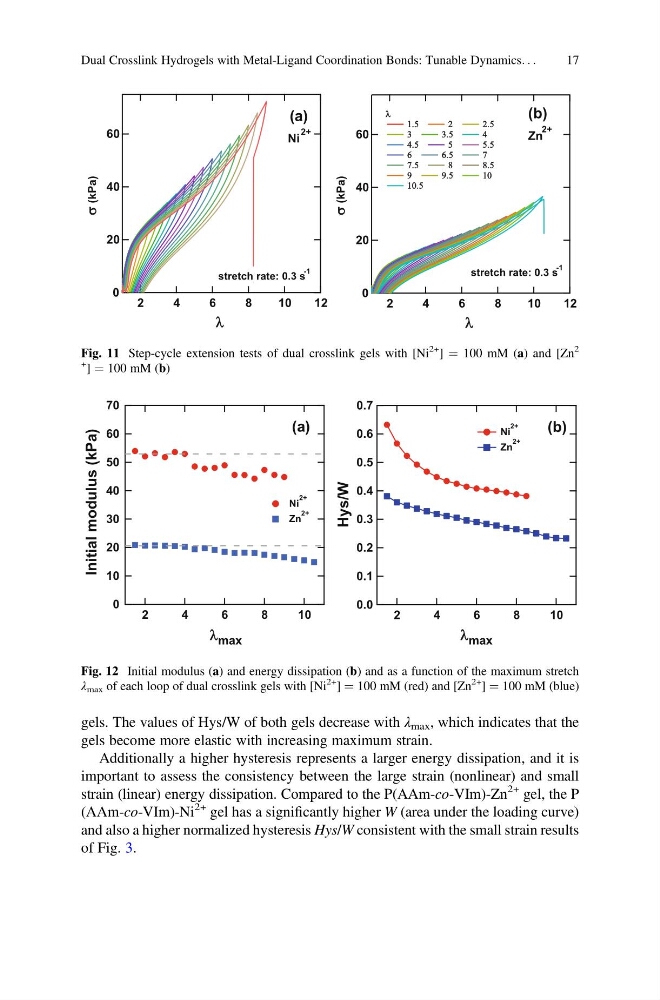
gels. The values of Hys/W of both gels decrease with λ max , which indicates that the
gels become more elastic with increasing maximum strain.
Additionally a higher hysteresis represents a larger energy dissipation, and it is
important to assess the consistency between the large strain (nonlinear) and small
strain (linear) energy dissipation. Compared to the P(AAm-co-VIm)-Zn
2+ gel, the P
(AAm-co-VIm)-Ni
2+ gel has a significantly higher W (area under the loading curve)
and also a higher normalized hysteresis Hys/W consistent with the small strain results
of Fig. 3.
60
40
20
0
σ (kPa)
12
10
8
6
4
2
λ λ
(a)
Ni
2+
stretch rate: 0.3 s
-1
60
40
20
0
12
10
8
6
4
2
λ λ
λ λ
1 1. .5 5
2 2
2 2. .5 5
3 3
3 3. .5 5
4 4
4 4. .5 5
5 5
5 5. .5 5
6 6
6 6. .5 5
7 7
7 7. .5 5
8 8
8 8. .5 5
9 9
9 9. .5 5
1 10 0
1 10 0. .5 5
(b)
Zn
2+
stretch rate: 0.3 s
-1
σ (kPa)
Fig. 11 Step-cycle extension tests of dual crosslink gels with [Ni
2+ ] ¼ 100 mM (a) and [Zn
2
+ ] ¼ 100 mM (b)
70
60
50
40
30
20
10
0
10
8
6
4
2
Ni
2+
Zn
2+
(a)
0.7
0.6
0.5
0.4
0.3
0.2
0.1
0.0
10
8
6
4
2
Ni
2+
Zn
2+
(b)
Hys/W
Initial modulus (kPa)
λ λ max
λ λ max
Fig. 12 Initial modulus (a) and energy dissipation (b) and as a function of the maximum stretch
λ max of each loop of dual crosslink gels with [Ni
2+ ] ¼ 100 mM (red) and [Zn
2+ ] ¼ 100 mM (blue)
Dual Crosslink Hydrogels with Metal-Ligand Coordination Bonds: Tunable Dynamics. . .
17
gels become more elastic with increasing maximum strain.
Additionally a higher hysteresis represents a larger energy dissipation, and it is
important to assess the consistency between the large strain (nonlinear) and small
strain (linear) energy dissipation. Compared to the P(AAm-co-VIm)-Zn
2+ gel, the P
(AAm-co-VIm)-Ni
2+ gel has a significantly higher W (area under the loading curve)
and also a higher normalized hysteresis Hys/W consistent with the small strain results
of Fig. 3.
60
40
20
0
σ (kPa)
12
10
8
6
4
2
λ λ
(a)
Ni
2+
stretch rate: 0.3 s
-1
60
40
20
0
12
10
8
6
4
2
λ λ
λ λ
1 1. .5 5
2 2
2 2. .5 5
3 3
3 3. .5 5
4 4
4 4. .5 5
5 5
5 5. .5 5
6 6
6 6. .5 5
7 7
7 7. .5 5
8 8
8 8. .5 5
9 9
9 9. .5 5
1 10 0
1 10 0. .5 5
(b)
Zn
2+
stretch rate: 0.3 s
-1
σ (kPa)
Fig. 11 Step-cycle extension tests of dual crosslink gels with [Ni
2+ ] ¼ 100 mM (a) and [Zn
2
+ ] ¼ 100 mM (b)
70
60
50
40
30
20
10
0
10
8
6
4
2
Ni
2+
Zn
2+
(a)
0.7
0.6
0.5
0.4
0.3
0.2
0.1
0.0
10
8
6
4
2
Ni
2+
Zn
2+
(b)
Hys/W
Initial modulus (kPa)
λ λ max
λ λ max
Fig. 12 Initial modulus (a) and energy dissipation (b) and as a function of the maximum stretch
λ max of each loop of dual crosslink gels with [Ni
2+ ] ¼ 100 mM (red) and [Zn
2+ ] ¼ 100 mM (blue)
Dual Crosslink Hydrogels with Metal-Ligand Coordination Bonds: Tunable Dynamics. . .
17