

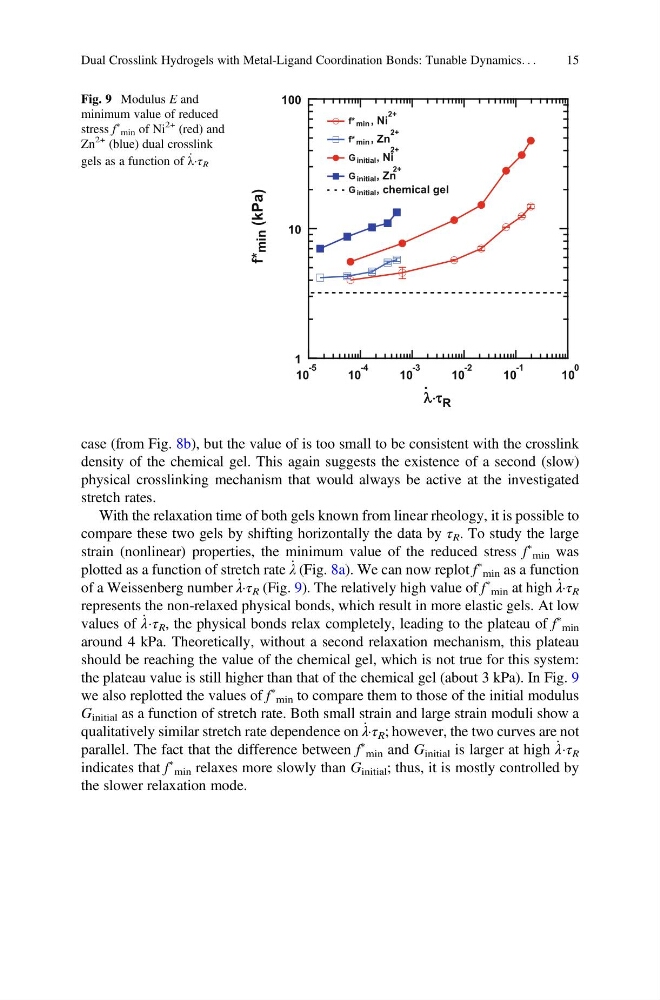
case (from Fig. 8b), but the value of is too small to be consistent with the crosslink
density of the chemical gel. This again suggests the existence of a second (slow)
physical crosslinking mechanism that would always be active at the investigated
stretch rates.
With the relaxation time of both gels known from linear rheology, it is possible to
compare these two gels by shifting horizontally the data by τ R . To study the large
strain (nonlinear) properties, the minimum value of the reduced stress f
Ã
min was
plotted as a function of stretch rate _
λ (Fig. 8a). We can now replot f
Ã
min as a function
of a Weissenberg number _
λÁτ R (Fig. 9). The relatively high value of f
Ã
min at high _
λÁτ R
represents the non-relaxed physical bonds, which result in more elastic gels. At low
values of _
λÁτ R , the physical bonds relax completely, leading to the plateau of f
Ã
min
around 4 kPa. Theoretically, without a second relaxation mechanism, this plateau
should be reaching the value of the chemical gel, which is not true for this system:
the plateau value is still higher than that of the chemical gel (about 3 kPa). In Fig. 9
we also replotted the values of f
Ã
min to compare them to those of the initial modulus
G initial as a function of stretch rate. Both small strain and large strain moduli show a
qualitatively similar stretch rate dependence on _
λÁτ R ; however, the two curves are not
parallel. The fact that the difference between f
Ã
min and G initial is larger at high _
λÁτ R
indicates that f
Ã
min relaxes more slowly than G initial ; thus, it is mostly controlled by
the slower relaxation mode.
1
10
100
f*
min (kPa)
10
-5
10
-4
10
-3
10
-2
10
-1
10
0
λ⋅τ R
f* min , Ni
2+
f* min , Zn
2+
G initial , Ni
2+
G initial , Zn
2+
G initial , chemical gel
·
Fig. 9 Modulus E and
minimum value of reduced
stress f
Ã
min of Ni
2+ (red) and
Zn
2+ (blue) dual crosslink
gels as a function of _
λÁτ R
Dual Crosslink Hydrogels with Metal-Ligand Coordination Bonds: Tunable Dynamics. . .
15
density of the chemical gel. This again suggests the existence of a second (slow)
physical crosslinking mechanism that would always be active at the investigated
stretch rates.
With the relaxation time of both gels known from linear rheology, it is possible to
compare these two gels by shifting horizontally the data by τ R . To study the large
strain (nonlinear) properties, the minimum value of the reduced stress f
Ã
min was
plotted as a function of stretch rate _
λ (Fig. 8a). We can now replot f
Ã
min as a function
of a Weissenberg number _
λÁτ R (Fig. 9). The relatively high value of f
Ã
min at high _
λÁτ R
represents the non-relaxed physical bonds, which result in more elastic gels. At low
values of _
λÁτ R , the physical bonds relax completely, leading to the plateau of f
Ã
min
around 4 kPa. Theoretically, without a second relaxation mechanism, this plateau
should be reaching the value of the chemical gel, which is not true for this system:
the plateau value is still higher than that of the chemical gel (about 3 kPa). In Fig. 9
we also replotted the values of f
Ã
min to compare them to those of the initial modulus
G initial as a function of stretch rate. Both small strain and large strain moduli show a
qualitatively similar stretch rate dependence on _
λÁτ R ; however, the two curves are not
parallel. The fact that the difference between f
Ã
min and G initial is larger at high _
λÁτ R
indicates that f
Ã
min relaxes more slowly than G initial ; thus, it is mostly controlled by
the slower relaxation mode.
1
10
100
f*
min (kPa)
10
-5
10
-4
10
-3
10
-2
10
-1
10
0
λ⋅τ R
f* min , Ni
2+
f* min , Zn
2+
G initial , Ni
2+
G initial , Zn
2+
G initial , chemical gel
·
Fig. 9 Modulus E and
minimum value of reduced
stress f
Ã
min of Ni
2+ (red) and
Zn
2+ (blue) dual crosslink
gels as a function of _
λÁτ R
Dual Crosslink Hydrogels with Metal-Ligand Coordination Bonds: Tunable Dynamics. . .
15