

The reduced stress can be plotted as a function of λ
À1 (Fig. 7b, d). As expected,
the reduced stress of the chemical gel at a stretch rate of 0.03 s
À1 is almost
independent of λ
À1 , which indicates that, in the absence of physical bonds and
polymer entanglements, the uniaxial deformation of the chemical gel is well
described by the rubber elasticity model, and the constant value of the reduced stress
is equivalent to its shear modulus. For dual crosslink gels, the values of reduced
stress are higher than that of the chemical gel over the whole range of λ, even at very
low stretch rates, which can be explained by the existence of the slow components.
At almost all stretch rates, a nonlinear viscoelastic softening occurs in the small λ
region (λ
À1
> 0.3): with increasing λ the reduced stress decreases. In the large λ
region (λ
À1 < 0.2), the reduced stress increases again, or a strain hardening appears
relative to the neo-Hookean behavior.
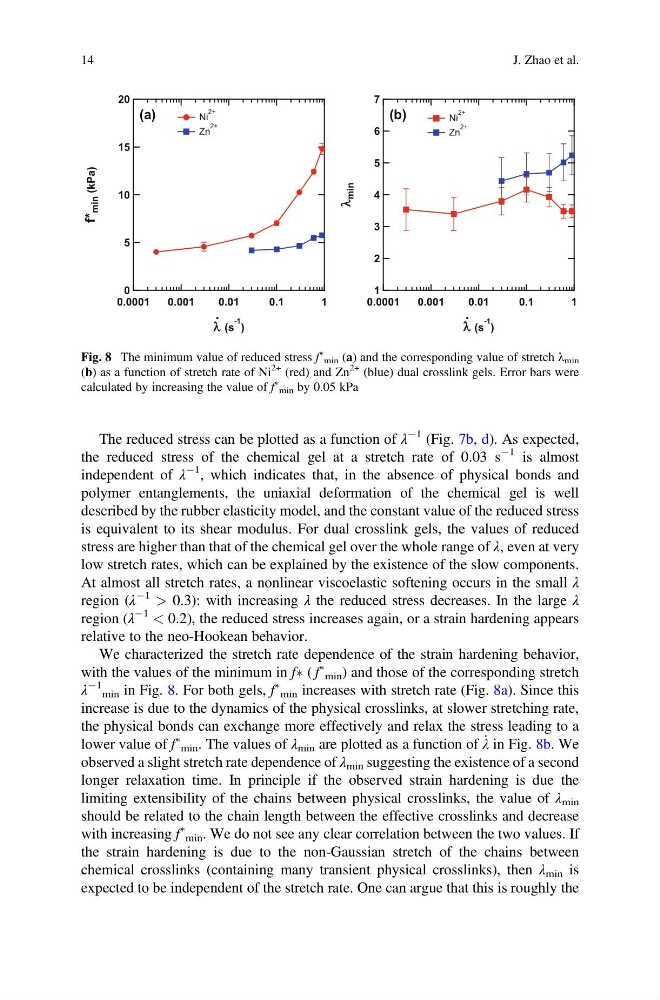
We characterized the stretch rate dependence of the strain hardening behavior,
with the values of the minimum in fà ( f
Ã
min ) and those of the corresponding stretch
λ
À1
min in Fig. 8. For both gels, f
Ã
min increases with stretch rate (Fig. 8a). Since this
increase is due to the dynamics of the physical crosslinks, at slower stretching rate,
the physical bonds can exchange more effectively and relax the stress leading to a
lower value of f
Ã
min . The values of λ min are plotted as a function of _
λ in Fig. 8b. We
observed a slight stretch rate dependence of λ min suggesting the existence of a second
longer relaxation time. In principle if the observed strain hardening is due the
limiting extensibility of the chains between physical crosslinks, the value of λ min
should be related to the chain length between the effective crosslinks and decrease
with increasing f
Ã
min . We do not see any clear correlation between the two values. If
the strain hardening is due to the non-Gaussian stretch of the chains between
chemical crosslinks (containing many transient physical crosslinks), then λ min is
expected to be independent of the stretch rate. One can argue that this is roughly the
20
15
10
5
0
f*
min
)
a
P
k
(
0.0001
0.001
0.01
0.1
1
(s
-1 )
(a)
Ni
2+
Zn
2+
7
6
5
4
3
2
1
min
0.0001
0.001
0.01
0.1
1
(s
-1 )
(b)
Ni
2+
Zn
2+
Fig. 8 The minimum value of reduced stress f
Ã
min (a) and the corresponding value of stretch λ min
(b) as a function of stretch rate of Ni
2+ (red) and Zn
2+ (blue) dual crosslink gels. Error bars were
calculated by increasing the value of f
Ã
min by 0.05 kPa
14
J. Zhao et al.
À1 (Fig. 7b, d). As expected,
the reduced stress of the chemical gel at a stretch rate of 0.03 s
À1 is almost
independent of λ
À1 , which indicates that, in the absence of physical bonds and
polymer entanglements, the uniaxial deformation of the chemical gel is well
described by the rubber elasticity model, and the constant value of the reduced stress
is equivalent to its shear modulus. For dual crosslink gels, the values of reduced
stress are higher than that of the chemical gel over the whole range of λ, even at very
low stretch rates, which can be explained by the existence of the slow components.
At almost all stretch rates, a nonlinear viscoelastic softening occurs in the small λ
region (λ
À1
> 0.3): with increasing λ the reduced stress decreases. In the large λ
region (λ
À1 < 0.2), the reduced stress increases again, or a strain hardening appears
relative to the neo-Hookean behavior.
We characterized the stretch rate dependence of the strain hardening behavior,
with the values of the minimum in fà ( f
Ã
min ) and those of the corresponding stretch
λ
À1
min in Fig. 8. For both gels, f
Ã
min increases with stretch rate (Fig. 8a). Since this
increase is due to the dynamics of the physical crosslinks, at slower stretching rate,
the physical bonds can exchange more effectively and relax the stress leading to a
lower value of f
Ã
min . The values of λ min are plotted as a function of _
λ in Fig. 8b. We
observed a slight stretch rate dependence of λ min suggesting the existence of a second
longer relaxation time. In principle if the observed strain hardening is due the
limiting extensibility of the chains between physical crosslinks, the value of λ min
should be related to the chain length between the effective crosslinks and decrease
with increasing f
Ã
min . We do not see any clear correlation between the two values. If
the strain hardening is due to the non-Gaussian stretch of the chains between
chemical crosslinks (containing many transient physical crosslinks), then λ min is
expected to be independent of the stretch rate. One can argue that this is roughly the
20
15
10
5
0
f*
min
)
a
P
k
(
0.0001
0.001
0.01
0.1
1
(s
-1 )
(a)
Ni
2+
Zn
2+
7
6
5
4
3
2
1
min
0.0001
0.001
0.01
0.1
1
(s
-1 )
(b)
Ni
2+
Zn
2+
Fig. 8 The minimum value of reduced stress f
Ã
min (a) and the corresponding value of stretch λ min
(b) as a function of stretch rate of Ni
2+ (red) and Zn
2+ (blue) dual crosslink gels. Error bars were
calculated by increasing the value of f
Ã
min by 0.05 kPa
14
J. Zhao et al.