

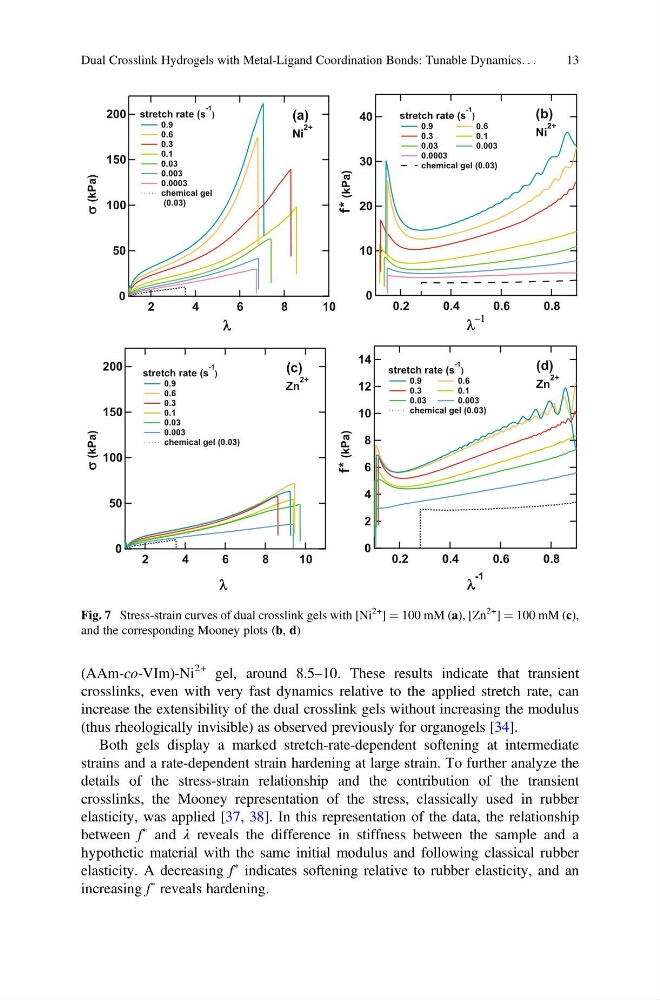
(AAm-co-VIm)-Ni
2+ gel, around 8.5–10. These results indicate that transient
crosslinks, even with very fast dynamics relative to the applied stretch rate, can
increase the extensibility of the dual crosslink gels without increasing the modulus
(thus rheologically invisible) as observed previously for organogels [34].
Both gels display a marked stretch-rate-dependent softening at intermediate
strains and a rate-dependent strain hardening at large strain. To further analyze the
details of the stress-strain relationship and the contribution of the transient
crosslinks, the Mooney representation of the stress, classically used in rubber
elasticity, was applied [37, 38]. In this representation of the data, the relationship
between f
à and λ reveals the difference in stiffness between the sample and a
hypothetic material with the same initial modulus and following classical rubber
elasticity. A decreasing f
à indicates softening relative to rubber elasticity, and an
increasing f
à reveals hardening.
200
150
100
50
0
10
8
6
4
2
λ
(a)
Ni
2+
stretch rate (s
-1
)
0.9
0.6
0.3
0.1
0.03
0.003
0.0003
chemical gel
(0.03)
40
30
20
10
0
0.8
0.6
0.4
0.2
λ
−1
(b)
Ni
2+
stretch rate (s
-1
)
0.9
0.6
0.3
0.1
0.03
0.003
0.0003
chemical gel (0.03)
200
150
100
50
0
10
8
6
4
2
λ
(c)
Zn
2+
stretch rate (s
-1
)
0.9
0.6
0.3
0.1
0.03
0.003
chemical gel (0.03)
14
12
10
8
6
4
2
0
0.8
0.6
0.4
0.2
λ
-1
(d)
Zn
2+
stretch rate (s
-1
)
0.9
0.6
0.3
0.1
0.03
0.003
chemical gel (0.03)
f* (kPa)
f* (kPa)
σ (kPa)
σ (kPa)
Fig. 7 Stress-strain curves of dual crosslink gels with [Ni
2+ ] ¼ 100 mM (a), [Zn
2+ ] ¼ 100 mM (c),
and the corresponding Mooney plots (b, d)
Dual Crosslink Hydrogels with Metal-Ligand Coordination Bonds: Tunable Dynamics. . .
13
2+ gel, around 8.5–10. These results indicate that transient
crosslinks, even with very fast dynamics relative to the applied stretch rate, can
increase the extensibility of the dual crosslink gels without increasing the modulus
(thus rheologically invisible) as observed previously for organogels [34].
Both gels display a marked stretch-rate-dependent softening at intermediate
strains and a rate-dependent strain hardening at large strain. To further analyze the
details of the stress-strain relationship and the contribution of the transient
crosslinks, the Mooney representation of the stress, classically used in rubber
elasticity, was applied [37, 38]. In this representation of the data, the relationship
between f
à and λ reveals the difference in stiffness between the sample and a
hypothetic material with the same initial modulus and following classical rubber
elasticity. A decreasing f
à indicates softening relative to rubber elasticity, and an
increasing f
à reveals hardening.
200
150
100
50
0
10
8
6
4
2
λ
(a)
Ni
2+
stretch rate (s
-1
)
0.9
0.6
0.3
0.1
0.03
0.003
0.0003
chemical gel
(0.03)
40
30
20
10
0
0.8
0.6
0.4
0.2
λ
−1
(b)
Ni
2+
stretch rate (s
-1
)
0.9
0.6
0.3
0.1
0.03
0.003
0.0003
chemical gel (0.03)
200
150
100
50
0
10
8
6
4
2
λ
(c)
Zn
2+
stretch rate (s
-1
)
0.9
0.6
0.3
0.1
0.03
0.003
chemical gel (0.03)
14
12
10
8
6
4
2
0
0.8
0.6
0.4
0.2
λ
-1
(d)
Zn
2+
stretch rate (s
-1
)
0.9
0.6
0.3
0.1
0.03
0.003
chemical gel (0.03)
f* (kPa)
f* (kPa)
σ (kPa)
σ (kPa)
Fig. 7 Stress-strain curves of dual crosslink gels with [Ni
2+ ] ¼ 100 mM (a), [Zn
2+ ] ¼ 100 mM (c),
and the corresponding Mooney plots (b, d)
Dual Crosslink Hydrogels with Metal-Ligand Coordination Bonds: Tunable Dynamics. . .
13