

3.5 Uniaxial Tensile Tests to Fracture
Tensile stress-strain curves of the dual crosslink gels with Ni
2+ and Zn
2+ at various
stretch rates _
λ (from 0.9 to 0.0003 s
À1 ) are shown in Fig. 7a, c together with the data
for the corresponding chemical gel at the stretch rate _
λ ¼ 0.03 s
À1 . Note that the
chemical gel does not exhibit any particular stretch rate dependence (data not
shown). It is immediately evident that the addition of the transient crosslinks
significantly increases the extensibility at rupture λ b compared to that of the chemical
gel and that λ b does not show a clear stretch rate dependence for both gels.
For the P(AAm-co-VIm)-Ni
2+ gel, the values of λ b were found around 6.5–8.5,
and for the P(AAm-co-VIm)-Zn
2+ gel, they were slightly higher than that of P
20
15
10
5
0
2
1
0.3
0.1
0.03
0.0003
0.001
0.01
0.003
(a) Ni
2+
stretch rate (s
-1
)
1
10
100
0.1
1
10
100
1000
stretch rate (s
-1
)
0.3
0.1
0.03
0.01
0.003
0.001
0.0003
(b) Ni
2+
20
15
10
5
0
2
1
λ
0.3
0.1
0.03
0.0003
0.001
0.01
0.003
(c) Zn
2+
Stretch rate (s
-1
)
1
10
100
f* (kPa)
0.1
1
10
100
1000
t (s)
Stretch rate (s
-1
)
0.3
0.1
0.03
0.01
0.003
0.001
0.0003
(d) Zn
2+
σ (kPa)
λ
t (s)
σ (kPa)
f* (kPa)
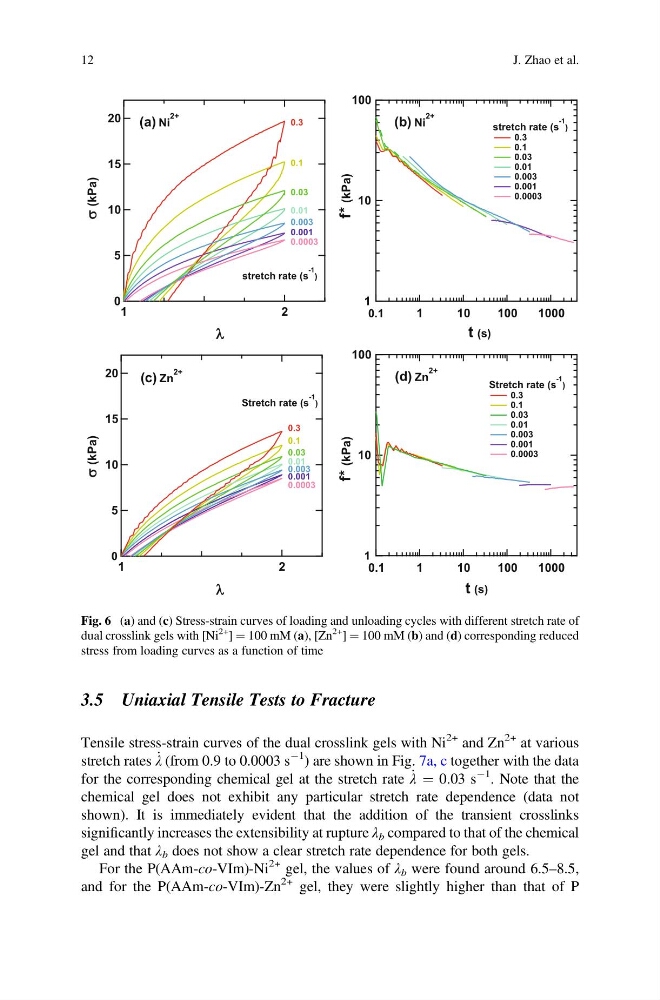
Fig. 6 (a) and (c) Stress-strain curves of loading and unloading cycles with different stretch rate of
dual crosslink gels with [Ni
2+ ] ¼ 100 mM (a), [Zn
2+ ] ¼ 100 mM (b) and (d) corresponding reduced
stress from loading curves as a function of time
12
J. Zhao et al.
Tensile stress-strain curves of the dual crosslink gels with Ni
2+ and Zn
2+ at various
stretch rates _
λ (from 0.9 to 0.0003 s
À1 ) are shown in Fig. 7a, c together with the data
for the corresponding chemical gel at the stretch rate _
λ ¼ 0.03 s
À1 . Note that the
chemical gel does not exhibit any particular stretch rate dependence (data not
shown). It is immediately evident that the addition of the transient crosslinks
significantly increases the extensibility at rupture λ b compared to that of the chemical
gel and that λ b does not show a clear stretch rate dependence for both gels.
For the P(AAm-co-VIm)-Ni
2+ gel, the values of λ b were found around 6.5–8.5,
and for the P(AAm-co-VIm)-Zn
2+ gel, they were slightly higher than that of P
20
15
10
5
0
2
1
0.3
0.1
0.03
0.0003
0.001
0.01
0.003
(a) Ni
2+
stretch rate (s
-1
)
1
10
100
0.1
1
10
100
1000
stretch rate (s
-1
)
0.3
0.1
0.03
0.01
0.003
0.001
0.0003
(b) Ni
2+
20
15
10
5
0
2
1
λ
0.3
0.1
0.03
0.0003
0.001
0.01
0.003
(c) Zn
2+
Stretch rate (s
-1
)
1
10
100
f* (kPa)
0.1
1
10
100
1000
t (s)
Stretch rate (s
-1
)
0.3
0.1
0.03
0.01
0.003
0.001
0.0003
(d) Zn
2+
σ (kPa)
λ
t (s)
σ (kPa)
f* (kPa)
Fig. 6 (a) and (c) Stress-strain curves of loading and unloading cycles with different stretch rate of
dual crosslink gels with [Ni
2+ ] ¼ 100 mM (a), [Zn
2+ ] ¼ 100 mM (b) and (d) corresponding reduced
stress from loading curves as a function of time
12
J. Zhao et al.