

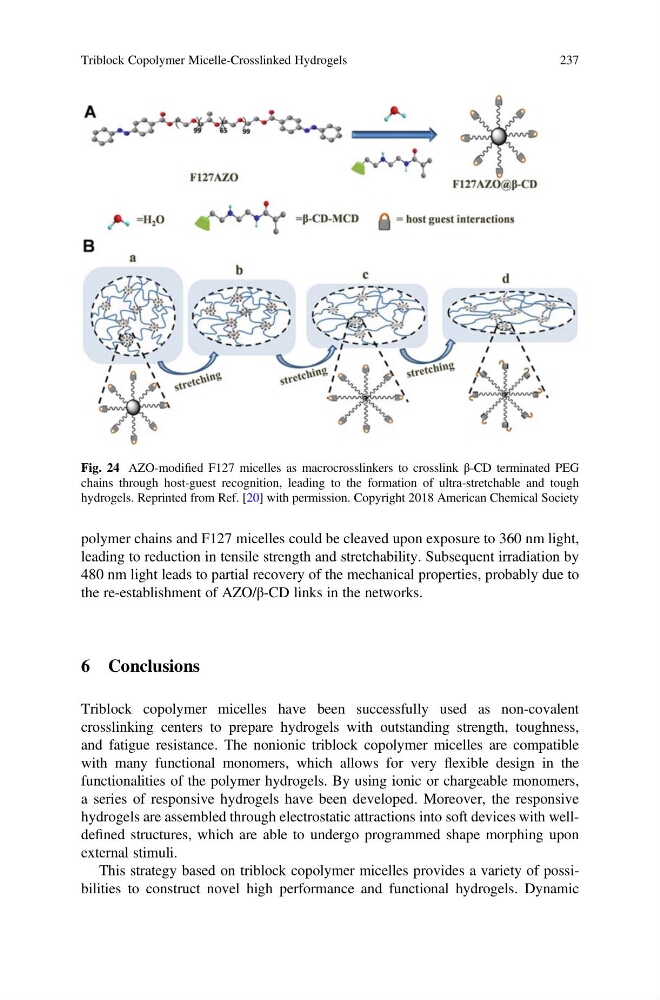
polymer chains and F127 micelles could be cleaved upon exposure to 360 nm light,
leading to reduction in tensile strength and stretchability. Subsequent irradiation by
480 nm light leads to partial recovery of the mechanical properties, probably due to
the re-establishment of AZO/β-CD links in the networks.
6 Conclusions
Triblock copolymer micelles have been successfully used as non-covalent
crosslinking centers to prepare hydrogels with outstanding strength, toughness,
and fatigue resistance. The nonionic triblock copolymer micelles are compatible
with many functional monomers, which allows for very flexible design in the
functionalities of the polymer hydrogels. By using ionic or chargeable monomers,
a series of responsive hydrogels have been developed. Moreover, the responsive
hydrogels are assembled through electrostatic attractions into soft devices with welldefined structures, which are able to undergo programmed shape morphing upon
external stimuli.
This strategy based on triblock copolymer micelles provides a variety of possibilities to construct novel high performance and functional hydrogels. Dynamic
Fig. 24 AZO-modified F127 micelles as macrocrosslinkers to crosslink β-CD terminated PEG
chains through host-guest recognition, leading to the formation of ultra-stretchable and tough
hydrogels. Reprinted from Ref. [20] with permission. Copyright 2018 American Chemical Society
Triblock Copolymer Micelle-Crosslinked Hydrogels
237
leading to reduction in tensile strength and stretchability. Subsequent irradiation by
480 nm light leads to partial recovery of the mechanical properties, probably due to
the re-establishment of AZO/β-CD links in the networks.
6 Conclusions
Triblock copolymer micelles have been successfully used as non-covalent
crosslinking centers to prepare hydrogels with outstanding strength, toughness,
and fatigue resistance. The nonionic triblock copolymer micelles are compatible
with many functional monomers, which allows for very flexible design in the
functionalities of the polymer hydrogels. By using ionic or chargeable monomers,
a series of responsive hydrogels have been developed. Moreover, the responsive
hydrogels are assembled through electrostatic attractions into soft devices with welldefined structures, which are able to undergo programmed shape morphing upon
external stimuli.
This strategy based on triblock copolymer micelles provides a variety of possibilities to construct novel high performance and functional hydrogels. Dynamic
Fig. 24 AZO-modified F127 micelles as macrocrosslinkers to crosslink β-CD terminated PEG
chains through host-guest recognition, leading to the formation of ultra-stretchable and tough
hydrogels. Reprinted from Ref. [20] with permission. Copyright 2018 American Chemical Society
Triblock Copolymer Micelle-Crosslinked Hydrogels
237