

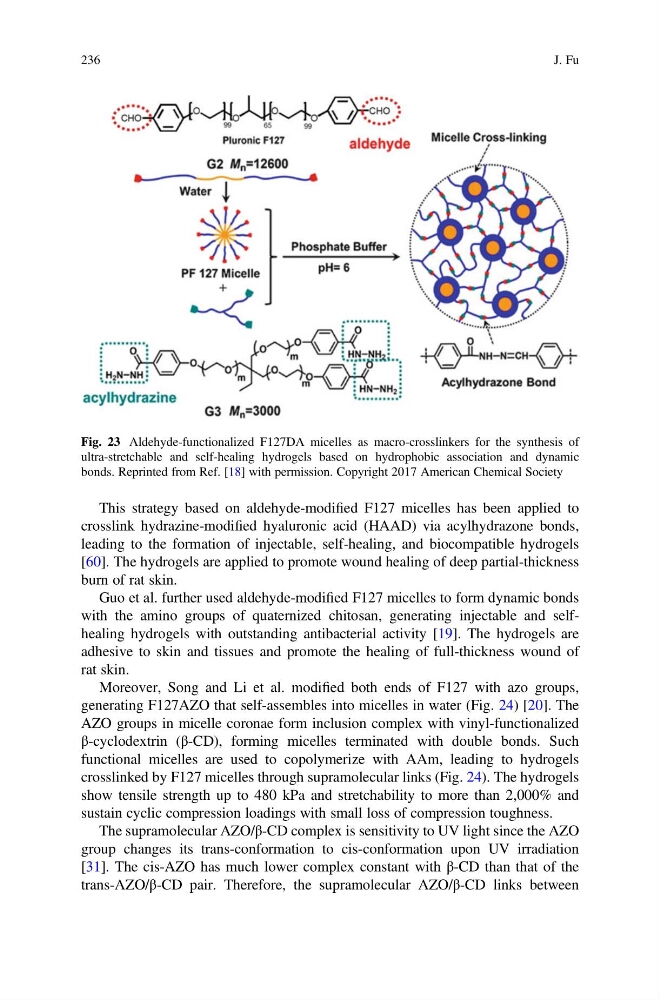
This strategy based on aldehyde-modified F127 micelles has been applied to
crosslink hydrazine-modified hyaluronic acid (HAAD) via acylhydrazone bonds,
leading to the formation of injectable, self-healing, and biocompatible hydrogels
[60]. The hydrogels are applied to promote wound healing of deep partial-thickness
burn of rat skin.
Guo et al. further used aldehyde-modified F127 micelles to form dynamic bonds
with the amino groups of quaternized chitosan, generating injectable and selfhealing hydrogels with outstanding antibacterial activity [19]. The hydrogels are
adhesive to skin and tissues and promote the healing of full-thickness wound of
rat skin.
Moreover, Song and Li et al. modified both ends of F127 with azo groups,
generating F127AZO that self-assembles into micelles in water (Fig. 24) [20]. The
AZO groups in micelle coronae form inclusion complex with vinyl-functionalized
β-cyclodextrin (β-CD), forming micelles terminated with double bonds. Such
functional micelles are used to copolymerize with AAm, leading to hydrogels
crosslinked by F127 micelles through supramolecular links (Fig. 24). The hydrogels
show tensile strength up to 480 kPa and stretchability to more than 2,000% and
sustain cyclic compression loadings with small loss of compression toughness.
The supramolecular AZO/β-CD complex is sensitivity to UV light since the AZO
group changes its trans-conformation to cis-conformation upon UV irradiation
[31]. The cis-AZO has much lower complex constant with β-CD than that of the
trans-AZO/β-CD pair. Therefore, the supramolecular AZO/β-CD links between
Fig. 23 Aldehyde-functionalized F127DA micelles as macro-crosslinkers for the synthesis of
ultra-stretchable and self-healing hydrogels based on hydrophobic association and dynamic
bonds. Reprinted from Ref. [18] with permission. Copyright 2017 American Chemical Society
236
J. Fu
crosslink hydrazine-modified hyaluronic acid (HAAD) via acylhydrazone bonds,
leading to the formation of injectable, self-healing, and biocompatible hydrogels
[60]. The hydrogels are applied to promote wound healing of deep partial-thickness
burn of rat skin.
Guo et al. further used aldehyde-modified F127 micelles to form dynamic bonds
with the amino groups of quaternized chitosan, generating injectable and selfhealing hydrogels with outstanding antibacterial activity [19]. The hydrogels are
adhesive to skin and tissues and promote the healing of full-thickness wound of
rat skin.
Moreover, Song and Li et al. modified both ends of F127 with azo groups,
generating F127AZO that self-assembles into micelles in water (Fig. 24) [20]. The
AZO groups in micelle coronae form inclusion complex with vinyl-functionalized
β-cyclodextrin (β-CD), forming micelles terminated with double bonds. Such
functional micelles are used to copolymerize with AAm, leading to hydrogels
crosslinked by F127 micelles through supramolecular links (Fig. 24). The hydrogels
show tensile strength up to 480 kPa and stretchability to more than 2,000% and
sustain cyclic compression loadings with small loss of compression toughness.
The supramolecular AZO/β-CD complex is sensitivity to UV light since the AZO
group changes its trans-conformation to cis-conformation upon UV irradiation
[31]. The cis-AZO has much lower complex constant with β-CD than that of the
trans-AZO/β-CD pair. Therefore, the supramolecular AZO/β-CD links between
Fig. 23 Aldehyde-functionalized F127DA micelles as macro-crosslinkers for the synthesis of
ultra-stretchable and self-healing hydrogels based on hydrophobic association and dynamic
bonds. Reprinted from Ref. [18] with permission. Copyright 2017 American Chemical Society
236
J. Fu