

between the electrodes. The bending angle reaches about 20
in about 10 s. As the
bias is reversed, the gel strip starts to bend backward and reaches an angle about 60
in less than 1 min (Fig. 15a). As the electric field direction is cyclically reversed, the
gel strip swings between the electrodes. The bending angle is merely dependent on
the actuation time. Similarly, the P(DMAEA-Q-co-AAm) gel is cyclically actuated
in the electric field (Fig. 15b).
The response of the hydrogel to the electric field is dependent on the salt
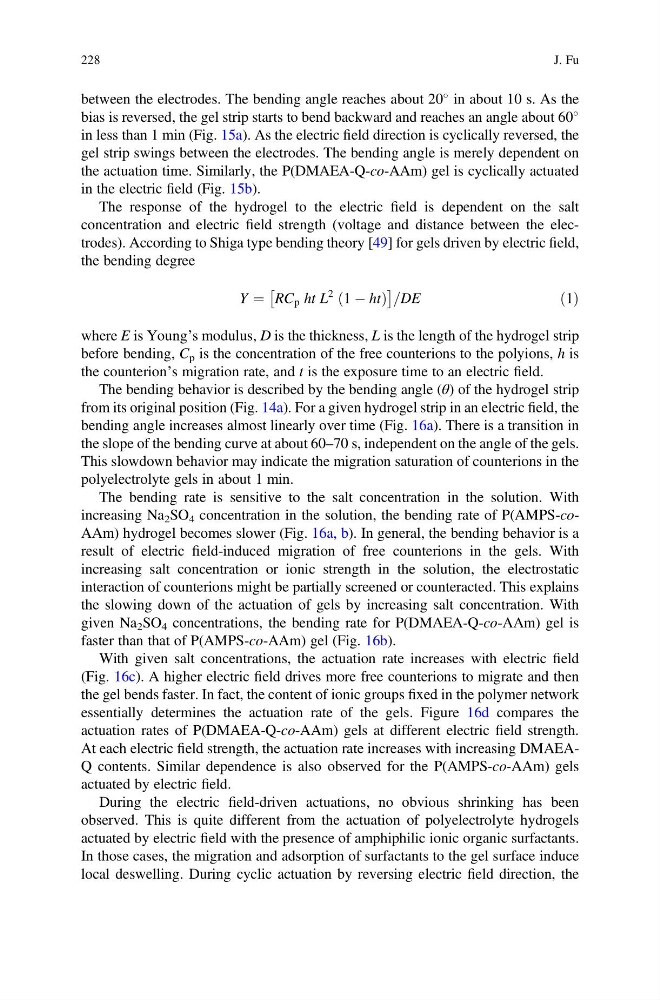
concentration and electric field strength (voltage and distance between the electrodes). According to Shiga type bending theory [49] for gels driven by electric field,
the bending degree
Y ¼ RC p ht L
2 1 À ht
ð
Þ
Â
Ã
=DE
ð1Þ
where E is Young’s modulus, D is the thickness, L is the length of the hydrogel strip
before bending, C p is the concentration of the free counterions to the polyions, h is
the counterion’s migration rate, and t is the exposure time to an electric field.
The bending behavior is described by the bending angle (θ) of the hydrogel strip
from its original position (Fig. 14a). For a given hydrogel strip in an electric field, the
bending angle increases almost linearly over time (Fig. 16a). There is a transition in
the slope of the bending curve at about 60–70 s, independent on the angle of the gels.
This slowdown behavior may indicate the migration saturation of counterions in the
polyelectrolyte gels in about 1 min.
The bending rate is sensitive to the salt concentration in the solution. With
increasing Na 2 SO 4 concentration in the solution, the bending rate of P(AMPS-coAAm) hydrogel becomes slower (Fig. 16a, b). In general, the bending behavior is a
result of electric field-induced migration of free counterions in the gels. With
increasing salt concentration or ionic strength in the solution, the electrostatic
interaction of counterions might be partially screened or counteracted. This explains
the slowing down of the actuation of gels by increasing salt concentration. With
given Na 2 SO 4 concentrations, the bending rate for P(DMAEA-Q-co-AAm) gel is
faster than that of P(AMPS-co-AAm) gel (Fig. 16b).
With given salt concentrations, the actuation rate increases with electric field
(Fig. 16c). A higher electric field drives more free counterions to migrate and then
the gel bends faster. In fact, the content of ionic groups fixed in the polymer network
essentially determines the actuation rate of the gels. Figure 16d compares the
actuation rates of P(DMAEA-Q-co-AAm) gels at different electric field strength.
At each electric field strength, the actuation rate increases with increasing DMAEAQ contents. Similar dependence is also observed for the P(AMPS-co-AAm) gels
actuated by electric field.
During the electric field-driven actuations, no obvious shrinking has been
observed. This is quite different from the actuation of polyelectrolyte hydrogels
actuated by electric field with the presence of amphiphilic ionic organic surfactants.
In those cases, the migration and adsorption of surfactants to the gel surface induce
local deswelling. During cyclic actuation by reversing electric field direction, the
228
J. Fu
in about 10 s. As the
bias is reversed, the gel strip starts to bend backward and reaches an angle about 60
in less than 1 min (Fig. 15a). As the electric field direction is cyclically reversed, the
gel strip swings between the electrodes. The bending angle is merely dependent on
the actuation time. Similarly, the P(DMAEA-Q-co-AAm) gel is cyclically actuated
in the electric field (Fig. 15b).
The response of the hydrogel to the electric field is dependent on the salt
concentration and electric field strength (voltage and distance between the electrodes). According to Shiga type bending theory [49] for gels driven by electric field,
the bending degree
Y ¼ RC p ht L
2 1 À ht
ð
Þ
Â
Ã
=DE
ð1Þ
where E is Young’s modulus, D is the thickness, L is the length of the hydrogel strip
before bending, C p is the concentration of the free counterions to the polyions, h is
the counterion’s migration rate, and t is the exposure time to an electric field.
The bending behavior is described by the bending angle (θ) of the hydrogel strip
from its original position (Fig. 14a). For a given hydrogel strip in an electric field, the
bending angle increases almost linearly over time (Fig. 16a). There is a transition in
the slope of the bending curve at about 60–70 s, independent on the angle of the gels.
This slowdown behavior may indicate the migration saturation of counterions in the
polyelectrolyte gels in about 1 min.
The bending rate is sensitive to the salt concentration in the solution. With
increasing Na 2 SO 4 concentration in the solution, the bending rate of P(AMPS-coAAm) hydrogel becomes slower (Fig. 16a, b). In general, the bending behavior is a
result of electric field-induced migration of free counterions in the gels. With
increasing salt concentration or ionic strength in the solution, the electrostatic
interaction of counterions might be partially screened or counteracted. This explains
the slowing down of the actuation of gels by increasing salt concentration. With
given Na 2 SO 4 concentrations, the bending rate for P(DMAEA-Q-co-AAm) gel is
faster than that of P(AMPS-co-AAm) gel (Fig. 16b).
With given salt concentrations, the actuation rate increases with electric field
(Fig. 16c). A higher electric field drives more free counterions to migrate and then
the gel bends faster. In fact, the content of ionic groups fixed in the polymer network
essentially determines the actuation rate of the gels. Figure 16d compares the
actuation rates of P(DMAEA-Q-co-AAm) gels at different electric field strength.
At each electric field strength, the actuation rate increases with increasing DMAEAQ contents. Similar dependence is also observed for the P(AMPS-co-AAm) gels
actuated by electric field.
During the electric field-driven actuations, no obvious shrinking has been
observed. This is quite different from the actuation of polyelectrolyte hydrogels
actuated by electric field with the presence of amphiphilic ionic organic surfactants.
In those cases, the migration and adsorption of surfactants to the gel surface induce
local deswelling. During cyclic actuation by reversing electric field direction, the
228
J. Fu