

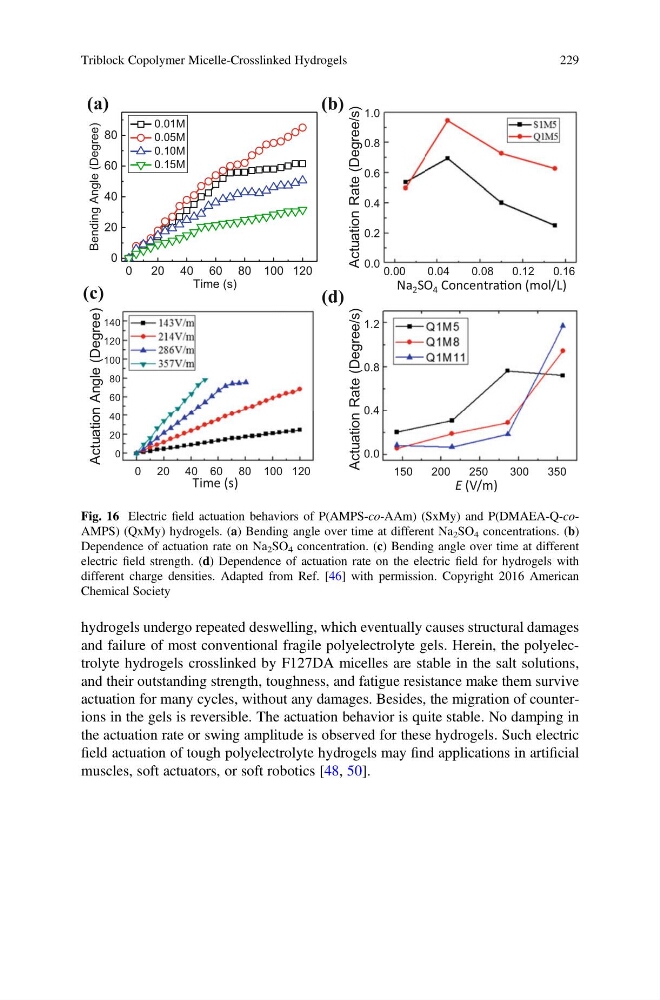
hydrogels undergo repeated deswelling, which eventually causes structural damages
and failure of most conventional fragile polyelectrolyte gels. Herein, the polyelectrolyte hydrogels crosslinked by F127DA micelles are stable in the salt solutions,
and their outstanding strength, toughness, and fatigue resistance make them survive
actuation for many cycles, without any damages. Besides, the migration of counterions in the gels is reversible. The actuation behavior is quite stable. No damping in
the actuation rate or swing amplitude is observed for these hydrogels. Such electric
field actuation of tough polyelectrolyte hydrogels may find applications in artificial
muscles, soft actuators, or soft robotics [48, 50].
(a)
(d)
(c)
0
20 40 60 80 100 120
0
20
40
60
80
)
e
e
r
g
e
D
(
e
l
g
n
A
g
n
i
d
n
e
B
Time (s)
0.01M
0.05M
0.10M
0.15M
Actuation Rate (Degree/s)
1.0
0.8
0.6
0.4
0.2
0.0 0.00
0.04
0.08
0.12
0.16
Na 2 SO 4 ConcentraƟon (mol/L)
Actuation Rate (Degree/s)
1.2
0.8
0.4
0.0
E (V/m)
0 20 40 60 80 100 120
Time (s)
140
120
100
80
60
40
20
0
(b)
)
e
e
r
g
e
D
(
e
l
g
n
A
n
o
i
t
a
u
t
c
A
150
200
250
300
350
Fig. 16 Electric field actuation behaviors of P(AMPS-co-AAm) (SxMy) and P(DMAEA-Q-coAMPS) (QxMy) hydrogels. (a) Bending angle over time at different Na 2 SO 4 concentrations. (b)
Dependence of actuation rate on Na 2 SO 4 concentration. (c) Bending angle over time at different
electric field strength. (d) Dependence of actuation rate on the electric field for hydrogels with
different charge densities. Adapted from Ref. [46] with permission. Copyright 2016 American
Chemical Society
Triblock Copolymer Micelle-Crosslinked Hydrogels
229
and failure of most conventional fragile polyelectrolyte gels. Herein, the polyelectrolyte hydrogels crosslinked by F127DA micelles are stable in the salt solutions,
and their outstanding strength, toughness, and fatigue resistance make them survive
actuation for many cycles, without any damages. Besides, the migration of counterions in the gels is reversible. The actuation behavior is quite stable. No damping in
the actuation rate or swing amplitude is observed for these hydrogels. Such electric
field actuation of tough polyelectrolyte hydrogels may find applications in artificial
muscles, soft actuators, or soft robotics [48, 50].
(a)
(d)
(c)
0
20 40 60 80 100 120
0
20
40
60
80
)
e
e
r
g
e
D
(
e
l
g
n
A
g
n
i
d
n
e
B
Time (s)
0.01M
0.05M
0.10M
0.15M
Actuation Rate (Degree/s)
1.0
0.8
0.6
0.4
0.2
0.0 0.00
0.04
0.08
0.12
0.16
Na 2 SO 4 ConcentraƟon (mol/L)
Actuation Rate (Degree/s)
1.2
0.8
0.4
0.0
E (V/m)
0 20 40 60 80 100 120
Time (s)
140
120
100
80
60
40
20
0
(b)
)
e
e
r
g
e
D
(
e
l
g
n
A
n
o
i
t
a
u
t
c
A
150
200
250
300
350
Fig. 16 Electric field actuation behaviors of P(AMPS-co-AAm) (SxMy) and P(DMAEA-Q-coAMPS) (QxMy) hydrogels. (a) Bending angle over time at different Na 2 SO 4 concentrations. (b)
Dependence of actuation rate on Na 2 SO 4 concentration. (c) Bending angle over time at different
electric field strength. (d) Dependence of actuation rate on the electric field for hydrogels with
different charge densities. Adapted from Ref. [46] with permission. Copyright 2016 American
Chemical Society
Triblock Copolymer Micelle-Crosslinked Hydrogels
229