

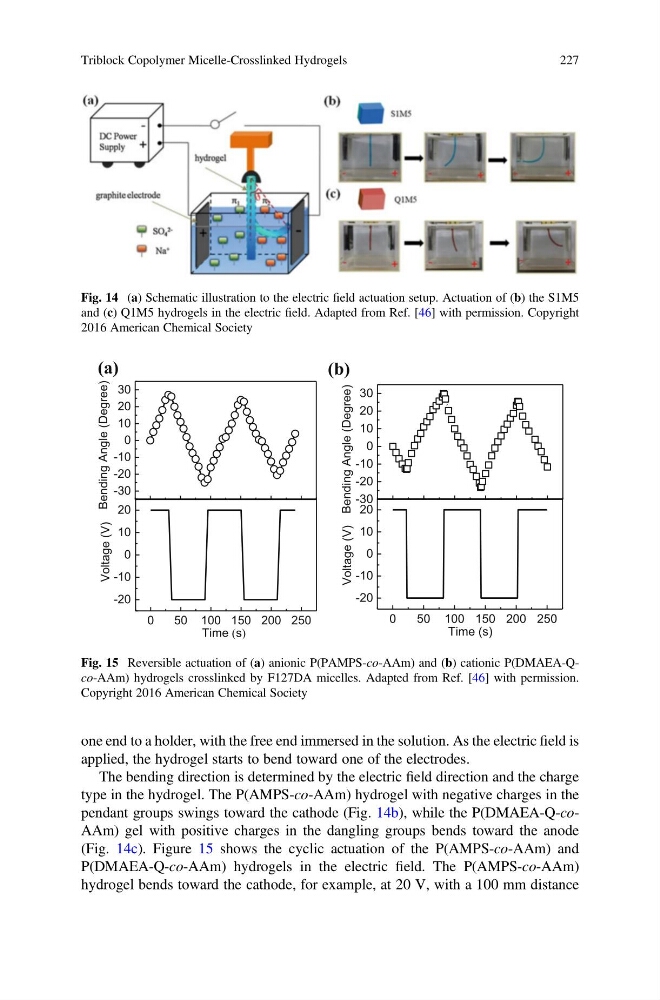
one end to a holder, with the free end immersed in the solution. As the electric field is
applied, the hydrogel starts to bend toward one of the electrodes.
The bending direction is determined by the electric field direction and the charge
type in the hydrogel. The P(AMPS-co-AAm) hydrogel with negative charges in the
pendant groups swings toward the cathode (Fig. 14b), while the P(DMAEA-Q-coAAm) gel with positive charges in the dangling groups bends toward the anode
(Fig. 14c). Figure 15 shows the cyclic actuation of the P(AMPS-co-AAm) and
P(DMAEA-Q-co-AAm) hydrogels in the electric field. The P(AMPS-co-AAm)
hydrogel bends toward the cathode, for example, at 20 V, with a 100 mm distance
Fig. 14 (a) Schematic illustration to the electric field actuation setup. Actuation of (b) the S1M5
and (c) Q1M5 hydrogels in the electric field. Adapted from Ref. [46] with permission. Copyright
2016 American Chemical Society
0
50 100 150 200 250
-20
-10
0
10
20
Voltage (V)
Voltage (V)
Bending Angle (Degree)
Bending Angle (Degree)
Time (s)
0
50 100 150 200 250
-20
-10
0
10
20
Time (s)
-30
-20
-10
0
10
20
30
-30
-20
-10
0
10
20
30
(a)
(b)
Fig. 15 Reversible actuation of (a) anionic P(PAMPS-co-AAm) and (b) cationic P(DMAEA-Qco-AAm) hydrogels crosslinked by F127DA micelles. Adapted from Ref. [46] with permission.
Copyright 2016 American Chemical Society
Triblock Copolymer Micelle-Crosslinked Hydrogels
227
applied, the hydrogel starts to bend toward one of the electrodes.
The bending direction is determined by the electric field direction and the charge
type in the hydrogel. The P(AMPS-co-AAm) hydrogel with negative charges in the
pendant groups swings toward the cathode (Fig. 14b), while the P(DMAEA-Q-coAAm) gel with positive charges in the dangling groups bends toward the anode
(Fig. 14c). Figure 15 shows the cyclic actuation of the P(AMPS-co-AAm) and
P(DMAEA-Q-co-AAm) hydrogels in the electric field. The P(AMPS-co-AAm)
hydrogel bends toward the cathode, for example, at 20 V, with a 100 mm distance
Fig. 14 (a) Schematic illustration to the electric field actuation setup. Actuation of (b) the S1M5
and (c) Q1M5 hydrogels in the electric field. Adapted from Ref. [46] with permission. Copyright
2016 American Chemical Society
0
50 100 150 200 250
-20
-10
0
10
20
Voltage (V)
Voltage (V)
Bending Angle (Degree)
Bending Angle (Degree)
Time (s)
0
50 100 150 200 250
-20
-10
0
10
20
Time (s)
-30
-20
-10
0
10
20
30
-30
-20
-10
0
10
20
30
(a)
(b)
Fig. 15 Reversible actuation of (a) anionic P(PAMPS-co-AAm) and (b) cationic P(DMAEA-Qco-AAm) hydrogels crosslinked by F127DA micelles. Adapted from Ref. [46] with permission.
Copyright 2016 American Chemical Society
Triblock Copolymer Micelle-Crosslinked Hydrogels
227