

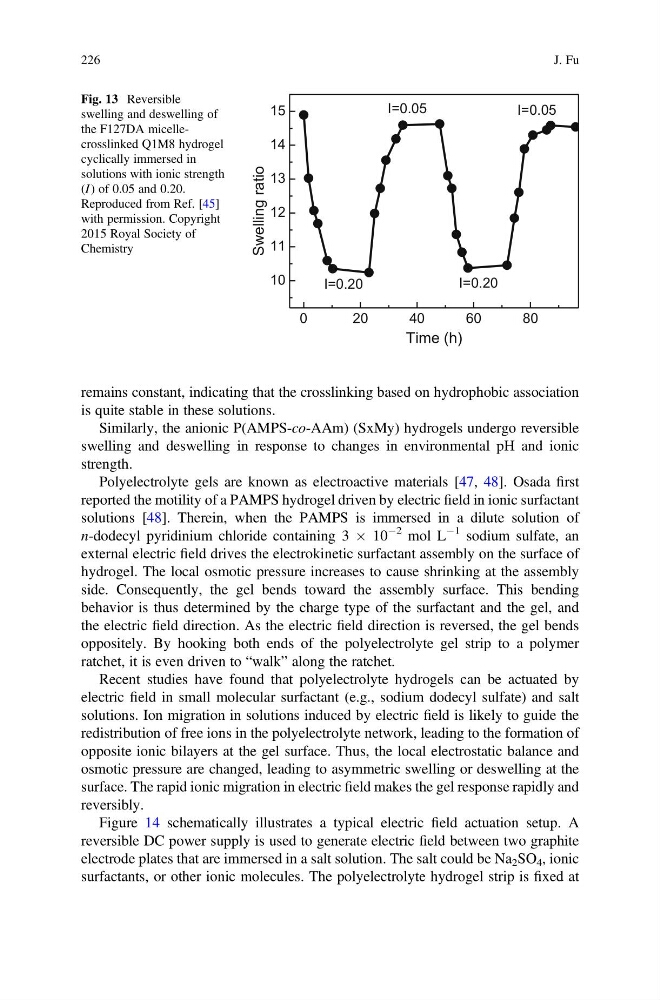
remains constant, indicating that the crosslinking based on hydrophobic association
is quite stable in these solutions.
Similarly, the anionic P(AMPS-co-AAm) (SxMy) hydrogels undergo reversible
swelling and deswelling in response to changes in environmental pH and ionic
strength.
Polyelectrolyte gels are known as electroactive materials [47, 48]. Osada first
reported the motility of a PAMPS hydrogel driven by electric field in ionic surfactant
solutions [48]. Therein, when the PAMPS is immersed in a dilute solution of
n-dodecyl pyridinium chloride containing 3 Â 10
À2 mol L
À1 sodium sulfate, an
external electric field drives the electrokinetic surfactant assembly on the surface of
hydrogel. The local osmotic pressure increases to cause shrinking at the assembly
side. Consequently, the gel bends toward the assembly surface. This bending
behavior is thus determined by the charge type of the surfactant and the gel, and
the electric field direction. As the electric field direction is reversed, the gel bends
oppositely. By hooking both ends of the polyelectrolyte gel strip to a polymer
ratchet, it is even driven to “walk” along the ratchet.
Recent studies have found that polyelectrolyte hydrogels can be actuated by
electric field in small molecular surfactant (e.g., sodium dodecyl sulfate) and salt
solutions. Ion migration in solutions induced by electric field is likely to guide the
redistribution of free ions in the polyelectrolyte network, leading to the formation of
opposite ionic bilayers at the gel surface. Thus, the local electrostatic balance and
osmotic pressure are changed, leading to asymmetric swelling or deswelling at the
surface. The rapid ionic migration in electric field makes the gel response rapidly and
reversibly.
Figure 14 schematically illustrates a typical electric field actuation setup. A
reversible DC power supply is used to generate electric field between two graphite
electrode plates that are immersed in a salt solution. The salt could be Na 2 SO 4 , ionic
surfactants, or other ionic molecules. The polyelectrolyte hydrogel strip is fixed at
0
2 0
4 0
6 0
8 0
10
11
12
13
14
15
I=0.05
I=0.20
I=0.05
I=0.20
o
i
t
a
r
g
n
i
l
l
e
w
S
Time (h)
Fig. 13 Reversible
swelling and deswelling of
the F127DA micellecrosslinked Q1M8 hydrogel
cyclically immersed in
solutions with ionic strength
(I ) of 0.05 and 0.20.
Reproduced from Ref. [45]
with permission. Copyright
2015 Royal Society of
Chemistry
226
J. Fu
is quite stable in these solutions.
Similarly, the anionic P(AMPS-co-AAm) (SxMy) hydrogels undergo reversible
swelling and deswelling in response to changes in environmental pH and ionic
strength.
Polyelectrolyte gels are known as electroactive materials [47, 48]. Osada first
reported the motility of a PAMPS hydrogel driven by electric field in ionic surfactant
solutions [48]. Therein, when the PAMPS is immersed in a dilute solution of
n-dodecyl pyridinium chloride containing 3 Â 10
À2 mol L
À1 sodium sulfate, an
external electric field drives the electrokinetic surfactant assembly on the surface of
hydrogel. The local osmotic pressure increases to cause shrinking at the assembly
side. Consequently, the gel bends toward the assembly surface. This bending
behavior is thus determined by the charge type of the surfactant and the gel, and
the electric field direction. As the electric field direction is reversed, the gel bends
oppositely. By hooking both ends of the polyelectrolyte gel strip to a polymer
ratchet, it is even driven to “walk” along the ratchet.
Recent studies have found that polyelectrolyte hydrogels can be actuated by
electric field in small molecular surfactant (e.g., sodium dodecyl sulfate) and salt
solutions. Ion migration in solutions induced by electric field is likely to guide the
redistribution of free ions in the polyelectrolyte network, leading to the formation of
opposite ionic bilayers at the gel surface. Thus, the local electrostatic balance and
osmotic pressure are changed, leading to asymmetric swelling or deswelling at the
surface. The rapid ionic migration in electric field makes the gel response rapidly and
reversibly.
Figure 14 schematically illustrates a typical electric field actuation setup. A
reversible DC power supply is used to generate electric field between two graphite
electrode plates that are immersed in a salt solution. The salt could be Na 2 SO 4 , ionic
surfactants, or other ionic molecules. The polyelectrolyte hydrogel strip is fixed at
0
2 0
4 0
6 0
8 0
10
11
12
13
14
15
I=0.05
I=0.20
I=0.05
I=0.20
o
i
t
a
r
g
n
i
l
l
e
w
S
Time (h)
Fig. 13 Reversible
swelling and deswelling of
the F127DA micellecrosslinked Q1M8 hydrogel
cyclically immersed in
solutions with ionic strength
(I ) of 0.05 and 0.20.
Reproduced from Ref. [45]
with permission. Copyright
2015 Royal Society of
Chemistry
226
J. Fu