

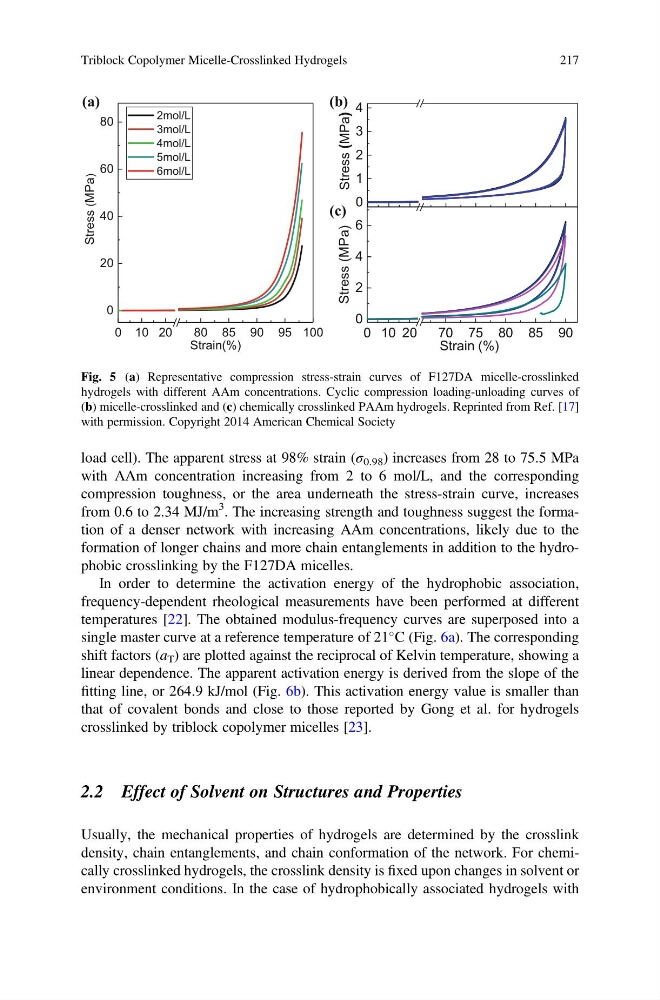
load cell). The apparent stress at 98% strain (σ 0.98 ) increases from 28 to 75.5 MPa
with AAm concentration increasing from 2 to 6 mol/L, and the corresponding
compression toughness, or the area underneath the stress-strain curve, increases
from 0.6 to 2.34 MJ/m
3 . The increasing strength and toughness suggest the formation of a denser network with increasing AAm concentrations, likely due to the
formation of longer chains and more chain entanglements in addition to the hydrophobic crosslinking by the F127DA micelles.
In order to determine the activation energy of the hydrophobic association,
frequency-dependent rheological measurements have been performed at different
temperatures [22]. The obtained modulus-frequency curves are superposed into a
single master curve at a reference temperature of 21
C (Fig. 6a). The corresponding
shift factors (a T ) are plotted against the reciprocal of Kelvin temperature, showing a
linear dependence. The apparent activation energy is derived from the slope of the
fitting line, or 264.9 kJ/mol (Fig. 6b). This activation energy value is smaller than
that of covalent bonds and close to those reported by Gong et al. for hydrogels
crosslinked by triblock copolymer micelles [23].
2.2 Effect of Solvent on Structures and Properties
Usually, the mechanical properties of hydrogels are determined by the crosslink
density, chain entanglements, and chain conformation of the network. For chemically crosslinked hydrogels, the crosslink density is fixed upon changes in solvent or
environment conditions. In the case of hydrophobically associated hydrogels with
0 10 20
80 85 90 95 100
0
20
40
60
80
2mol/L
3mol/L
4mol/L
5mol/L
6mol/L
s
s
e
r
t
S
(
a
P
M )
Strain(%)
(a)
0 10 20
70 75 80 85 90
0
2
4
6
s
s
e
r
t
S
)
a
P
M
(
Strain (%)
0
1
2
3
4
s
s
e
r
t
S
( a
P
M
)
(b)
(c)
Fig. 5 (a) Representative compression stress-strain curves of F127DA micelle-crosslinked
hydrogels with different AAm concentrations. Cyclic compression loading-unloading curves of
(b) micelle-crosslinked and (c) chemically crosslinked PAAm hydrogels. Reprinted from Ref. [17]
with permission. Copyright 2014 American Chemical Society
Triblock Copolymer Micelle-Crosslinked Hydrogels
217
with AAm concentration increasing from 2 to 6 mol/L, and the corresponding
compression toughness, or the area underneath the stress-strain curve, increases
from 0.6 to 2.34 MJ/m
3 . The increasing strength and toughness suggest the formation of a denser network with increasing AAm concentrations, likely due to the
formation of longer chains and more chain entanglements in addition to the hydrophobic crosslinking by the F127DA micelles.
In order to determine the activation energy of the hydrophobic association,
frequency-dependent rheological measurements have been performed at different
temperatures [22]. The obtained modulus-frequency curves are superposed into a
single master curve at a reference temperature of 21
C (Fig. 6a). The corresponding
shift factors (a T ) are plotted against the reciprocal of Kelvin temperature, showing a
linear dependence. The apparent activation energy is derived from the slope of the
fitting line, or 264.9 kJ/mol (Fig. 6b). This activation energy value is smaller than
that of covalent bonds and close to those reported by Gong et al. for hydrogels
crosslinked by triblock copolymer micelles [23].
2.2 Effect of Solvent on Structures and Properties
Usually, the mechanical properties of hydrogels are determined by the crosslink
density, chain entanglements, and chain conformation of the network. For chemically crosslinked hydrogels, the crosslink density is fixed upon changes in solvent or
environment conditions. In the case of hydrophobically associated hydrogels with
0 10 20
80 85 90 95 100
0
20
40
60
80
2mol/L
3mol/L
4mol/L
5mol/L
6mol/L
s
s
e
r
t
S
(
a
P
M )
Strain(%)
(a)
0 10 20
70 75 80 85 90
0
2
4
6
s
s
e
r
t
S
)
a
P
M
(
Strain (%)
0
1
2
3
4
s
s
e
r
t
S
( a
P
M
)
(b)
(c)
Fig. 5 (a) Representative compression stress-strain curves of F127DA micelle-crosslinked
hydrogels with different AAm concentrations. Cyclic compression loading-unloading curves of
(b) micelle-crosslinked and (c) chemically crosslinked PAAm hydrogels. Reprinted from Ref. [17]
with permission. Copyright 2014 American Chemical Society
Triblock Copolymer Micelle-Crosslinked Hydrogels
217