

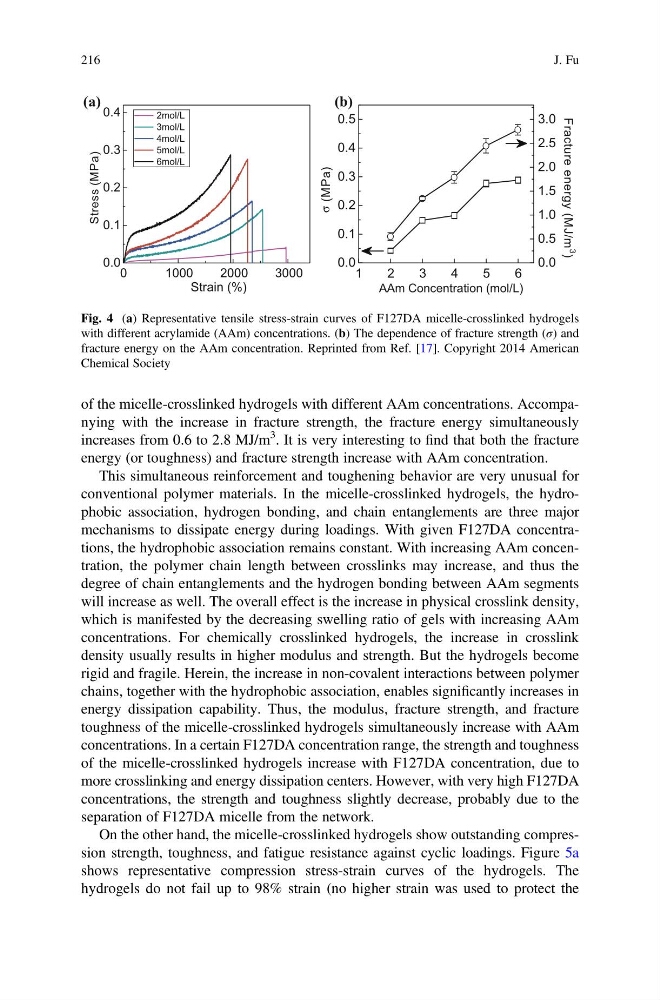
of the micelle-crosslinked hydrogels with different AAm concentrations. Accompanying with the increase in fracture strength, the fracture energy simultaneously
increases from 0.6 to 2.8 MJ/m
3 . It is very interesting to find that both the fracture
energy (or toughness) and fracture strength increase with AAm concentration.
This simultaneous reinforcement and toughening behavior are very unusual for
conventional polymer materials. In the micelle-crosslinked hydrogels, the hydrophobic association, hydrogen bonding, and chain entanglements are three major
mechanisms to dissipate energy during loadings. With given F127DA concentrations, the hydrophobic association remains constant. With increasing AAm concentration, the polymer chain length between crosslinks may increase, and thus the
degree of chain entanglements and the hydrogen bonding between AAm segments
will increase as well. The overall effect is the increase in physical crosslink density,
which is manifested by the decreasing swelling ratio of gels with increasing AAm
concentrations. For chemically crosslinked hydrogels, the increase in crosslink
density usually results in higher modulus and strength. But the hydrogels become
rigid and fragile. Herein, the increase in non-covalent interactions between polymer
chains, together with the hydrophobic association, enables significantly increases in
energy dissipation capability. Thus, the modulus, fracture strength, and fracture
toughness of the micelle-crosslinked hydrogels simultaneously increase with AAm
concentrations. In a certain F127DA concentration range, the strength and toughness
of the micelle-crosslinked hydrogels increase with F127DA concentration, due to
more crosslinking and energy dissipation centers. However, with very high F127DA
concentrations, the strength and toughness slightly decrease, probably due to the
separation of F127DA micelle from the network.
On the other hand, the micelle-crosslinked hydrogels show outstanding compression strength, toughness, and fatigue resistance against cyclic loadings. Figure 5a
shows representative compression stress-strain curves of the hydrogels. The
hydrogels do not fail up to 98% strain (no higher strain was used to protect the
0
1000
2000
3000
0.0
0.1
0.2
0.3
0.4
s
s
e
r
t
S
)
a
P
M
(
Strain (%)
2mol/L
3mol/L
4mol/L
5mol/L
6mol/L
(a)
(b)
1
2
3
4
5
6
0.0
0.1
0.2
0.3
0.4
0.5
AAm Concentration (mol/L)
)
a
P
M
(
0.0
0.5
1.0
1.5
2.0
2.5
3.0
y
g
r
e
n
e
e
r
u
t
c
a
r
F
(
m
/
J
M
3
)
σ
Fig. 4 (a) Representative tensile stress-strain curves of F127DA micelle-crosslinked hydrogels
with different acrylamide (AAm) concentrations. (b) The dependence of fracture strength (σ) and
fracture energy on the AAm concentration. Reprinted from Ref. [17]. Copyright 2014 American
Chemical Society
216
J. Fu
increases from 0.6 to 2.8 MJ/m
3 . It is very interesting to find that both the fracture
energy (or toughness) and fracture strength increase with AAm concentration.
This simultaneous reinforcement and toughening behavior are very unusual for
conventional polymer materials. In the micelle-crosslinked hydrogels, the hydrophobic association, hydrogen bonding, and chain entanglements are three major
mechanisms to dissipate energy during loadings. With given F127DA concentrations, the hydrophobic association remains constant. With increasing AAm concentration, the polymer chain length between crosslinks may increase, and thus the
degree of chain entanglements and the hydrogen bonding between AAm segments
will increase as well. The overall effect is the increase in physical crosslink density,
which is manifested by the decreasing swelling ratio of gels with increasing AAm
concentrations. For chemically crosslinked hydrogels, the increase in crosslink
density usually results in higher modulus and strength. But the hydrogels become
rigid and fragile. Herein, the increase in non-covalent interactions between polymer
chains, together with the hydrophobic association, enables significantly increases in
energy dissipation capability. Thus, the modulus, fracture strength, and fracture
toughness of the micelle-crosslinked hydrogels simultaneously increase with AAm
concentrations. In a certain F127DA concentration range, the strength and toughness
of the micelle-crosslinked hydrogels increase with F127DA concentration, due to
more crosslinking and energy dissipation centers. However, with very high F127DA
concentrations, the strength and toughness slightly decrease, probably due to the
separation of F127DA micelle from the network.
On the other hand, the micelle-crosslinked hydrogels show outstanding compression strength, toughness, and fatigue resistance against cyclic loadings. Figure 5a
shows representative compression stress-strain curves of the hydrogels. The
hydrogels do not fail up to 98% strain (no higher strain was used to protect the
0
1000
2000
3000
0.0
0.1
0.2
0.3
0.4
s
s
e
r
t
S
)
a
P
M
(
Strain (%)
2mol/L
3mol/L
4mol/L
5mol/L
6mol/L
(a)
(b)
1
2
3
4
5
6
0.0
0.1
0.2
0.3
0.4
0.5
AAm Concentration (mol/L)
)
a
P
M
(
0.0
0.5
1.0
1.5
2.0
2.5
3.0
y
g
r
e
n
e
e
r
u
t
c
a
r
F
(
m
/
J
M
3
)
σ
Fig. 4 (a) Representative tensile stress-strain curves of F127DA micelle-crosslinked hydrogels
with different acrylamide (AAm) concentrations. (b) The dependence of fracture strength (σ) and
fracture energy on the AAm concentration. Reprinted from Ref. [17]. Copyright 2014 American
Chemical Society
216
J. Fu