

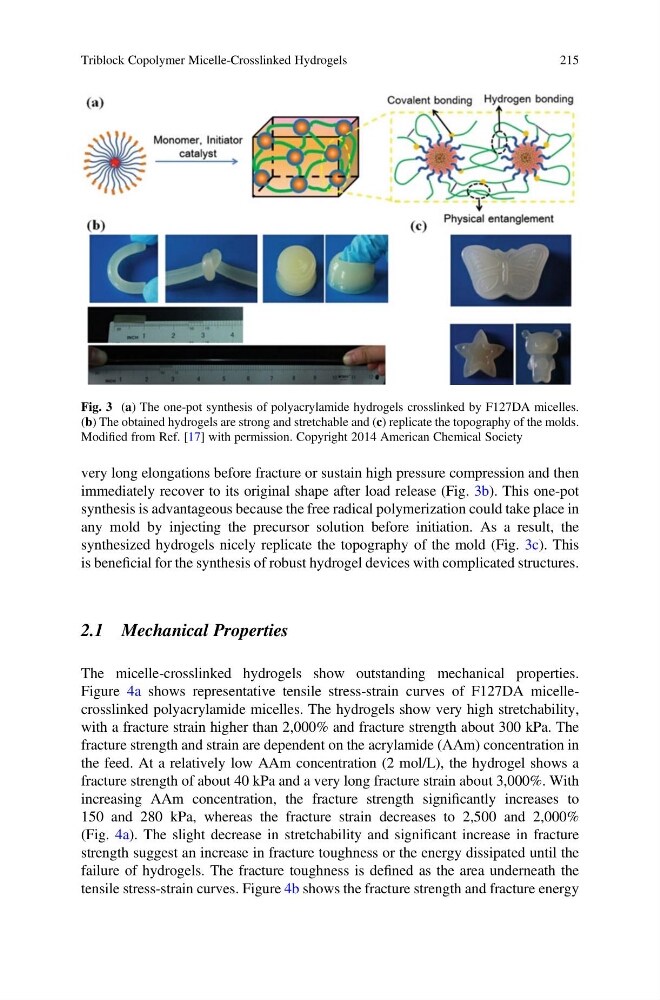
very long elongations before fracture or sustain high pressure compression and then
immediately recover to its original shape after load release (Fig. 3b). This one-pot
synthesis is advantageous because the free radical polymerization could take place in
any mold by injecting the precursor solution before initiation. As a result, the
synthesized hydrogels nicely replicate the topography of the mold (Fig. 3c). This
is beneficial for the synthesis of robust hydrogel devices with complicated structures.
2.1 Mechanical Properties
The micelle-crosslinked hydrogels show outstanding mechanical properties.
Figure 4a shows representative tensile stress-strain curves of F127DA micellecrosslinked polyacrylamide micelles. The hydrogels show very high stretchability,
with a fracture strain higher than 2,000% and fracture strength about 300 kPa. The
fracture strength and strain are dependent on the acrylamide (AAm) concentration in
the feed. At a relatively low AAm concentration (2 mol/L), the hydrogel shows a
fracture strength of about 40 kPa and a very long fracture strain about 3,000%. With
increasing AAm concentration, the fracture strength significantly increases to
150 and 280 kPa, whereas the fracture strain decreases to 2,500 and 2,000%
(Fig. 4a). The slight decrease in stretchability and significant increase in fracture
strength suggest an increase in fracture toughness or the energy dissipated until the
failure of hydrogels. The fracture toughness is defined as the area underneath the
tensile stress-strain curves. Figure 4b shows the fracture strength and fracture energy
Fig. 3 (a) The one-pot synthesis of polyacrylamide hydrogels crosslinked by F127DA micelles.
(b) The obtained hydrogels are strong and stretchable and (c) replicate the topography of the molds.
Modified from Ref. [17] with permission. Copyright 2014 American Chemical Society
Triblock Copolymer Micelle-Crosslinked Hydrogels
215
immediately recover to its original shape after load release (Fig. 3b). This one-pot
synthesis is advantageous because the free radical polymerization could take place in
any mold by injecting the precursor solution before initiation. As a result, the
synthesized hydrogels nicely replicate the topography of the mold (Fig. 3c). This
is beneficial for the synthesis of robust hydrogel devices with complicated structures.
2.1 Mechanical Properties
The micelle-crosslinked hydrogels show outstanding mechanical properties.
Figure 4a shows representative tensile stress-strain curves of F127DA micellecrosslinked polyacrylamide micelles. The hydrogels show very high stretchability,
with a fracture strain higher than 2,000% and fracture strength about 300 kPa. The
fracture strength and strain are dependent on the acrylamide (AAm) concentration in
the feed. At a relatively low AAm concentration (2 mol/L), the hydrogel shows a
fracture strength of about 40 kPa and a very long fracture strain about 3,000%. With
increasing AAm concentration, the fracture strength significantly increases to
150 and 280 kPa, whereas the fracture strain decreases to 2,500 and 2,000%
(Fig. 4a). The slight decrease in stretchability and significant increase in fracture
strength suggest an increase in fracture toughness or the energy dissipated until the
failure of hydrogels. The fracture toughness is defined as the area underneath the
tensile stress-strain curves. Figure 4b shows the fracture strength and fracture energy
Fig. 3 (a) The one-pot synthesis of polyacrylamide hydrogels crosslinked by F127DA micelles.
(b) The obtained hydrogels are strong and stretchable and (c) replicate the topography of the molds.
Modified from Ref. [17] with permission. Copyright 2014 American Chemical Society
Triblock Copolymer Micelle-Crosslinked Hydrogels
215