

Pluronic polymers are a family of amphiphilic nonionic triblock copolymer
surfactants that are widely used in industry, cosmetics, and pharmaceutics [12–
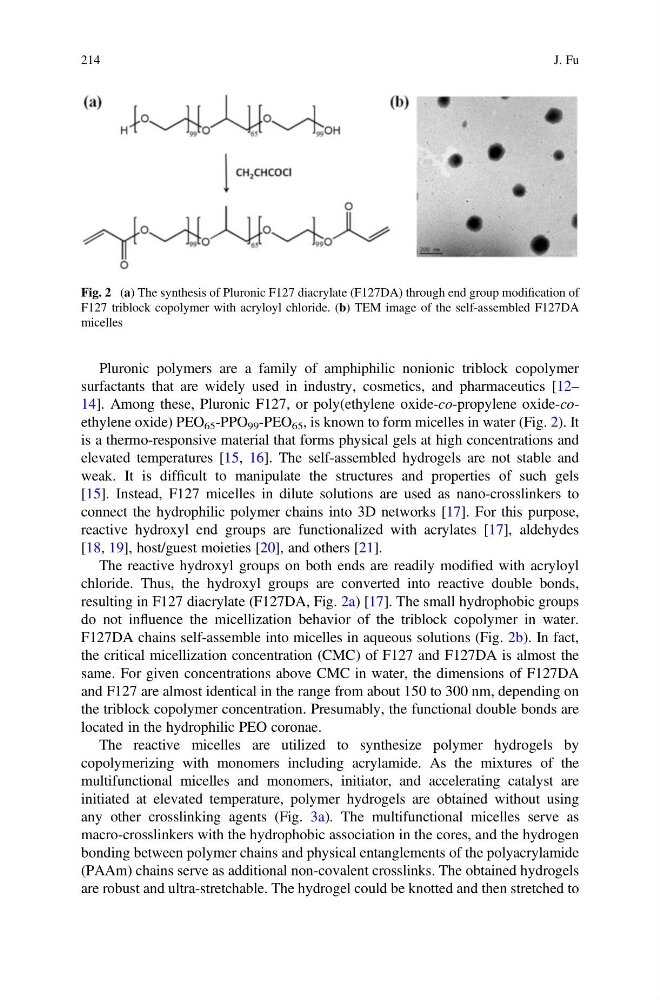
14]. Among these, Pluronic F127, or poly(ethylene oxide-co-propylene oxide-coethylene oxide) PEO 65 -PPO 99 -PEO 65 , is known to form micelles in water (Fig. 2). It
is a thermo-responsive material that forms physical gels at high concentrations and
elevated temperatures [15, 16]. The self-assembled hydrogels are not stable and
weak. It is difficult to manipulate the structures and properties of such gels
[15]. Instead, F127 micelles in dilute solutions are used as nano-crosslinkers to
connect the hydrophilic polymer chains into 3D networks [17]. For this purpose,
reactive hydroxyl end groups are functionalized with acrylates [17], aldehydes
[18, 19], host/guest moieties [20], and others [21].
The reactive hydroxyl groups on both ends are readily modified with acryloyl
chloride. Thus, the hydroxyl groups are converted into reactive double bonds,
resulting in F127 diacrylate (F127DA, Fig. 2a) [17]. The small hydrophobic groups
do not influence the micellization behavior of the triblock copolymer in water.
F127DA chains self-assemble into micelles in aqueous solutions (Fig. 2b). In fact,
the critical micellization concentration (CMC) of F127 and F127DA is almost the
same. For given concentrations above CMC in water, the dimensions of F127DA
and F127 are almost identical in the range from about 150 to 300 nm, depending on
the triblock copolymer concentration. Presumably, the functional double bonds are
located in the hydrophilic PEO coronae.
The reactive micelles are utilized to synthesize polymer hydrogels by
copolymerizing with monomers including acrylamide. As the mixtures of the
multifunctional micelles and monomers, initiator, and accelerating catalyst are
initiated at elevated temperature, polymer hydrogels are obtained without using
any other crosslinking agents (Fig. 3a). The multifunctional micelles serve as
macro-crosslinkers with the hydrophobic association in the cores, and the hydrogen
bonding between polymer chains and physical entanglements of the polyacrylamide
(PAAm) chains serve as additional non-covalent crosslinks. The obtained hydrogels
are robust and ultra-stretchable. The hydrogel could be knotted and then stretched to
Fig. 2 (a) The synthesis of Pluronic F127 diacrylate (F127DA) through end group modification of
F127 triblock copolymer with acryloyl chloride. (b) TEM image of the self-assembled F127DA
micelles
214
J. Fu
surfactants that are widely used in industry, cosmetics, and pharmaceutics [12–
14]. Among these, Pluronic F127, or poly(ethylene oxide-co-propylene oxide-coethylene oxide) PEO 65 -PPO 99 -PEO 65 , is known to form micelles in water (Fig. 2). It
is a thermo-responsive material that forms physical gels at high concentrations and
elevated temperatures [15, 16]. The self-assembled hydrogels are not stable and
weak. It is difficult to manipulate the structures and properties of such gels
[15]. Instead, F127 micelles in dilute solutions are used as nano-crosslinkers to
connect the hydrophilic polymer chains into 3D networks [17]. For this purpose,
reactive hydroxyl end groups are functionalized with acrylates [17], aldehydes
[18, 19], host/guest moieties [20], and others [21].
The reactive hydroxyl groups on both ends are readily modified with acryloyl
chloride. Thus, the hydroxyl groups are converted into reactive double bonds,
resulting in F127 diacrylate (F127DA, Fig. 2a) [17]. The small hydrophobic groups
do not influence the micellization behavior of the triblock copolymer in water.
F127DA chains self-assemble into micelles in aqueous solutions (Fig. 2b). In fact,
the critical micellization concentration (CMC) of F127 and F127DA is almost the
same. For given concentrations above CMC in water, the dimensions of F127DA
and F127 are almost identical in the range from about 150 to 300 nm, depending on
the triblock copolymer concentration. Presumably, the functional double bonds are
located in the hydrophilic PEO coronae.
The reactive micelles are utilized to synthesize polymer hydrogels by
copolymerizing with monomers including acrylamide. As the mixtures of the
multifunctional micelles and monomers, initiator, and accelerating catalyst are
initiated at elevated temperature, polymer hydrogels are obtained without using
any other crosslinking agents (Fig. 3a). The multifunctional micelles serve as
macro-crosslinkers with the hydrophobic association in the cores, and the hydrogen
bonding between polymer chains and physical entanglements of the polyacrylamide
(PAAm) chains serve as additional non-covalent crosslinks. The obtained hydrogels
are robust and ultra-stretchable. The hydrogel could be knotted and then stretched to
Fig. 2 (a) The synthesis of Pluronic F127 diacrylate (F127DA) through end group modification of
F127 triblock copolymer with acryloyl chloride. (b) TEM image of the self-assembled F127DA
micelles
214
J. Fu