

[6]. Wang et al. used the self-assembled nanoparticles of surfactants as reactive
crosslinkers after exposure to gamma ray that generates free radicals of the
nanoparticles to initiate free radical polymerization and synthesize highly resilient
hydrogels [7, 8].
Amphiphilic block copolymers are a family of macromolecular surfactants that
self-assemble in water into micelles at the length scale from a few to hundreds of
nanometers, as driven by the thermodynamic gain from the separation of water and
hydrophobic blocks [9–11]. Thus, the micelles are dynamic but quite stable at given
concentrations and temperature. This dynamic nature of hydrophobic association is
advantageous beyond the conventional rigid chemical crosslinkers since it is flexible
to deform upon loadings, which may allow for efficient energy dissipation before the
network fractures. Moreover, the micelles, once damaged, may be able to reform at
ambient conditions, which is important for self-healing.
This chapter reports on representative tough and responsive hydrogels
crosslinked by functional triblock copolymer micelles. The toughening mechanisms
will be discussed based on investigations of mechanical properties and in situ X-ray
scattering studies on the structure evolution of micelles upon loadings. Recent
updates on the applications of such hydrogels as building blocks for the fabrication
of responsive hydrogel devices are presented.
2 Triblock Copolymer Micelle-Crosslinked Hydrogels
Polymer chains are comprised of at least one hydrophobic block and one hydrophilic
block usually form micelles in water since the hydrophobic block precipitates from
water whereas the hydrophilic one dissolves or swells in water [11]. Thus, micelles
with hydrophobic cores and hydrophilic coronae are formed to minimize the unfavorable contact between water and hydrophobic segments. The micelle conformation usually depends on the composition and volume fraction of the blocks. For
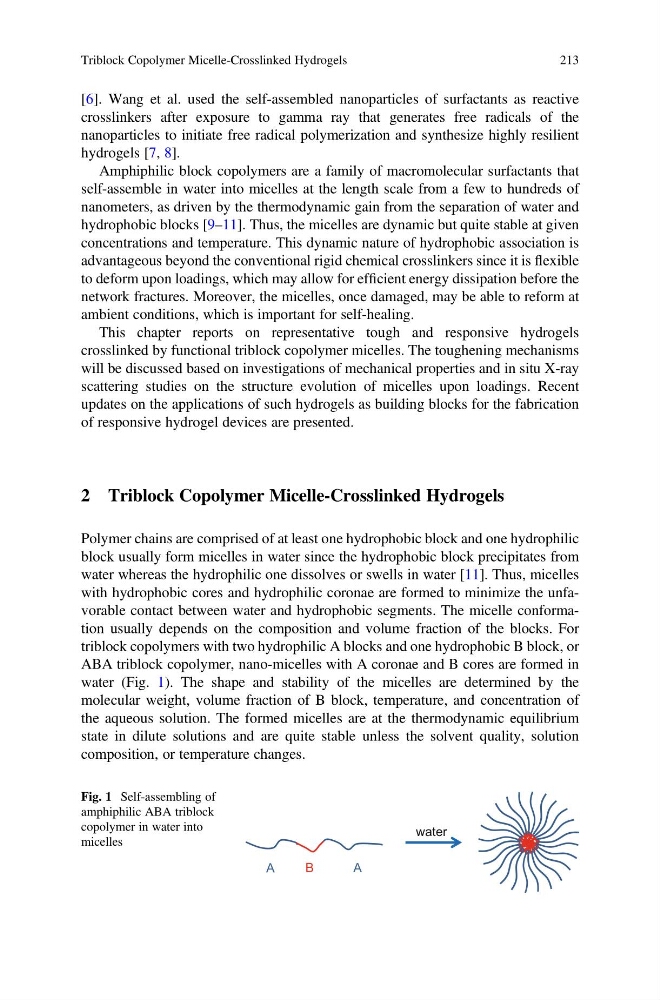
triblock copolymers with two hydrophilic A blocks and one hydrophobic B block, or
ABA triblock copolymer, nano-micelles with A coronae and B cores are formed in
water (Fig. 1). The shape and stability of the micelles are determined by the
molecular weight, volume fraction of B block, temperature, and concentration of
the aqueous solution. The formed micelles are at the thermodynamic equilibrium
state in dilute solutions and are quite stable unless the solvent quality, solution
composition, or temperature changes.
water
A
A
B
Fig. 1 Self-assembling of
amphiphilic ABA triblock
copolymer in water into
micelles
Triblock Copolymer Micelle-Crosslinked Hydrogels
213
crosslinkers after exposure to gamma ray that generates free radicals of the
nanoparticles to initiate free radical polymerization and synthesize highly resilient
hydrogels [7, 8].
Amphiphilic block copolymers are a family of macromolecular surfactants that
self-assemble in water into micelles at the length scale from a few to hundreds of
nanometers, as driven by the thermodynamic gain from the separation of water and
hydrophobic blocks [9–11]. Thus, the micelles are dynamic but quite stable at given
concentrations and temperature. This dynamic nature of hydrophobic association is
advantageous beyond the conventional rigid chemical crosslinkers since it is flexible
to deform upon loadings, which may allow for efficient energy dissipation before the
network fractures. Moreover, the micelles, once damaged, may be able to reform at
ambient conditions, which is important for self-healing.
This chapter reports on representative tough and responsive hydrogels
crosslinked by functional triblock copolymer micelles. The toughening mechanisms
will be discussed based on investigations of mechanical properties and in situ X-ray
scattering studies on the structure evolution of micelles upon loadings. Recent
updates on the applications of such hydrogels as building blocks for the fabrication
of responsive hydrogel devices are presented.
2 Triblock Copolymer Micelle-Crosslinked Hydrogels
Polymer chains are comprised of at least one hydrophobic block and one hydrophilic
block usually form micelles in water since the hydrophobic block precipitates from
water whereas the hydrophilic one dissolves or swells in water [11]. Thus, micelles
with hydrophobic cores and hydrophilic coronae are formed to minimize the unfavorable contact between water and hydrophobic segments. The micelle conformation usually depends on the composition and volume fraction of the blocks. For
triblock copolymers with two hydrophilic A blocks and one hydrophobic B block, or
ABA triblock copolymer, nano-micelles with A coronae and B cores are formed in
water (Fig. 1). The shape and stability of the micelles are determined by the
molecular weight, volume fraction of B block, temperature, and concentration of
the aqueous solution. The formed micelles are at the thermodynamic equilibrium
state in dilute solutions and are quite stable unless the solvent quality, solution
composition, or temperature changes.
water
A
A
B
Fig. 1 Self-assembling of
amphiphilic ABA triblock
copolymer in water into
micelles
Triblock Copolymer Micelle-Crosslinked Hydrogels
213