

micelles as macro-crosslinkers, the association number and micelle dimensions are
sensitive to solvent quality. The solvent-copolymer interactions, as well as the chain
conformations, are sensitive to the solvent selectivity to specific chains.
The influence of solvent quality on the structures and mechanical properties of
F127DA micelle-crosslinked hydrogels has been systematically investigated by Xu
et al. [24]. An organic solvent, dimethyl sulfoxide (DMSO), which is water soluble
and less selective than water to the polymer chains, is used to tune the selectivity of
solvent in the gels. A series of water/DMSO binary solvents are used to synthesize
PAAm hydrogels crosslinked by F127DA micelles. In the binary solvents, F127DA
forms micelles with similar size distributions and hydrodynamic size ξ H , independent of the DMSO volume ratio ( f ) in water and DMSO mixture, according to
dynamic light scattering (DLS) measurements. The ξ H value ranges from 140 to
180 nm with no significant difference between each other.
Free radical polymerization of acrylamide monomers and F127DA micelles in
DMSO/water solvent takes place to produce hydrogels. Here, the DMSO volume
fraction in the binary solvent ( f ) is increased from 0 to 0.5, 0.75, 0.9, and 1.0, and
the obtained gels are correspondingly denoted as MFD 0 , MFD 0.5 , MFD 0.75 , MFD 0.9 ,
and MFD 1 .
Figure 7a shows representative tensile stress-strain curves of the gels crosslinked
by F127DA micelles with different f values. With increasing DMSO content in the
gels, the fracture strength decreases from 137 to 135, 87, 68 and 32 kPa (Fig. 7b),
while the corresponding fracture strain increases from about 700 to 750, 900, 1,200,
and 2,800% (Fig. 7c). It is interesting that the fracture toughness, or the area
below the stress-strain curves of these gels, is almost constant, independent on the
volume fraction of DMSO (Fig. 7d). It has been established that the tensile toughness is primarily attributed to the hydrophobic association in the micelle cores
2.6 2.8 3.0 3.2 3.4 3.6
-25
-20
-15
-10
-5
0
5
10
lna
T
1/T (10
–3 –1
K )
E a =264.9 kJ/mol
10
-11 10
-8 10
-5 10
-2 10
1 10
4
10
2
10
3
10
4
10
5
91 °C
81 °C
71 °C
61 °C
51 °C
41 °C
31 °C
21 °C
11 °C
1 °C
G ,
'
G
)
a
P
(
'
'
Frequency (rad s
-1 )
0.0
0.1
0.2
0.3
0.4
0.5
n
a
T
(a)
(b)
G’
G’’
tan
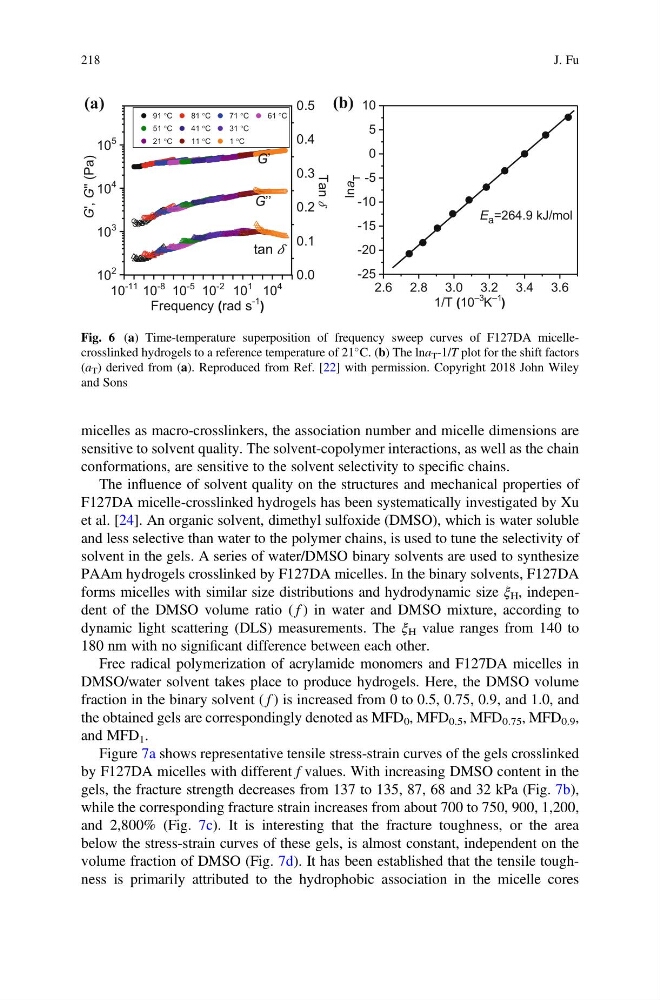
Fig. 6 (a) Time-temperature superposition of frequency sweep curves of F127DA micellecrosslinked hydrogels to a reference temperature of 21
C. (b) The lna T -1/T plot for the shift factors
(a T ) derived from (a). Reproduced from Ref. [22] with permission. Copyright 2018 John Wiley
and Sons
218
J. Fu
sensitive to solvent quality. The solvent-copolymer interactions, as well as the chain
conformations, are sensitive to the solvent selectivity to specific chains.
The influence of solvent quality on the structures and mechanical properties of
F127DA micelle-crosslinked hydrogels has been systematically investigated by Xu
et al. [24]. An organic solvent, dimethyl sulfoxide (DMSO), which is water soluble
and less selective than water to the polymer chains, is used to tune the selectivity of
solvent in the gels. A series of water/DMSO binary solvents are used to synthesize
PAAm hydrogels crosslinked by F127DA micelles. In the binary solvents, F127DA
forms micelles with similar size distributions and hydrodynamic size ξ H , independent of the DMSO volume ratio ( f ) in water and DMSO mixture, according to
dynamic light scattering (DLS) measurements. The ξ H value ranges from 140 to
180 nm with no significant difference between each other.
Free radical polymerization of acrylamide monomers and F127DA micelles in
DMSO/water solvent takes place to produce hydrogels. Here, the DMSO volume
fraction in the binary solvent ( f ) is increased from 0 to 0.5, 0.75, 0.9, and 1.0, and
the obtained gels are correspondingly denoted as MFD 0 , MFD 0.5 , MFD 0.75 , MFD 0.9 ,
and MFD 1 .
Figure 7a shows representative tensile stress-strain curves of the gels crosslinked
by F127DA micelles with different f values. With increasing DMSO content in the
gels, the fracture strength decreases from 137 to 135, 87, 68 and 32 kPa (Fig. 7b),
while the corresponding fracture strain increases from about 700 to 750, 900, 1,200,
and 2,800% (Fig. 7c). It is interesting that the fracture toughness, or the area
below the stress-strain curves of these gels, is almost constant, independent on the
volume fraction of DMSO (Fig. 7d). It has been established that the tensile toughness is primarily attributed to the hydrophobic association in the micelle cores
2.6 2.8 3.0 3.2 3.4 3.6
-25
-20
-15
-10
-5
0
5
10
lna
T
1/T (10
–3 –1
K )
E a =264.9 kJ/mol
10
-11 10
-8 10
-5 10
-2 10
1 10
4
10
2
10
3
10
4
10
5
91 °C
81 °C
71 °C
61 °C
51 °C
41 °C
31 °C
21 °C
11 °C
1 °C
G ,
'
G
)
a
P
(
'
'
Frequency (rad s
-1 )
0.0
0.1
0.2
0.3
0.4
0.5
n
a
T
(a)
(b)
G’
G’’
tan
Fig. 6 (a) Time-temperature superposition of frequency sweep curves of F127DA micellecrosslinked hydrogels to a reference temperature of 21
C. (b) The lna T -1/T plot for the shift factors
(a T ) derived from (a). Reproduced from Ref. [22] with permission. Copyright 2018 John Wiley
and Sons
218
J. Fu