

must be diligent with regard to the dose rate (i.e., the number of drops used) and must
continue treatment over relatively long time periods – weeks or months. Cyclosporin
A can also have harmful effects on the patient if the amount of the drug used is too
high. If the amount used is too low, the drug is ineffective. Peng and Chauhan [94]
estimated that the therapeutic window for daily delivery of cyclosporin A by a
contact lens is 1.6–12.8 μg.
The ex vivo cyclosporin A daily release rate from the DFmx hydrogels into a
buffered saline solution for a period of about 3 weeks is shown in Fig. 24. The
therapeutic window from Ref. [94] is shown by the dashed lines. Except for the burst
on the first day, the daily drug release values for the DFm28 and DFm20 hydrogels
were within the therapeutic window for 17 and 18 days, respectively, which is a
promising result for controlled release of cyclosporin A for treatment of dry eye with
a contact lens.
3.4 Antifreeze Hydrogel
The volume expansion of water during freezing in confined spaces (pores) can be
very destructive, as can be attested to by anyone who has had water pipes freeze or
has encountered a pothole formed during the winter in an asphalt pavement. Similarly, the large mechanical stresses generated by freezing water are a problem in
biomedical applications such as in cryosurgery [95] and cryogenic preservation of
cells, blood, and organs [96].The inhibition or control of ice formation is also
important in other applications where water concentrations are appreciable, such
as surface icing [97], agriculture [98], and food preservation [99]. Adding a solute
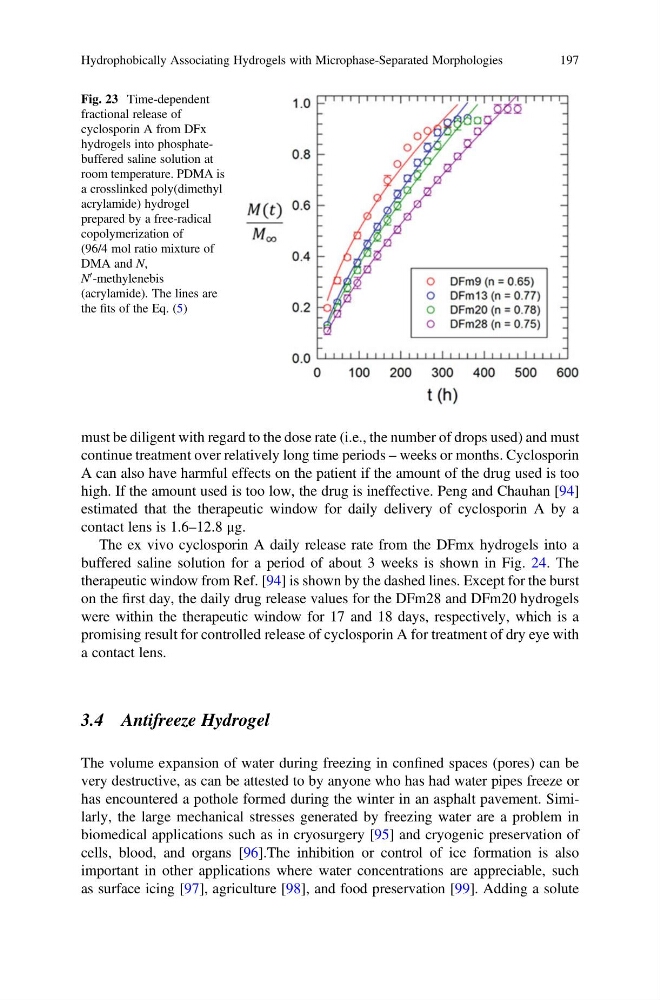
Fig. 23 Time-dependent
fractional release of
cyclosporin A from DFx
hydrogels into phosphatebuffered saline solution at
room temperature. PDMA is
a crosslinked poly(dimethyl
acrylamide) hydrogel
prepared by a free-radical
copolymerization of
(96/4 mol ratio mixture of
DMA and N,
N
0 -methylenebis
(acrylamide). The lines are
the fits of the Eq. (5)
Hydrophobically Associating Hydrogels with Microphase-Separated Morphologies
197
continue treatment over relatively long time periods – weeks or months. Cyclosporin
A can also have harmful effects on the patient if the amount of the drug used is too
high. If the amount used is too low, the drug is ineffective. Peng and Chauhan [94]
estimated that the therapeutic window for daily delivery of cyclosporin A by a
contact lens is 1.6–12.8 μg.
The ex vivo cyclosporin A daily release rate from the DFmx hydrogels into a
buffered saline solution for a period of about 3 weeks is shown in Fig. 24. The
therapeutic window from Ref. [94] is shown by the dashed lines. Except for the burst
on the first day, the daily drug release values for the DFm28 and DFm20 hydrogels
were within the therapeutic window for 17 and 18 days, respectively, which is a
promising result for controlled release of cyclosporin A for treatment of dry eye with
a contact lens.
3.4 Antifreeze Hydrogel
The volume expansion of water during freezing in confined spaces (pores) can be
very destructive, as can be attested to by anyone who has had water pipes freeze or
has encountered a pothole formed during the winter in an asphalt pavement. Similarly, the large mechanical stresses generated by freezing water are a problem in
biomedical applications such as in cryosurgery [95] and cryogenic preservation of
cells, blood, and organs [96].The inhibition or control of ice formation is also
important in other applications where water concentrations are appreciable, such
as surface icing [97], agriculture [98], and food preservation [99]. Adding a solute
Fig. 23 Time-dependent
fractional release of
cyclosporin A from DFx
hydrogels into phosphatebuffered saline solution at
room temperature. PDMA is
a crosslinked poly(dimethyl
acrylamide) hydrogel
prepared by a free-radical
copolymerization of
(96/4 mol ratio mixture of
DMA and N,
N
0 -methylenebis
(acrylamide). The lines are
the fits of the Eq. (5)
Hydrophobically Associating Hydrogels with Microphase-Separated Morphologies
197