

The values of n shown in parentheses in Fig. 23 are between 0.5 and 1.0, which
indicate anomalous diffusion – i.e., diffusion with some Fickian and some Case II
behavior for the release of cyclosporin A from the DFmx hydrogels.
The anomalous diffusion result can be explained by considering the diffusion
path of a cyclosporin A molecule from the microphase-separated hydrogel. First, the
cyclosporin A has to diffuse out of the glassy fluoroacrylate nanodomain, which
involves Case II diffusion. However, the cyclosporin A is then in the water phase.
Diffusion of the cyclosporin A from the water phase of the hydrogel into the target
media (phosphate buffer solution) is Fickian; thus the overall exponent for Eq. (5) is
between 0.5 and 1.0. The anomalous diffusion kinetics may be controlled by varying
the FOSM concentration in the DFmx copolymer. The controlling step for the
release of the cyclosporin A from the gel is the diffusion of the cyclosporin A
from the nanodomain into the aqueous phase of the hydrogel.
Current treatment of dry eye involves the application of eye drops containing
cyclosporin A [93], and treatment is complicated by the requirement that the patient
4
3
2
1
Media Sorbed/Polymer Mass
(mg/mg)
0
0
5
10
15
20
25
30
0% FOSA
5.4% FOSA
9.8% FOSA
20.4% FOSA
28.9% FOSA
(Time)
1/2 /Thickness (min
1/2 /mm)
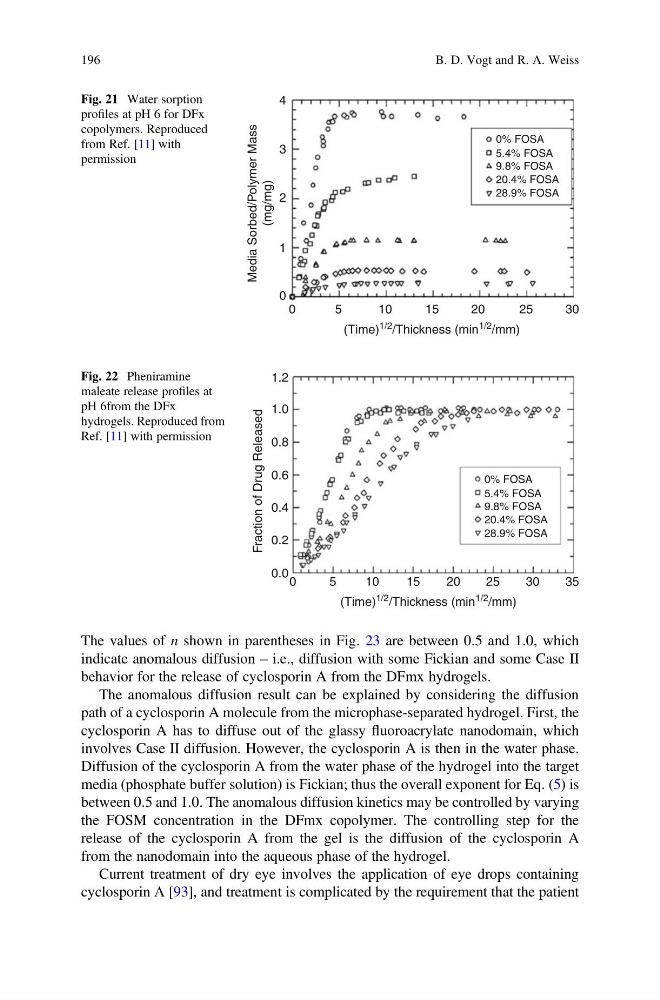
Fig. 21 Water sorption
profiles at pH 6 for DFx
copolymers. Reproduced
from Ref. [11] with
permission
1.2
1.0
0.8
0.6
0.4
0.2
0.0
Fraction of Drug Released
0
5
10
15
20
25
30
35
0% FOSA
5.4% FOSA
9.8% FOSA
20.4% FOSA
28.9% FOSA
(Time)
1/2 /Thickness (min
1/2 /mm)
Fig. 22 Pheniramine
maleate release profiles at
pH 6from the DFx
hydrogels. Reproduced from
Ref. [11] with permission
196
B. D. Vogt and R. A. Weiss
indicate anomalous diffusion – i.e., diffusion with some Fickian and some Case II
behavior for the release of cyclosporin A from the DFmx hydrogels.
The anomalous diffusion result can be explained by considering the diffusion
path of a cyclosporin A molecule from the microphase-separated hydrogel. First, the
cyclosporin A has to diffuse out of the glassy fluoroacrylate nanodomain, which
involves Case II diffusion. However, the cyclosporin A is then in the water phase.
Diffusion of the cyclosporin A from the water phase of the hydrogel into the target
media (phosphate buffer solution) is Fickian; thus the overall exponent for Eq. (5) is
between 0.5 and 1.0. The anomalous diffusion kinetics may be controlled by varying
the FOSM concentration in the DFmx copolymer. The controlling step for the
release of the cyclosporin A from the gel is the diffusion of the cyclosporin A
from the nanodomain into the aqueous phase of the hydrogel.
Current treatment of dry eye involves the application of eye drops containing
cyclosporin A [93], and treatment is complicated by the requirement that the patient
4
3
2
1
Media Sorbed/Polymer Mass
(mg/mg)
0
0
5
10
15
20
25
30
0% FOSA
5.4% FOSA
9.8% FOSA
20.4% FOSA
28.9% FOSA
(Time)
1/2 /Thickness (min
1/2 /mm)
Fig. 21 Water sorption
profiles at pH 6 for DFx
copolymers. Reproduced
from Ref. [11] with
permission
1.2
1.0
0.8
0.6
0.4
0.2
0.0
Fraction of Drug Released
0
5
10
15
20
25
30
35
0% FOSA
5.4% FOSA
9.8% FOSA
20.4% FOSA
28.9% FOSA
(Time)
1/2 /Thickness (min
1/2 /mm)
Fig. 22 Pheniramine
maleate release profiles at
pH 6from the DFx
hydrogels. Reproduced from
Ref. [11] with permission
196
B. D. Vogt and R. A. Weiss