

ocular drug delivery is contact lenses [86, 87]. The amphiphilic hydrogels described
in this chapter were originally developed for use as injection moldable contact lenses
[88], and the controlled release characteristics of an ocular antihistamine,
pheniramine maleate (PM), by DFx hydrogels films were published in 2006 [11].
PM is a hydrophilic compound and its equilibrium solubility in a DFx hydrogel
decreases with increasing x, Fig. 21. The ex vivo release characteristics of PM from
the DFx hydrogels, shown in Fig. 22, indicate that the overall drug release rate from
the polymers decreased as the FOSA composition of the copolymers increased. The
decreasing release rate is a consequence of the increasing hydrophobic-phase concentration as the FOSA concentration in the copolymer increased, which increases
the tortuosity of the diffusive pathway. Those results are similar to the effect of
microphase separation of long alkyl chains on the release rate of insulin from
hydrogels derived from amphiphilic terpolymers of poly(N-isopropyl acrylamideco-sodium acrylate-co-n-N-alkylacrylamide) [89]. The PM and insulin diffusion
rates in the DFx and the amphiphilic terpolymer hydrogel in Ref. [89] were Fickian,
which is a consequence of the drugs having insignificant solubility in the hydrophobic phase.
The release characteristics in microphase-separated hydrogels for drugs that are
hydrophobic, however, can deviate significantly from Fickian diffusion, which provides additional control over the release kinetics. Examples of the fractional release
data for cyclosporin A, a hydrophobic immune-suppressant drug that is also used to
treat dry eye syndrome, a chronic dryness of the cornea surface [90], are shown for
various DFmx hydrogels in Fig. 23.
Those data were fit to the empirical Korsmeyer-Peppas equation [91],
M t
M ∾
¼ Kt
n
ð5Þ
where n is a release index and K is a constant. The release index is 0.5 for Fickian
diffusion and 1.0 for Case II diffusion [92], where the mass transport is controlled by
the relaxation behavior of the material from which the drug is diffusing. In this case,
the cylclosporin dissolves in the glassy hydrophobic fluoroacrylate nanodomains.
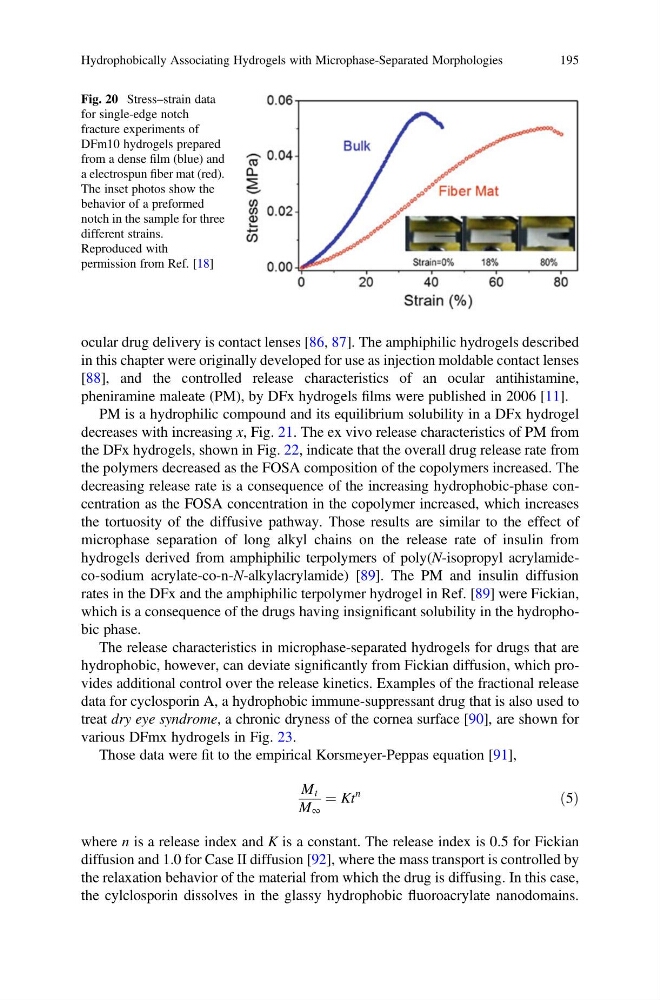
Fig. 20 Stress–strain data
for single-edge notch
fracture experiments of
DFm10 hydrogels prepared
from a dense film (blue) and
a electrospun fiber mat (red).
The inset photos show the
behavior of a preformed
notch in the sample for three
different strains.
Reproduced with
permission from Ref. [18]
Hydrophobically Associating Hydrogels with Microphase-Separated Morphologies
195
in this chapter were originally developed for use as injection moldable contact lenses
[88], and the controlled release characteristics of an ocular antihistamine,
pheniramine maleate (PM), by DFx hydrogels films were published in 2006 [11].
PM is a hydrophilic compound and its equilibrium solubility in a DFx hydrogel
decreases with increasing x, Fig. 21. The ex vivo release characteristics of PM from
the DFx hydrogels, shown in Fig. 22, indicate that the overall drug release rate from
the polymers decreased as the FOSA composition of the copolymers increased. The
decreasing release rate is a consequence of the increasing hydrophobic-phase concentration as the FOSA concentration in the copolymer increased, which increases
the tortuosity of the diffusive pathway. Those results are similar to the effect of
microphase separation of long alkyl chains on the release rate of insulin from
hydrogels derived from amphiphilic terpolymers of poly(N-isopropyl acrylamideco-sodium acrylate-co-n-N-alkylacrylamide) [89]. The PM and insulin diffusion
rates in the DFx and the amphiphilic terpolymer hydrogel in Ref. [89] were Fickian,
which is a consequence of the drugs having insignificant solubility in the hydrophobic phase.
The release characteristics in microphase-separated hydrogels for drugs that are
hydrophobic, however, can deviate significantly from Fickian diffusion, which provides additional control over the release kinetics. Examples of the fractional release
data for cyclosporin A, a hydrophobic immune-suppressant drug that is also used to
treat dry eye syndrome, a chronic dryness of the cornea surface [90], are shown for
various DFmx hydrogels in Fig. 23.
Those data were fit to the empirical Korsmeyer-Peppas equation [91],
M t
M ∾
¼ Kt
n
ð5Þ
where n is a release index and K is a constant. The release index is 0.5 for Fickian
diffusion and 1.0 for Case II diffusion [92], where the mass transport is controlled by
the relaxation behavior of the material from which the drug is diffusing. In this case,
the cylclosporin dissolves in the glassy hydrophobic fluoroacrylate nanodomains.
Fig. 20 Stress–strain data
for single-edge notch
fracture experiments of
DFm10 hydrogels prepared
from a dense film (blue) and
a electrospun fiber mat (red).
The inset photos show the
behavior of a preformed
notch in the sample for three
different strains.
Reproduced with
permission from Ref. [18]
Hydrophobically Associating Hydrogels with Microphase-Separated Morphologies
195