

and unloading cycle as well as for the recovery behavior. The large hysteresis is a
consequence of breaking physical crosslinks and the finite time necessary for the
microstructure to recover.
Figure 11 also indicates that after a loading and unloading cycle, the modulus
(i.e., the slope of the stress–strain curve as ε ! 0) of the gel measured on the
subsequent loading–unloading cycle decreased, which is due to the reduction of the
effective crosslink density, ν e , see Eq. (4), that results from physical hydrophobic
bonds breaking during deformation. For the data in Fig. 11, the water content was
not re-measured prior to every loading and unloading cycle, but according to Eq. (4),
a loss of water during the tensile experiment would increase ν e . That is the opposite
of what was observed, so water loss during the loading and unloading cycles was not
considered to be significant. The finite resting time necessary to recover the original
stress–strain behavior is indicative of the kinetics for the microstructure healing
process, i.e., the restoration of the hydrophobic bonds and the network microstructure, which was of the order of hours [20]. The microstructure healing process results
in an increase of the modulus and ν e , eventually to the original values for the
unperturbed hydrogel.
Complete healing of the microstructure of the NF8 gel is not evident for any of the
data in Fig. 11. The best that was achieved was a recovery of 96% of the original
stress–strain curve after a rest period of 60 min. The time for full recovery of the
microstructure and mechanical response of an DF10 hydrogel following a loading
and unloading cycle were estimated using small-angle neutron scattering (SANS)
and stress relaxation data [20]. For a large step strain, full recovery of the stress in the
network chains and the nanodomain spacing required ~10 h.
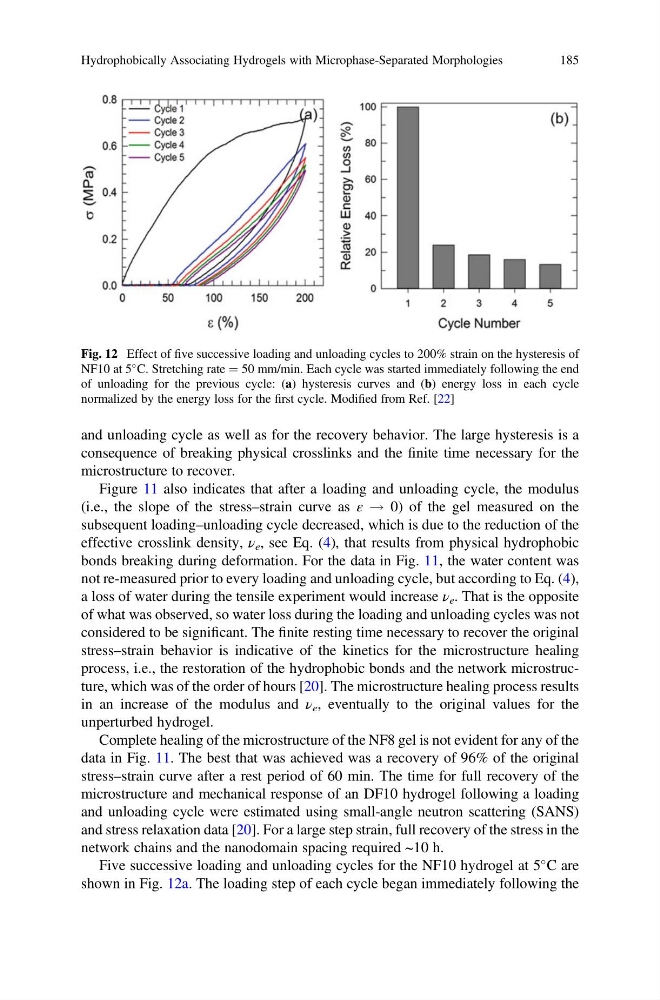
Five successive loading and unloading cycles for the NF10 hydrogel at 5
C are
shown in Fig. 12a. The loading step of each cycle began immediately following the
Fig. 12 Effect of five successive loading and unloading cycles to 200% strain on the hysteresis of
NF10 at 5
C. Stretching rate ¼ 50 mm/min. Each cycle was started immediately following the end
of unloading for the previous cycle: (a) hysteresis curves and (b) energy loss in each cycle
normalized by the energy loss for the first cycle. Modified from Ref. [22]
Hydrophobically Associating Hydrogels with Microphase-Separated Morphologies
185
consequence of breaking physical crosslinks and the finite time necessary for the
microstructure to recover.
Figure 11 also indicates that after a loading and unloading cycle, the modulus
(i.e., the slope of the stress–strain curve as ε ! 0) of the gel measured on the
subsequent loading–unloading cycle decreased, which is due to the reduction of the
effective crosslink density, ν e , see Eq. (4), that results from physical hydrophobic
bonds breaking during deformation. For the data in Fig. 11, the water content was
not re-measured prior to every loading and unloading cycle, but according to Eq. (4),
a loss of water during the tensile experiment would increase ν e . That is the opposite
of what was observed, so water loss during the loading and unloading cycles was not
considered to be significant. The finite resting time necessary to recover the original
stress–strain behavior is indicative of the kinetics for the microstructure healing
process, i.e., the restoration of the hydrophobic bonds and the network microstructure, which was of the order of hours [20]. The microstructure healing process results
in an increase of the modulus and ν e , eventually to the original values for the
unperturbed hydrogel.
Complete healing of the microstructure of the NF8 gel is not evident for any of the
data in Fig. 11. The best that was achieved was a recovery of 96% of the original
stress–strain curve after a rest period of 60 min. The time for full recovery of the
microstructure and mechanical response of an DF10 hydrogel following a loading
and unloading cycle were estimated using small-angle neutron scattering (SANS)
and stress relaxation data [20]. For a large step strain, full recovery of the stress in the
network chains and the nanodomain spacing required ~10 h.
Five successive loading and unloading cycles for the NF10 hydrogel at 5
C are
shown in Fig. 12a. The loading step of each cycle began immediately following the
Fig. 12 Effect of five successive loading and unloading cycles to 200% strain on the hysteresis of
NF10 at 5
C. Stretching rate ¼ 50 mm/min. Each cycle was started immediately following the end
of unloading for the previous cycle: (a) hysteresis curves and (b) energy loss in each cycle
normalized by the energy loss for the first cycle. Modified from Ref. [22]
Hydrophobically Associating Hydrogels with Microphase-Separated Morphologies
185