

unloading step of the previous cycle. The hysteresis and energy loss of each cycle
decreased from the previous cycle, though the most significant drop in those values
occurred between the first and second loading and unloading cycle, Fig. 12b. Each
successive cycle also exhibited a larger residual strain, Fig. 12a, though the residual
deformation in each cycle was recovered by resting the hydrogel for about an hour to
allow the structure to re-equilibrate. Similar hysteresis behavior has also been
reported for polyampholyte hydrogels [59]. Double network (DN) hydrogels exhibit
hysteresis behavior upon successive loading/unloading cycling if the maximum
strain is kept below the yield point, but for larger strains a permanent deformation
occurs due to irreversible breaking of the first, more brittle network [64, 65] that
produces plastic flow. Hybrid hydrogels that contain covalent and physical
crosslinks, such as crosslinked poly(acrylamide-co-calcium alginate) hydrogels,
exhibit a small but finite permanent deformation due to the irreversible rupture of
some of the chemical crosslinks [48].
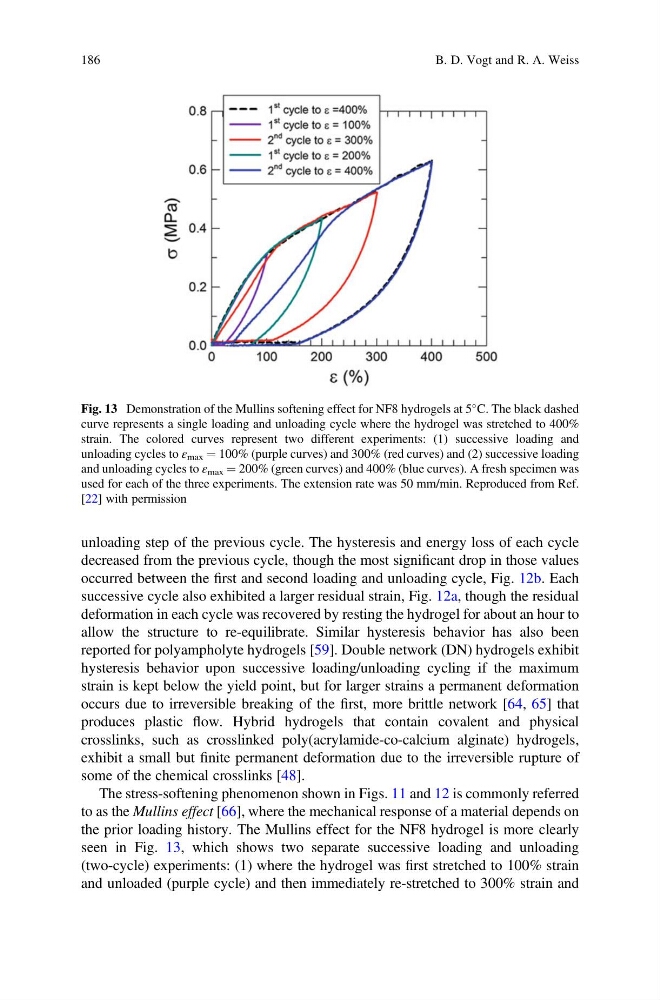
The stress-softening phenomenon shown in Figs. 11 and 12 is commonly referred
to as the Mullins effect [66], where the mechanical response of a material depends on
the prior loading history. The Mullins effect for the NF8 hydrogel is more clearly
seen in Fig. 13, which shows two separate successive loading and unloading
(two-cycle) experiments: (1) where the hydrogel was first stretched to 100% strain
and unloaded (purple cycle) and then immediately re-stretched to 300% strain and
Fig. 13 Demonstration of the Mullins softening effect for NF8 hydrogels at 5
C. The black dashed
curve represents a single loading and unloading cycle where the hydrogel was stretched to 400%
strain. The colored curves represent two different experiments: (1) successive loading and
unloading cycles to ε max ¼ 100% (purple curves) and 300% (red curves) and (2) successive loading
and unloading cycles to ε max ¼ 200% (green curves) and 400% (blue curves). A fresh specimen was
used for each of the three experiments. The extension rate was 50 mm/min. Reproduced from Ref.
[22] with permission
186
B. D. Vogt and R. A. Weiss
decreased from the previous cycle, though the most significant drop in those values
occurred between the first and second loading and unloading cycle, Fig. 12b. Each
successive cycle also exhibited a larger residual strain, Fig. 12a, though the residual
deformation in each cycle was recovered by resting the hydrogel for about an hour to
allow the structure to re-equilibrate. Similar hysteresis behavior has also been
reported for polyampholyte hydrogels [59]. Double network (DN) hydrogels exhibit
hysteresis behavior upon successive loading/unloading cycling if the maximum
strain is kept below the yield point, but for larger strains a permanent deformation
occurs due to irreversible breaking of the first, more brittle network [64, 65] that
produces plastic flow. Hybrid hydrogels that contain covalent and physical
crosslinks, such as crosslinked poly(acrylamide-co-calcium alginate) hydrogels,
exhibit a small but finite permanent deformation due to the irreversible rupture of
some of the chemical crosslinks [48].
The stress-softening phenomenon shown in Figs. 11 and 12 is commonly referred
to as the Mullins effect [66], where the mechanical response of a material depends on
the prior loading history. The Mullins effect for the NF8 hydrogel is more clearly
seen in Fig. 13, which shows two separate successive loading and unloading
(two-cycle) experiments: (1) where the hydrogel was first stretched to 100% strain
and unloaded (purple cycle) and then immediately re-stretched to 300% strain and
Fig. 13 Demonstration of the Mullins softening effect for NF8 hydrogels at 5
C. The black dashed
curve represents a single loading and unloading cycle where the hydrogel was stretched to 400%
strain. The colored curves represent two different experiments: (1) successive loading and
unloading cycles to ε max ¼ 100% (purple curves) and 300% (red curves) and (2) successive loading
and unloading cycles to ε max ¼ 200% (green curves) and 400% (blue curves). A fresh specimen was
used for each of the three experiments. The extension rate was 50 mm/min. Reproduced from Ref.
[22] with permission
186
B. D. Vogt and R. A. Weiss