

2.4 Direct Extrusion of Hydrogels
As a consequence of the non-covalent nature of the hydrophobic bonds, viscous flow
of the hydrogel can be achieved at elevated temperatures and/or if a sufficiently high
stress is applied to the gel. Below the T g of the associated FOSA or FOSM groups,
~45
C, the fluorocarbon core of the nanodomains is in a glassy state, and the
relaxation time of the physical network is very long. The hydrogel is strong and
tough, and a prohibitively high stress is needed to achieve viscous flow. The
hydrogel cannot be easily injected or reformed under those conditions. However,
extrusion of the hydrophobically associating hydrogels can be achieved by raising
the temperature above the T g of the nanodomains, where the relaxation times of the
physical network are greatly reduced and hydrogel becomes a viscoelastic liquid
[12]. A similar result can also be achieved by plasticizing the FOSA nanodomains,
e.g., by adding a small amount of an organic solvent to the water-swollen hydrogel.
DMSO is an attractive plasticizer, since it solvates the hydrophobic bonds and it has
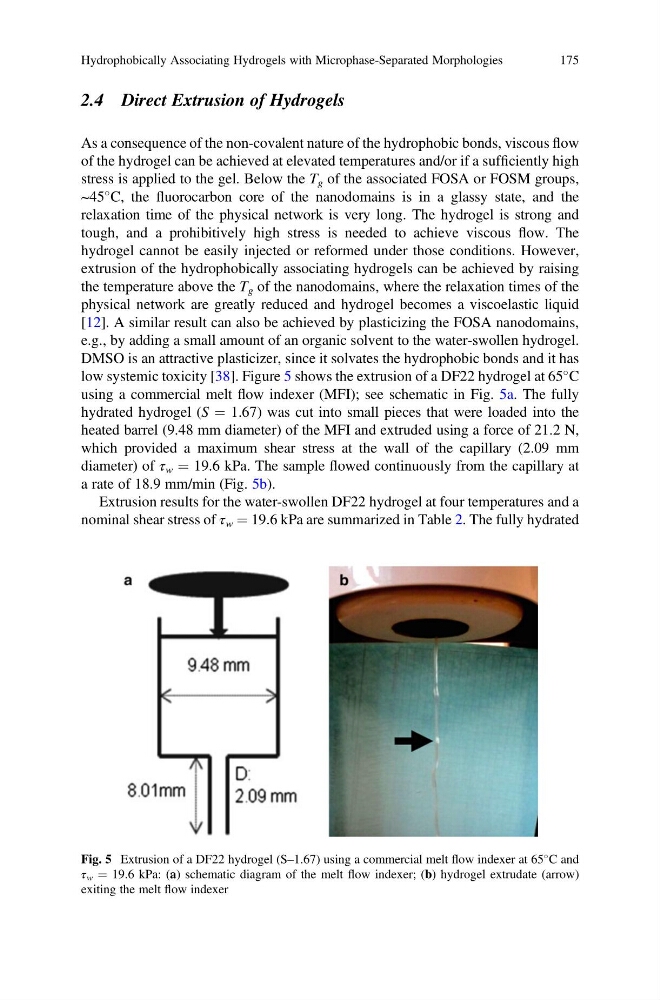
low systemic toxicity [38]. Figure 5 shows the extrusion of a DF22 hydrogel at 65
C
using a commercial melt flow indexer (MFI); see schematic in Fig. 5a. The fully
hydrated hydrogel (S ¼ 1.67) was cut into small pieces that were loaded into the
heated barrel (9.48 mm diameter) of the MFI and extruded using a force of 21.2 N,
which provided a maximum shear stress at the wall of the capillary (2.09 mm
diameter) of τ w ¼ 19.6 kPa. The sample flowed continuously from the capillary at
a rate of 18.9 mm/min (Fig. 5b).
Extrusion results for the water-swollen DF22 hydrogel at four temperatures and a
nominal shear stress of τ w ¼ 19.6 kPa are summarized in Table 2. The fully hydrated
Fig. 5 Extrusion of a DF22 hydrogel (S–1.67) using a commercial melt flow indexer at 65
C and
τ w ¼ 19.6 kPa: (a) schematic diagram of the melt flow indexer; (b) hydrogel extrudate (arrow)
exiting the melt flow indexer
Hydrophobically Associating Hydrogels with Microphase-Separated Morphologies
175
As a consequence of the non-covalent nature of the hydrophobic bonds, viscous flow
of the hydrogel can be achieved at elevated temperatures and/or if a sufficiently high
stress is applied to the gel. Below the T g of the associated FOSA or FOSM groups,
~45
C, the fluorocarbon core of the nanodomains is in a glassy state, and the
relaxation time of the physical network is very long. The hydrogel is strong and
tough, and a prohibitively high stress is needed to achieve viscous flow. The
hydrogel cannot be easily injected or reformed under those conditions. However,
extrusion of the hydrophobically associating hydrogels can be achieved by raising
the temperature above the T g of the nanodomains, where the relaxation times of the
physical network are greatly reduced and hydrogel becomes a viscoelastic liquid
[12]. A similar result can also be achieved by plasticizing the FOSA nanodomains,
e.g., by adding a small amount of an organic solvent to the water-swollen hydrogel.
DMSO is an attractive plasticizer, since it solvates the hydrophobic bonds and it has
low systemic toxicity [38]. Figure 5 shows the extrusion of a DF22 hydrogel at 65
C
using a commercial melt flow indexer (MFI); see schematic in Fig. 5a. The fully
hydrated hydrogel (S ¼ 1.67) was cut into small pieces that were loaded into the
heated barrel (9.48 mm diameter) of the MFI and extruded using a force of 21.2 N,
which provided a maximum shear stress at the wall of the capillary (2.09 mm
diameter) of τ w ¼ 19.6 kPa. The sample flowed continuously from the capillary at
a rate of 18.9 mm/min (Fig. 5b).
Extrusion results for the water-swollen DF22 hydrogel at four temperatures and a
nominal shear stress of τ w ¼ 19.6 kPa are summarized in Table 2. The fully hydrated
Fig. 5 Extrusion of a DF22 hydrogel (S–1.67) using a commercial melt flow indexer at 65
C and
τ w ¼ 19.6 kPa: (a) schematic diagram of the melt flow indexer; (b) hydrogel extrudate (arrow)
exiting the melt flow indexer
Hydrophobically Associating Hydrogels with Microphase-Separated Morphologies
175