

the fluoroacrylate hydrophobically associating hydrogels were generally calculated
from the modulus of a hydrogel freshly swollen to equilibrium before any
deformation was applied, using the following equation [36]
G ¼
E
3
¼ 1 À
2
f
ν e RTϕ
1=3
2
ð2Þ
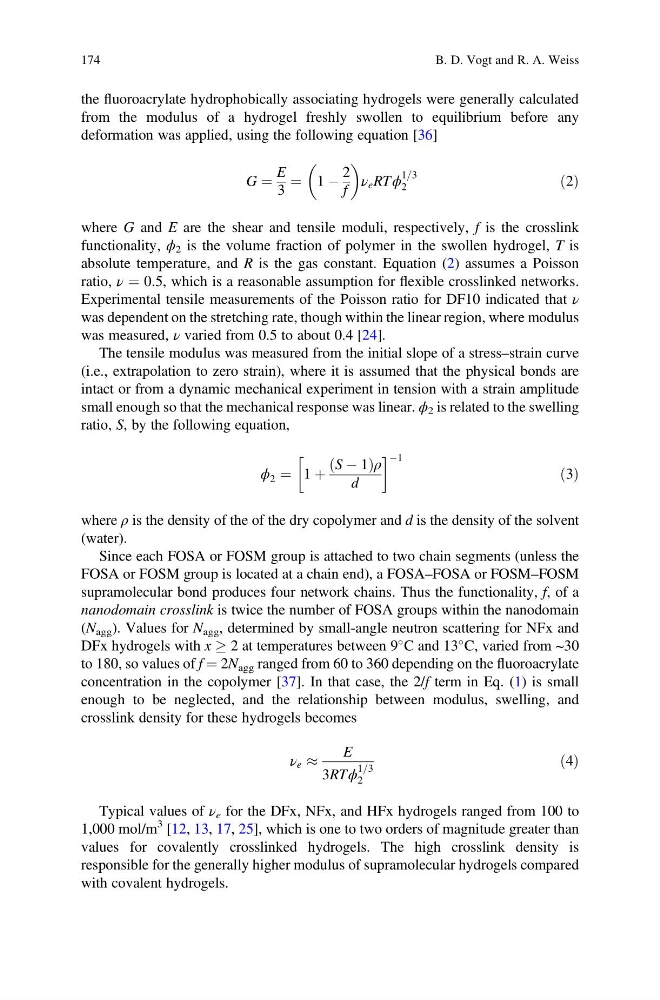
where G and E are the shear and tensile moduli, respectively, f is the crosslink
functionality, ϕ 2 is the volume fraction of polymer in the swollen hydrogel, T is
absolute temperature, and R is the gas constant. Equation (2) assumes a Poisson
ratio, ν ¼ 0.5, which is a reasonable assumption for flexible crosslinked networks.
Experimental tensile measurements of the Poisson ratio for DF10 indicated that ν
was dependent on the stretching rate, though within the linear region, where modulus
was measured, ν varied from 0.5 to about 0.4 [24].
The tensile modulus was measured from the initial slope of a stress–strain curve
(i.e., extrapolation to zero strain), where it is assumed that the physical bonds are
intact or from a dynamic mechanical experiment in tension with a strain amplitude
small enough so that the mechanical response was linear. ϕ 2 is related to the swelling
ratio, S, by the following equation,
ϕ 2 ¼ 1 þ
S À 1
ð
Þρ
d
À1
ð3Þ
where ρ is the density of the of the dry copolymer and d is the density of the solvent
(water).
Since each FOSA or FOSM group is attached to two chain segments (unless the
FOSA or FOSM group is located at a chain end), a FOSA–FOSA or FOSM–FOSM
supramolecular bond produces four network chains. Thus the functionality, f, of a
nanodomain crosslink is twice the number of FOSA groups within the nanodomain
(N agg ). Values for N agg , determined by small-angle neutron scattering for NFx and
DFx hydrogels with x ! 2 at temperatures between 9
C and 13
C, varied from ~30
to 180, so values of f ¼ 2N agg ranged from 60 to 360 depending on the fluoroacrylate
concentration in the copolymer [37]. In that case, the 2/f term in Eq. (1) is small
enough to be neglected, and the relationship between modulus, swelling, and
crosslink density for these hydrogels becomes
ν e %
E
3RTϕ
1=3
2
ð4Þ
Typical values of ν e for the DFx, NFx, and HFx hydrogels ranged from 100 to
1,000 mol/m
3 [12, 13, 17, 25], which is one to two orders of magnitude greater than
values for covalently crosslinked hydrogels. The high crosslink density is
responsible for the generally higher modulus of supramolecular hydrogels compared
with covalent hydrogels.
174
B. D. Vogt and R. A. Weiss
from the modulus of a hydrogel freshly swollen to equilibrium before any
deformation was applied, using the following equation [36]
G ¼
E
3
¼ 1 À
2
f
ν e RTϕ
1=3
2
ð2Þ
where G and E are the shear and tensile moduli, respectively, f is the crosslink
functionality, ϕ 2 is the volume fraction of polymer in the swollen hydrogel, T is
absolute temperature, and R is the gas constant. Equation (2) assumes a Poisson
ratio, ν ¼ 0.5, which is a reasonable assumption for flexible crosslinked networks.
Experimental tensile measurements of the Poisson ratio for DF10 indicated that ν
was dependent on the stretching rate, though within the linear region, where modulus
was measured, ν varied from 0.5 to about 0.4 [24].
The tensile modulus was measured from the initial slope of a stress–strain curve
(i.e., extrapolation to zero strain), where it is assumed that the physical bonds are
intact or from a dynamic mechanical experiment in tension with a strain amplitude
small enough so that the mechanical response was linear. ϕ 2 is related to the swelling
ratio, S, by the following equation,
ϕ 2 ¼ 1 þ
S À 1
ð
Þρ
d
À1
ð3Þ
where ρ is the density of the of the dry copolymer and d is the density of the solvent
(water).
Since each FOSA or FOSM group is attached to two chain segments (unless the
FOSA or FOSM group is located at a chain end), a FOSA–FOSA or FOSM–FOSM
supramolecular bond produces four network chains. Thus the functionality, f, of a
nanodomain crosslink is twice the number of FOSA groups within the nanodomain
(N agg ). Values for N agg , determined by small-angle neutron scattering for NFx and
DFx hydrogels with x ! 2 at temperatures between 9
C and 13
C, varied from ~30
to 180, so values of f ¼ 2N agg ranged from 60 to 360 depending on the fluoroacrylate
concentration in the copolymer [37]. In that case, the 2/f term in Eq. (1) is small
enough to be neglected, and the relationship between modulus, swelling, and
crosslink density for these hydrogels becomes
ν e %
E
3RTϕ
1=3
2
ð4Þ
Typical values of ν e for the DFx, NFx, and HFx hydrogels ranged from 100 to
1,000 mol/m
3 [12, 13, 17, 25], which is one to two orders of magnitude greater than
values for covalently crosslinked hydrogels. The high crosslink density is
responsible for the generally higher modulus of supramolecular hydrogels compared
with covalent hydrogels.
174
B. D. Vogt and R. A. Weiss