

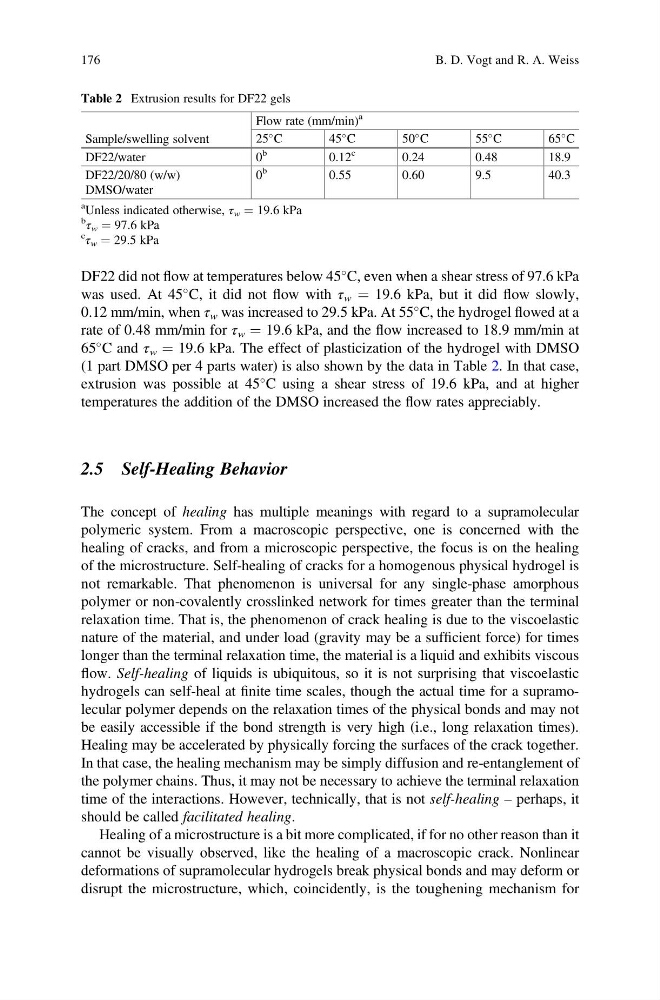
DF22 did not flow at temperatures below 45
C, even when a shear stress of 97.6 kPa
was used. At 45
C, it did not flow with τ w ¼ 19.6 kPa, but it did flow slowly,
0.12 mm/min, when τ w was increased to 29.5 kPa. At 55
C, the hydrogel flowed at a
rate of 0.48 mm/min for τ w ¼ 19.6 kPa, and the flow increased to 18.9 mm/min at
65
C and τ w ¼ 19.6 kPa. The effect of plasticization of the hydrogel with DMSO
(1 part DMSO per 4 parts water) is also shown by the data in Table 2. In that case,
extrusion was possible at 45
C using a shear stress of 19.6 kPa, and at higher
temperatures the addition of the DMSO increased the flow rates appreciably.
2.5 Self-Healing Behavior
The concept of healing has multiple meanings with regard to a supramolecular
polymeric system. From a macroscopic perspective, one is concerned with the
healing of cracks, and from a microscopic perspective, the focus is on the healing
of the microstructure. Self-healing of cracks for a homogenous physical hydrogel is
not remarkable. That phenomenon is universal for any single-phase amorphous
polymer or non-covalently crosslinked network for times greater than the terminal
relaxation time. That is, the phenomenon of crack healing is due to the viscoelastic
nature of the material, and under load (gravity may be a sufficient force) for times
longer than the terminal relaxation time, the material is a liquid and exhibits viscous
flow. Self-healing of liquids is ubiquitous, so it is not surprising that viscoelastic
hydrogels can self-heal at finite time scales, though the actual time for a supramolecular polymer depends on the relaxation times of the physical bonds and may not
be easily accessible if the bond strength is very high (i.e., long relaxation times).
Healing may be accelerated by physically forcing the surfaces of the crack together.
In that case, the healing mechanism may be simply diffusion and re-entanglement of
the polymer chains. Thus, it may not be necessary to achieve the terminal relaxation
time of the interactions. However, technically, that is not self-healing – perhaps, it
should be called facilitated healing.
Healing of a microstructure is a bit more complicated, if for no other reason than it
cannot be visually observed, like the healing of a macroscopic crack. Nonlinear
deformations of supramolecular hydrogels break physical bonds and may deform or
disrupt the microstructure, which, coincidently, is the toughening mechanism for
Table 2 Extrusion results for DF22 gels
Sample/swelling solvent
Flow rate (mm/min)
a
25
C
4 5
C
5 0
C
5 5
C
6 5
C
DF22/water
0
b
0.12
c
0.24
0.48
18.9
DF22/20/80 (w/w)
DMSO/water
0
b
0.55
0.60
9.5
40.3
a Unless indicated otherwise, τ w ¼ 19.6 kPa
b
τ w ¼ 97.6 kPa
c τ w ¼ 29.5 kPa
176
B. D. Vogt and R. A. Weiss
C, even when a shear stress of 97.6 kPa
was used. At 45
C, it did not flow with τ w ¼ 19.6 kPa, but it did flow slowly,
0.12 mm/min, when τ w was increased to 29.5 kPa. At 55
C, the hydrogel flowed at a
rate of 0.48 mm/min for τ w ¼ 19.6 kPa, and the flow increased to 18.9 mm/min at
65
C and τ w ¼ 19.6 kPa. The effect of plasticization of the hydrogel with DMSO
(1 part DMSO per 4 parts water) is also shown by the data in Table 2. In that case,
extrusion was possible at 45
C using a shear stress of 19.6 kPa, and at higher
temperatures the addition of the DMSO increased the flow rates appreciably.
2.5 Self-Healing Behavior
The concept of healing has multiple meanings with regard to a supramolecular
polymeric system. From a macroscopic perspective, one is concerned with the
healing of cracks, and from a microscopic perspective, the focus is on the healing
of the microstructure. Self-healing of cracks for a homogenous physical hydrogel is
not remarkable. That phenomenon is universal for any single-phase amorphous
polymer or non-covalently crosslinked network for times greater than the terminal
relaxation time. That is, the phenomenon of crack healing is due to the viscoelastic
nature of the material, and under load (gravity may be a sufficient force) for times
longer than the terminal relaxation time, the material is a liquid and exhibits viscous
flow. Self-healing of liquids is ubiquitous, so it is not surprising that viscoelastic
hydrogels can self-heal at finite time scales, though the actual time for a supramolecular polymer depends on the relaxation times of the physical bonds and may not
be easily accessible if the bond strength is very high (i.e., long relaxation times).
Healing may be accelerated by physically forcing the surfaces of the crack together.
In that case, the healing mechanism may be simply diffusion and re-entanglement of
the polymer chains. Thus, it may not be necessary to achieve the terminal relaxation
time of the interactions. However, technically, that is not self-healing – perhaps, it
should be called facilitated healing.
Healing of a microstructure is a bit more complicated, if for no other reason than it
cannot be visually observed, like the healing of a macroscopic crack. Nonlinear
deformations of supramolecular hydrogels break physical bonds and may deform or
disrupt the microstructure, which, coincidently, is the toughening mechanism for
Table 2 Extrusion results for DF22 gels
Sample/swelling solvent
Flow rate (mm/min)
a
25
C
4 5
C
5 0
C
5 5
C
6 5
C
DF22/water
0
b
0.12
c
0.24
0.48
18.9
DF22/20/80 (w/w)
DMSO/water
0
b
0.55
0.60
9.5
40.3
a Unless indicated otherwise, τ w ¼ 19.6 kPa
b
τ w ¼ 97.6 kPa
c τ w ¼ 29.5 kPa
176
B. D. Vogt and R. A. Weiss