

around ω ¼ 4–5 rad/s. The P(AAm-co-VIm)-Zn
2+ gel has a lower G
0 over the whole
frequency range, and no clear elastic plateau is observed within the tested frequency
window. Similarly G
00 does not show a peak indicating that the dissociation kinetics
of Zn
2+
– imidazole is much faster than that of Ni
2+
– imidazole and the peak of G
00
are not experimentally accessible with this rheometer.
A simple physical picture of the dual crosslink gels suggests an additive contribution of permanent and transient crosslinks to the dynamic moduli, and the
dynamics of the transient bonds can be characterized by a main relaxation time.
Note that in principle the value of G
0 (ω) for these gels should approach the value of
G
0 of the chemical gel at low frequency. However, as shown in Fig. 3, the measured
values of G
0 are still significantly higher than that of the chemical gel even at the
lowest frequency studied. This result indicates that there can be a second slower
transient component in the dual crosslink gel systems.
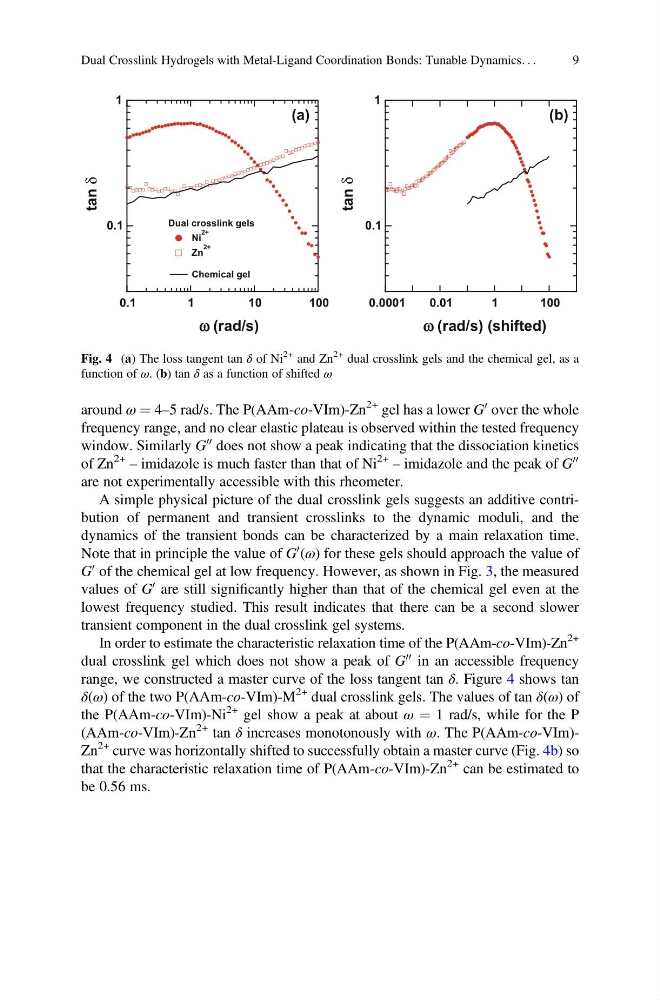
In order to estimate the characteristic relaxation time of the P(AAm-co-VIm)-Zn
2+
dual crosslink gel which does not show a peak of G
00 in an accessible frequency
range, we constructed a master curve of the loss tangent tan δ. Figure 4 shows tan
δ(ω) of the two P(AAm-co-VIm)-M
2+ dual crosslink gels. The values of tan δ(ω) of
the P(AAm-co-VIm)-Ni
2+ gel show a peak at about ω ¼ 1 rad/s, while for the P
(AAm-co-VIm)-Zn
2+ tan δ increases monotonously with ω. The P(AAm-co-VIm)Zn
2+ curve was horizontally shifted to successfully obtain a master curve (Fig. 4b) so
that the characteristic relaxation time of P(AAm-co-VIm)-Zn
2+ can be estimated to
be 0.56 ms.
0.1
1
tan
δ
tan
δ
0.1
1
10
100
w (rad/s)
Dual crosslink gels
Ni
2+
Zn
2+
Chemical gel
(a)
0.1
1
0.0001
0.01
1
100
w (rad/s) (shifted)
(b)
Fig. 4 (a) The loss tangent tan δ of Ni
2+ and Zn
2+ dual crosslink gels and the chemical gel, as a
function of ω. (b) tan δ as a function of shifted ω
Dual Crosslink Hydrogels with Metal-Ligand Coordination Bonds: Tunable Dynamics. . .
9
2+ gel has a lower G
0 over the whole
frequency range, and no clear elastic plateau is observed within the tested frequency
window. Similarly G
00 does not show a peak indicating that the dissociation kinetics
of Zn
2+
– imidazole is much faster than that of Ni
2+
– imidazole and the peak of G
00
are not experimentally accessible with this rheometer.
A simple physical picture of the dual crosslink gels suggests an additive contribution of permanent and transient crosslinks to the dynamic moduli, and the
dynamics of the transient bonds can be characterized by a main relaxation time.
Note that in principle the value of G
0 (ω) for these gels should approach the value of
G
0 of the chemical gel at low frequency. However, as shown in Fig. 3, the measured
values of G
0 are still significantly higher than that of the chemical gel even at the
lowest frequency studied. This result indicates that there can be a second slower
transient component in the dual crosslink gel systems.
In order to estimate the characteristic relaxation time of the P(AAm-co-VIm)-Zn
2+
dual crosslink gel which does not show a peak of G
00 in an accessible frequency
range, we constructed a master curve of the loss tangent tan δ. Figure 4 shows tan
δ(ω) of the two P(AAm-co-VIm)-M
2+ dual crosslink gels. The values of tan δ(ω) of
the P(AAm-co-VIm)-Ni
2+ gel show a peak at about ω ¼ 1 rad/s, while for the P
(AAm-co-VIm)-Zn
2+ tan δ increases monotonously with ω. The P(AAm-co-VIm)Zn
2+ curve was horizontally shifted to successfully obtain a master curve (Fig. 4b) so
that the characteristic relaxation time of P(AAm-co-VIm)-Zn
2+ can be estimated to
be 0.56 ms.
0.1
1
tan
δ
tan
δ
0.1
1
10
100
w (rad/s)
Dual crosslink gels
Ni
2+
Zn
2+
Chemical gel
(a)
0.1
1
0.0001
0.01
1
100
w (rad/s) (shifted)
(b)
Fig. 4 (a) The loss tangent tan δ of Ni
2+ and Zn
2+ dual crosslink gels and the chemical gel, as a
function of ω. (b) tan δ as a function of shifted ω
Dual Crosslink Hydrogels with Metal-Ligand Coordination Bonds: Tunable Dynamics. . .
9