

3.3 Stress Relaxation
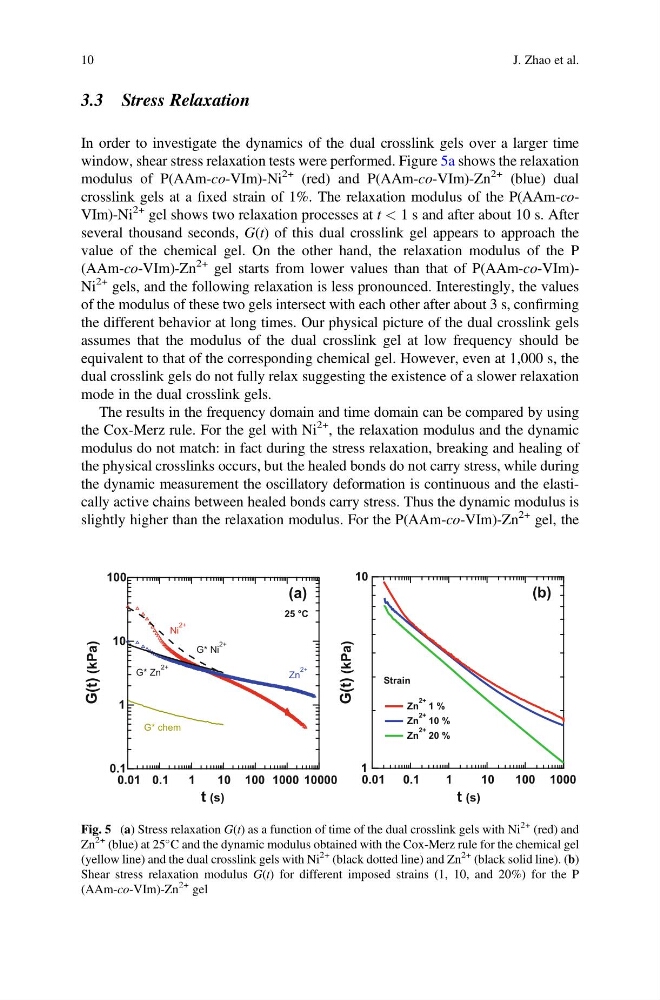
In order to investigate the dynamics of the dual crosslink gels over a larger time
window, shear stress relaxation tests were performed. Figure 5a shows the relaxation
modulus of P(AAm-co-VIm)-Ni
2+ (red) and P(AAm-co-VIm)-Zn
2+ (blue) dual
crosslink gels at a fixed strain of 1%. The relaxation modulus of the P(AAm-coVIm)-Ni
2+ gel shows two relaxation processes at t < 1 s and after about 10 s. After
several thousand seconds, G(t) of this dual crosslink gel appears to approach the
value of the chemical gel. On the other hand, the relaxation modulus of the P
(AAm-co-VIm)-Zn
2+ gel starts from lower values than that of P(AAm-co-VIm)Ni
2+ gels, and the following relaxation is less pronounced. Interestingly, the values
of the modulus of these two gels intersect with each other after about 3 s, confirming
the different behavior at long times. Our physical picture of the dual crosslink gels
assumes that the modulus of the dual crosslink gel at low frequency should be
equivalent to that of the corresponding chemical gel. However, even at 1,000 s, the
dual crosslink gels do not fully relax suggesting the existence of a slower relaxation
mode in the dual crosslink gels.
The results in the frequency domain and time domain can be compared by using
the Cox-Merz rule. For the gel with Ni
2+ , the relaxation modulus and the dynamic
modulus do not match: in fact during the stress relaxation, breaking and healing of
the physical crosslinks occurs, but the healed bonds do not carry stress, while during
the dynamic measurement the oscillatory deformation is continuous and the elastically active chains between healed bonds carry stress. Thus the dynamic modulus is
slightly higher than the relaxation modulus. For the P(AAm-co-VIm)-Zn
2+ gel, the
1
10
0.01 0.1
1
10
100 1000
(b)
Strain
Zn
2+ 1 %
Zn
2+ 10 %
Zn
2+ 20 %
G(t) (kPa)
G(t) (kPa)
0.1
1
10
100
0.01 0.1
1
10 100 1000 10000
t (s)
(a)
25 °C
Ni
2+
Zn
2+
G* Ni
2+
G* Zn
2+
G* chem
t (s)
Fig. 5 (a) Stress relaxation G(t) as a function of time of the dual crosslink gels with Ni
2+ (red) and
Zn
2+ (blue) at 25
C and the dynamic modulus obtained with the Cox-Merz rule for the chemical gel
(yellow line) and the dual crosslink gels with Ni
2+ (black dotted line) and Zn
2+ (black solid line). (b)
Shear stress relaxation modulus G(t) for different imposed strains (1, 10, and 20%) for the P
(AAm-co-VIm)-Zn
2+ gel
10
J. Zhao et al.
In order to investigate the dynamics of the dual crosslink gels over a larger time
window, shear stress relaxation tests were performed. Figure 5a shows the relaxation
modulus of P(AAm-co-VIm)-Ni
2+ (red) and P(AAm-co-VIm)-Zn
2+ (blue) dual
crosslink gels at a fixed strain of 1%. The relaxation modulus of the P(AAm-coVIm)-Ni
2+ gel shows two relaxation processes at t < 1 s and after about 10 s. After
several thousand seconds, G(t) of this dual crosslink gel appears to approach the
value of the chemical gel. On the other hand, the relaxation modulus of the P
(AAm-co-VIm)-Zn
2+ gel starts from lower values than that of P(AAm-co-VIm)Ni
2+ gels, and the following relaxation is less pronounced. Interestingly, the values
of the modulus of these two gels intersect with each other after about 3 s, confirming
the different behavior at long times. Our physical picture of the dual crosslink gels
assumes that the modulus of the dual crosslink gel at low frequency should be
equivalent to that of the corresponding chemical gel. However, even at 1,000 s, the
dual crosslink gels do not fully relax suggesting the existence of a slower relaxation
mode in the dual crosslink gels.
The results in the frequency domain and time domain can be compared by using
the Cox-Merz rule. For the gel with Ni
2+ , the relaxation modulus and the dynamic
modulus do not match: in fact during the stress relaxation, breaking and healing of
the physical crosslinks occurs, but the healed bonds do not carry stress, while during
the dynamic measurement the oscillatory deformation is continuous and the elastically active chains between healed bonds carry stress. Thus the dynamic modulus is
slightly higher than the relaxation modulus. For the P(AAm-co-VIm)-Zn
2+ gel, the
1
10
0.01 0.1
1
10
100 1000
(b)
Strain
Zn
2+ 1 %
Zn
2+ 10 %
Zn
2+ 20 %
G(t) (kPa)
G(t) (kPa)
0.1
1
10
100
0.01 0.1
1
10 100 1000 10000
t (s)
(a)
25 °C
Ni
2+
Zn
2+
G* Ni
2+
G* Zn
2+
G* chem
t (s)
Fig. 5 (a) Stress relaxation G(t) as a function of time of the dual crosslink gels with Ni
2+ (red) and
Zn
2+ (blue) at 25
C and the dynamic modulus obtained with the Cox-Merz rule for the chemical gel
(yellow line) and the dual crosslink gels with Ni
2+ (black dotted line) and Zn
2+ (black solid line). (b)
Shear stress relaxation modulus G(t) for different imposed strains (1, 10, and 20%) for the P
(AAm-co-VIm)-Zn
2+ gel
10
J. Zhao et al.