

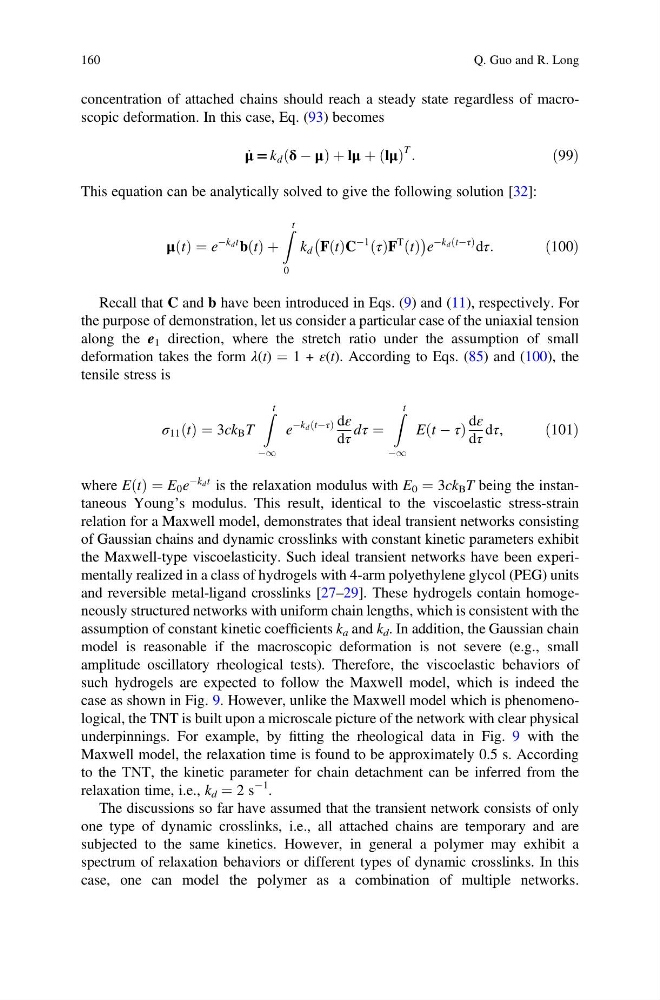
concentration of attached chains should reach a steady state regardless of macroscopic deformation. In this case, Eq. (93) becomes
_
μ = k d δ À μ
ð
Þþlμ þ lμ
ð Þ
T :
ð99Þ
This equation can be analytically solved to give the following solution [32]:
μ t
ð Þ ¼ e
Àk d t b t
ð Þ þ
Z t
0
k d F t
ð ÞC
À1
τ
ð ÞF
T t
ð Þ
À
Á
e
Àk d tÀτ
ð
Þ dτ:
ð100Þ
Recall that C and b have been introduced in Eqs. (9) and (11), respectively. For
the purpose of demonstration, let us consider a particular case of the uniaxial tension
along the e 1 direction, where the stretch ratio under the assumption of small
deformation takes the form λ(t) ¼ 1 + ε(t). According to Eqs. (85) and (100), the
tensile stress is
σ 11 t
ð Þ ¼ 3ck B T
Z t
À1
e
Àk d tÀτ
ð
Þ dε
dτ
dτ ¼
Z t
À1
E t À τ
ð
Þ
dε
dτ
dτ,
ð101Þ
where E t
ð Þ ¼ E 0 e
Àk d t is the relaxation modulus with E 0 ¼ 3ck B T being the instantaneous Young’s modulus. This result, identical to the viscoelastic stress-strain
relation for a Maxwell model, demonstrates that ideal transient networks consisting
of Gaussian chains and dynamic crosslinks with constant kinetic parameters exhibit
the Maxwell-type viscoelasticity. Such ideal transient networks have been experimentally realized in a class of hydrogels with 4-arm polyethylene glycol (PEG) units
and reversible metal-ligand crosslinks [27–29]. These hydrogels contain homogeneously structured networks with uniform chain lengths, which is consistent with the
assumption of constant kinetic coefficients k a and k d . In addition, the Gaussian chain
model is reasonable if the macroscopic deformation is not severe (e.g., small
amplitude oscillatory rheological tests). Therefore, the viscoelastic behaviors of
such hydrogels are expected to follow the Maxwell model, which is indeed the
case as shown in Fig. 9. However, unlike the Maxwell model which is phenomenological, the TNT is built upon a microscale picture of the network with clear physical
underpinnings. For example, by fitting the rheological data in Fig. 9 with the
Maxwell model, the relaxation time is found to be approximately 0.5 s. According
to the TNT, the kinetic parameter for chain detachment can be inferred from the
relaxation time, i.e., k d ¼ 2 s
À1
.
The discussions so far have assumed that the transient network consists of only
one type of dynamic crosslinks, i.e., all attached chains are temporary and are
subjected to the same kinetics. However, in general a polymer may exhibit a
spectrum of relaxation behaviors or different types of dynamic crosslinks. In this
case, one can model the polymer as a combination of multiple networks.
160
Q. Guo and R. Long
_
μ = k d δ À μ
ð
Þþlμ þ lμ
ð Þ
T :
ð99Þ
This equation can be analytically solved to give the following solution [32]:
μ t
ð Þ ¼ e
Àk d t b t
ð Þ þ
Z t
0
k d F t
ð ÞC
À1
τ
ð ÞF
T t
ð Þ
À
Á
e
Àk d tÀτ
ð
Þ dτ:
ð100Þ
Recall that C and b have been introduced in Eqs. (9) and (11), respectively. For
the purpose of demonstration, let us consider a particular case of the uniaxial tension
along the e 1 direction, where the stretch ratio under the assumption of small
deformation takes the form λ(t) ¼ 1 + ε(t). According to Eqs. (85) and (100), the
tensile stress is
σ 11 t
ð Þ ¼ 3ck B T
Z t
À1
e
Àk d tÀτ
ð
Þ dε
dτ
dτ ¼
Z t
À1
E t À τ
ð
Þ
dε
dτ
dτ,
ð101Þ
where E t
ð Þ ¼ E 0 e
Àk d t is the relaxation modulus with E 0 ¼ 3ck B T being the instantaneous Young’s modulus. This result, identical to the viscoelastic stress-strain
relation for a Maxwell model, demonstrates that ideal transient networks consisting
of Gaussian chains and dynamic crosslinks with constant kinetic parameters exhibit
the Maxwell-type viscoelasticity. Such ideal transient networks have been experimentally realized in a class of hydrogels with 4-arm polyethylene glycol (PEG) units
and reversible metal-ligand crosslinks [27–29]. These hydrogels contain homogeneously structured networks with uniform chain lengths, which is consistent with the
assumption of constant kinetic coefficients k a and k d . In addition, the Gaussian chain
model is reasonable if the macroscopic deformation is not severe (e.g., small
amplitude oscillatory rheological tests). Therefore, the viscoelastic behaviors of
such hydrogels are expected to follow the Maxwell model, which is indeed the
case as shown in Fig. 9. However, unlike the Maxwell model which is phenomenological, the TNT is built upon a microscale picture of the network with clear physical
underpinnings. For example, by fitting the rheological data in Fig. 9 with the
Maxwell model, the relaxation time is found to be approximately 0.5 s. According
to the TNT, the kinetic parameter for chain detachment can be inferred from the
relaxation time, i.e., k d ¼ 2 s
À1
.
The discussions so far have assumed that the transient network consists of only
one type of dynamic crosslinks, i.e., all attached chains are temporary and are
subjected to the same kinetics. However, in general a polymer may exhibit a
spectrum of relaxation behaviors or different types of dynamic crosslinks. In this
case, one can model the polymer as a combination of multiple networks.
160
Q. Guo and R. Long