

For example, the model system shown in Fig. 1 contains two types of crosslinks:
static and dynamic. To model it using the TNT, we can treat it as two networks: a
static network and a transient network. For the static network, let c s be the chain
concentration and μ s (¼ b) be the corresponding chain distribution tensor. For the
transient network, let c 1 be the concentration of attached chains, c 1t be the concentration of all temporary chains, and μ 1 be the corresponding chain distribution
tensor. The total chain distribution tensor μ is
cμ = c s μ s þ c 1 μ 1 ¼ c s b þ c 1 μ 1 ,
ð102Þ
where c ¼ c s + c 1 is the total concentration of attached chains. The Cauchy stress
tensor can still be determined by Eq. (85) provided that the combined μ in Eq. (102)
is used. More generally, if a polymer exhibits multiple different relaxation mechanisms, which can be represented by multiple transient networks, Eq. (102) can be
extended to
cμ = c s b þ
X M
i¼1
c i μ i ,
ð103Þ
where c ¼ c s þ
P M
i¼1 c i .
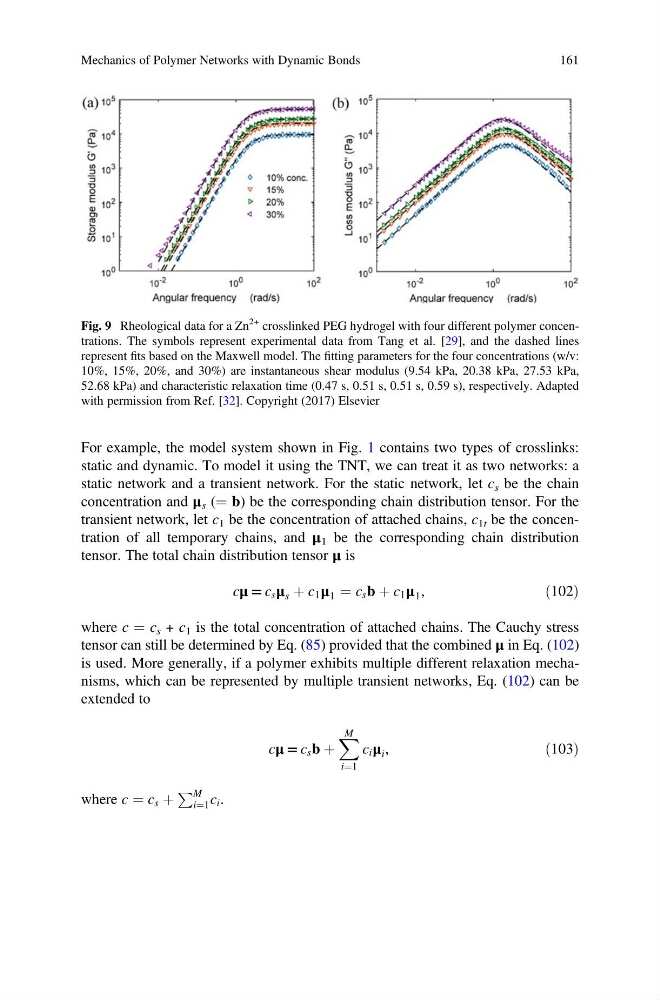
Fig. 9 Rheological data for a Zn
2+ crosslinked PEG hydrogel with four different polymer concentrations. The symbols represent experimental data from Tang et al. [29], and the dashed lines
represent fits based on the Maxwell model. The fitting parameters for the four concentrations (w/v:
10%, 15%, 20%, and 30%) are instantaneous shear modulus (9.54 kPa, 20.38 kPa, 27.53 kPa,
52.68 kPa) and characteristic relaxation time (0.47 s, 0.51 s, 0.51 s, 0.59 s), respectively. Adapted
with permission from Ref. [32]. Copyright (2017) Elsevier
Mechanics of Polymer Networks with Dynamic Bonds
161
static and dynamic. To model it using the TNT, we can treat it as two networks: a
static network and a transient network. For the static network, let c s be the chain
concentration and μ s (¼ b) be the corresponding chain distribution tensor. For the
transient network, let c 1 be the concentration of attached chains, c 1t be the concentration of all temporary chains, and μ 1 be the corresponding chain distribution
tensor. The total chain distribution tensor μ is
cμ = c s μ s þ c 1 μ 1 ¼ c s b þ c 1 μ 1 ,
ð102Þ
where c ¼ c s + c 1 is the total concentration of attached chains. The Cauchy stress
tensor can still be determined by Eq. (85) provided that the combined μ in Eq. (102)
is used. More generally, if a polymer exhibits multiple different relaxation mechanisms, which can be represented by multiple transient networks, Eq. (102) can be
extended to
cμ = c s b þ
X M
i¼1
c i μ i ,
ð103Þ
where c ¼ c s þ
P M
i¼1 c i .
Fig. 9 Rheological data for a Zn
2+ crosslinked PEG hydrogel with four different polymer concentrations. The symbols represent experimental data from Tang et al. [29], and the dashed lines
represent fits based on the Maxwell model. The fitting parameters for the four concentrations (w/v:
10%, 15%, 20%, and 30%) are instantaneous shear modulus (9.54 kPa, 20.38 kPa, 27.53 kPa,
52.68 kPa) and characteristic relaxation time (0.47 s, 0.51 s, 0.51 s, 0.59 s), respectively. Adapted
with permission from Ref. [32]. Copyright (2017) Elsevier
Mechanics of Polymer Networks with Dynamic Bonds
161