

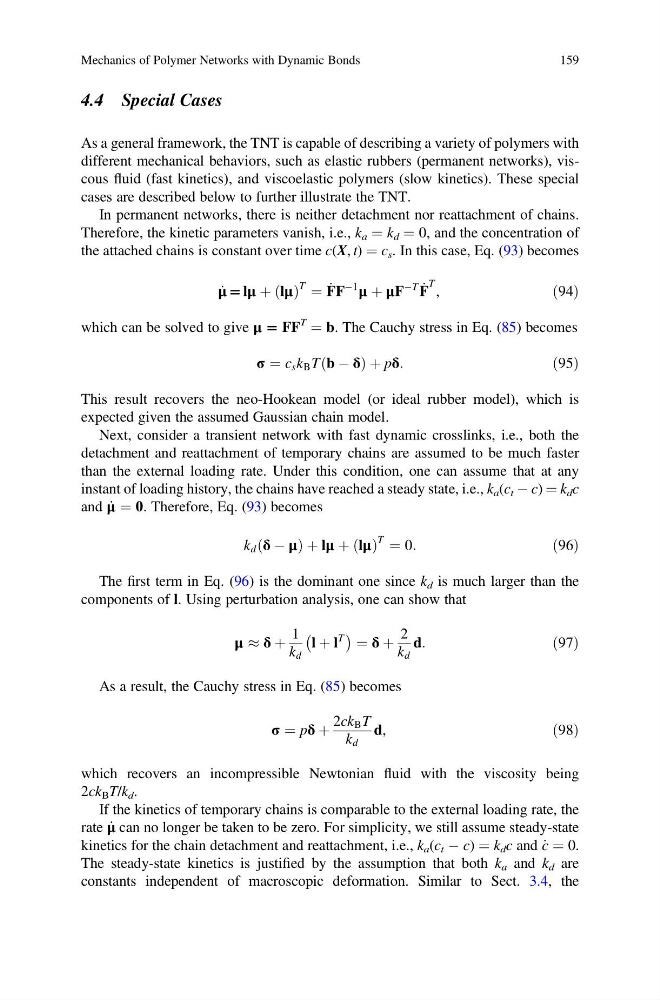
4.4 Special Cases
As a general framework, the TNT is capable of describing a variety of polymers with
different mechanical behaviors, such as elastic rubbers (permanent networks), viscous fluid (fast kinetics), and viscoelastic polymers (slow kinetics). These special
cases are described below to further illustrate the TNT.
In permanent networks, there is neither detachment nor reattachment of chains.
Therefore, the kinetic parameters vanish, i.e., k a ¼ k d ¼ 0, and the concentration of
the attached chains is constant over time c(X, t) ¼ c s . In this case, Eq. (93) becomes
_
μ = lμ þ lμ
ð Þ
T ¼ _
FF
À1
μ þ μF
ÀT _
F
T ,
ð94Þ
which can be solved to give μ = FF
T
¼ b. The Cauchy stress in Eq. (85) becomes
σ ¼ c s k B T b À δ
ð
Þþpδ:
ð95Þ
This result recovers the neo-Hookean model (or ideal rubber model), which is
expected given the assumed Gaussian chain model.
Next, consider a transient network with fast dynamic crosslinks, i.e., both the
detachment and reattachment of temporary chains are assumed to be much faster
than the external loading rate. Under this condition, one can assume that at any
instant of loading history, the chains have reached a steady state, i.e., k a (c t À c) ¼ k d c
and _
μ ¼ 0. Therefore, Eq. (93) becomes
k d δ À μ
ð
Þþlμ þ lμ
ð Þ
T ¼ 0:
ð96Þ
The first term in Eq. (96) is the dominant one since k d is much larger than the
components of l. Using perturbation analysis, one can show that
μ % δ þ
1
k d
l þ l
T
À
Á ¼ δ þ
2
k d
d:
ð97Þ
As a result, the Cauchy stress in Eq. (85) becomes
σ ¼ pδ þ
2ck B T
k d
d,
ð98Þ
which recovers an incompressible Newtonian fluid with the viscosity being
2ck B T/k d .
If the kinetics of temporary chains is comparable to the external loading rate, the
rate _
μ can no longer be taken to be zero. For simplicity, we still assume steady-state
kinetics for the chain detachment and reattachment, i.e., k a (c t À c) ¼ k d c and _
c ¼ 0.
The steady-state kinetics is justified by the assumption that both k a and k d are
constants independent of macroscopic deformation. Similar to Sect. 3.4, the
Mechanics of Polymer Networks with Dynamic Bonds
159
As a general framework, the TNT is capable of describing a variety of polymers with
different mechanical behaviors, such as elastic rubbers (permanent networks), viscous fluid (fast kinetics), and viscoelastic polymers (slow kinetics). These special
cases are described below to further illustrate the TNT.
In permanent networks, there is neither detachment nor reattachment of chains.
Therefore, the kinetic parameters vanish, i.e., k a ¼ k d ¼ 0, and the concentration of
the attached chains is constant over time c(X, t) ¼ c s . In this case, Eq. (93) becomes
_
μ = lμ þ lμ
ð Þ
T ¼ _
FF
À1
μ þ μF
ÀT _
F
T ,
ð94Þ
which can be solved to give μ = FF
T
¼ b. The Cauchy stress in Eq. (85) becomes
σ ¼ c s k B T b À δ
ð
Þþpδ:
ð95Þ
This result recovers the neo-Hookean model (or ideal rubber model), which is
expected given the assumed Gaussian chain model.
Next, consider a transient network with fast dynamic crosslinks, i.e., both the
detachment and reattachment of temporary chains are assumed to be much faster
than the external loading rate. Under this condition, one can assume that at any
instant of loading history, the chains have reached a steady state, i.e., k a (c t À c) ¼ k d c
and _
μ ¼ 0. Therefore, Eq. (93) becomes
k d δ À μ
ð
Þþlμ þ lμ
ð Þ
T ¼ 0:
ð96Þ
The first term in Eq. (96) is the dominant one since k d is much larger than the
components of l. Using perturbation analysis, one can show that
μ % δ þ
1
k d
l þ l
T
À
Á ¼ δ þ
2
k d
d:
ð97Þ
As a result, the Cauchy stress in Eq. (85) becomes
σ ¼ pδ þ
2ck B T
k d
d,
ð98Þ
which recovers an incompressible Newtonian fluid with the viscosity being
2ck B T/k d .
If the kinetics of temporary chains is comparable to the external loading rate, the
rate _
μ can no longer be taken to be zero. For simplicity, we still assume steady-state
kinetics for the chain detachment and reattachment, i.e., k a (c t À c) ¼ k d c and _
c ¼ 0.
The steady-state kinetics is justified by the assumption that both k a and k d are
constants independent of macroscopic deformation. Similar to Sect. 3.4, the
Mechanics of Polymer Networks with Dynamic Bonds
159