

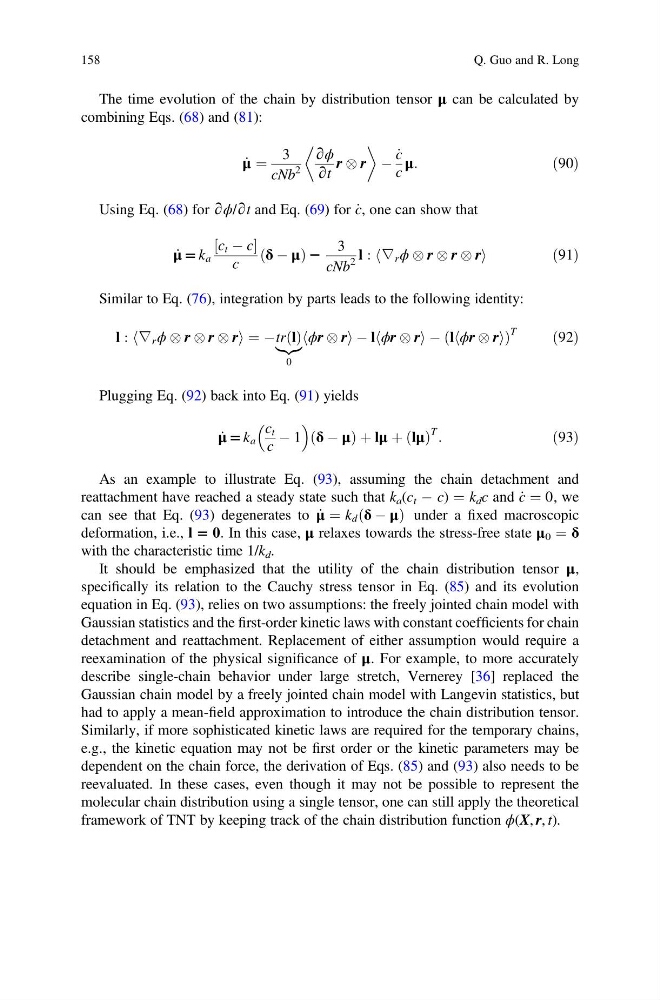
The time evolution of the chain by distribution tensor μ can be calculated by
combining Eqs. (68) and (81):
_
μ ¼
3
cNb
2
∂ϕ
∂t
r r
(
)
À
_
c
c
μ:
ð90Þ
Using Eq. (68) for ∂ϕ/∂t and Eq. (69) for _
c, one can show that
_
μ = k a
c t À c
½
c
δ À μ
ð
Þ2
3
cNb
2
l : ∇ r ϕ r r r
h
i
ð91Þ
Similar to Eq. (76), integration by parts leads to the following identity:
l : ∇ r ϕ r r r
h
i ¼ Àtr l
ð Þ
|{z}
0
ϕr r
h
iÀ l ϕr r
h
iÀ l ϕr r
h
i
ð
Þ
T
ð92Þ
Plugging Eq. (92) back into Eq. (91) yields
_
μ = k a
c t
c
À 1
δ À μ
ð
Þþlμ þ lμ
ð Þ
T :
ð93Þ
As an example to illustrate Eq. (93), assuming the chain detachment and
reattachment have reached a steady state such that k a (c t À c) ¼ k d c and _
c ¼ 0, we
can see that Eq. (93) degenerates to _
μ ¼ k d δ À μ
ð
Þ under a fixed macroscopic
deformation, i.e., l = 0. In this case, μ relaxes towards the stress-free state μ 0 ¼ δ
with the characteristic time 1/k d .
It should be emphasized that the utility of the chain distribution tensor μ,
specifically its relation to the Cauchy stress tensor in Eq. (85) and its evolution
equation in Eq. (93), relies on two assumptions: the freely jointed chain model with
Gaussian statistics and the first-order kinetic laws with constant coefficients for chain
detachment and reattachment. Replacement of either assumption would require a
reexamination of the physical significance of μ. For example, to more accurately
describe single-chain behavior under large stretch, Vernerey [36] replaced the
Gaussian chain model by a freely jointed chain model with Langevin statistics, but
had to apply a mean-field approximation to introduce the chain distribution tensor.
Similarly, if more sophisticated kinetic laws are required for the temporary chains,
e.g., the kinetic equation may not be first order or the kinetic parameters may be
dependent on the chain force, the derivation of Eqs. (85) and (93) also needs to be
reevaluated. In these cases, even though it may not be possible to represent the
molecular chain distribution using a single tensor, one can still apply the theoretical
framework of TNT by keeping track of the chain distribution function ϕ(X, r, t).
158
Q. Guo and R. Long
combining Eqs. (68) and (81):
_
μ ¼
3
cNb
2
∂ϕ
∂t
r r
(
)
À
_
c
c
μ:
ð90Þ
Using Eq. (68) for ∂ϕ/∂t and Eq. (69) for _
c, one can show that
_
μ = k a
c t À c
½
c
δ À μ
ð
Þ2
3
cNb
2
l : ∇ r ϕ r r r
h
i
ð91Þ
Similar to Eq. (76), integration by parts leads to the following identity:
l : ∇ r ϕ r r r
h
i ¼ Àtr l
ð Þ
|{z}
0
ϕr r
h
iÀ l ϕr r
h
iÀ l ϕr r
h
i
ð
Þ
T
ð92Þ
Plugging Eq. (92) back into Eq. (91) yields
_
μ = k a
c t
c
À 1
δ À μ
ð
Þþlμ þ lμ
ð Þ
T :
ð93Þ
As an example to illustrate Eq. (93), assuming the chain detachment and
reattachment have reached a steady state such that k a (c t À c) ¼ k d c and _
c ¼ 0, we
can see that Eq. (93) degenerates to _
μ ¼ k d δ À μ
ð
Þ under a fixed macroscopic
deformation, i.e., l = 0. In this case, μ relaxes towards the stress-free state μ 0 ¼ δ
with the characteristic time 1/k d .
It should be emphasized that the utility of the chain distribution tensor μ,
specifically its relation to the Cauchy stress tensor in Eq. (85) and its evolution
equation in Eq. (93), relies on two assumptions: the freely jointed chain model with
Gaussian statistics and the first-order kinetic laws with constant coefficients for chain
detachment and reattachment. Replacement of either assumption would require a
reexamination of the physical significance of μ. For example, to more accurately
describe single-chain behavior under large stretch, Vernerey [36] replaced the
Gaussian chain model by a freely jointed chain model with Langevin statistics, but
had to apply a mean-field approximation to introduce the chain distribution tensor.
Similarly, if more sophisticated kinetic laws are required for the temporary chains,
e.g., the kinetic equation may not be first order or the kinetic parameters may be
dependent on the chain force, the derivation of Eqs. (85) and (93) also needs to be
reevaluated. In these cases, even though it may not be possible to represent the
molecular chain distribution using a single tensor, one can still apply the theoretical
framework of TNT by keeping track of the chain distribution function ϕ(X, r, t).
158
Q. Guo and R. Long