

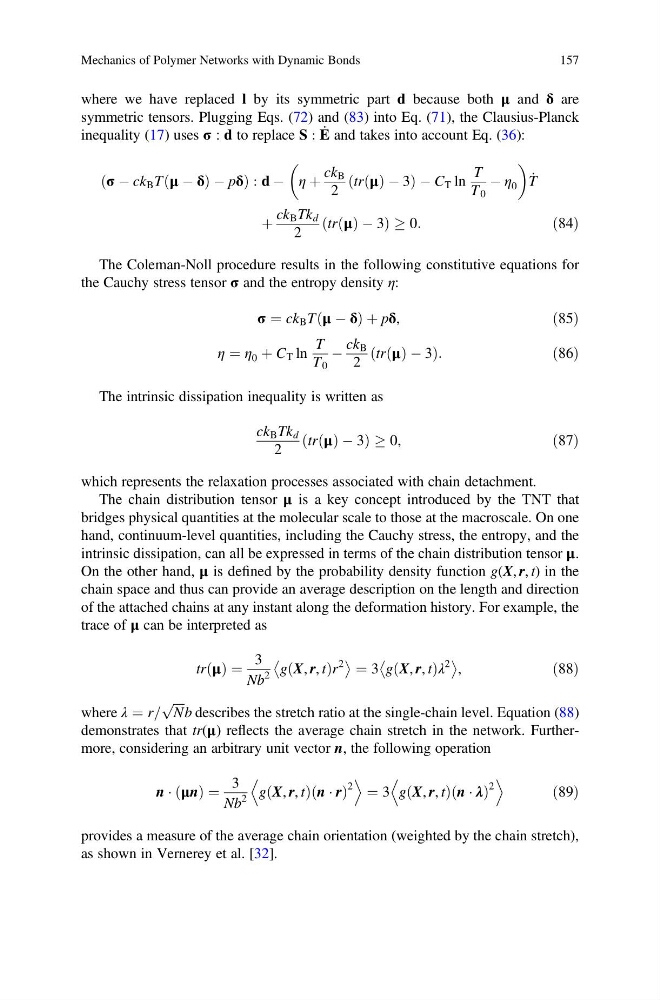
where we have replaced l by its symmetric part d because both μ and δ are
symmetric tensors. Plugging Eqs. (72) and (83) into Eq. (71), the Clausius-Planck
inequality (17) uses σ : d to replace S : _
E and takes into account Eq. (36):
σ À ck B T μ À δ
ð
ÞÀpδ
ð
Þ : d À η þ
ck B
2
tr μ
ð Þ À 3
ð
ÞÀC T ln
T
T 0
À η 0
_
T
þ
ck B Tk d
2
tr μ
ð Þ À 3Þ ! 0:
ð
ð 84Þ
The Coleman-Noll procedure results in the following constitutive equations for
the Cauchy stress tensor σ and the entropy density η:
σ ¼ ck B T μ À δ
ð
Þþpδ,
ð85Þ
η ¼ η 0 þ C T ln
T
T 0
À
ck B
2
tr μ
ð Þ À 3
ð
Þ :
ð86Þ
The intrinsic dissipation inequality is written as
ck B Tk d
2
tr μ
ð Þ À 3
ð
Þ!0,
ð87Þ
which represents the relaxation processes associated with chain detachment.
The chain distribution tensor μ is a key concept introduced by the TNT that
bridges physical quantities at the molecular scale to those at the macroscale. On one
hand, continuum-level quantities, including the Cauchy stress, the entropy, and the
intrinsic dissipation, can all be expressed in terms of the chain distribution tensor μ.
On the other hand, μ is defined by the probability density function g(X, r, t) in the
chain space and thus can provide an average description on the length and direction
of the attached chains at any instant along the deformation history. For example, the
trace of μ can be interpreted as
tr μ
ð Þ ¼
3
Nb
2
g X, r, t
ð
Þr
2
¼ 3 g X, r, t
ð
Þλ
2
,
ð88Þ
where λ ¼ r=
ffiffiffiffi
N
p
b describes the stretch ratio at the single-chain level. Equation (88)
demonstrates that tr(μ) reflects the average chain stretch in the network. Furthermore, considering an arbitrary unit vector n, the following operation
n Á μn
ð Þ ¼
3
Nb
2
g X, r, t
ð
Þ n Á r
ð
Þ
2
D
E
¼ 3 g X, r, t
ð
Þ n Á λ
ð
Þ
2
D
E
ð89Þ
provides a measure of the average chain orientation (weighted by the chain stretch),
as shown in Vernerey et al. [32].
Mechanics of Polymer Networks with Dynamic Bonds
157
symmetric tensors. Plugging Eqs. (72) and (83) into Eq. (71), the Clausius-Planck
inequality (17) uses σ : d to replace S : _
E and takes into account Eq. (36):
σ À ck B T μ À δ
ð
ÞÀpδ
ð
Þ : d À η þ
ck B
2
tr μ
ð Þ À 3
ð
ÞÀC T ln
T
T 0
À η 0
_
T
þ
ck B Tk d
2
tr μ
ð Þ À 3Þ ! 0:
ð
ð 84Þ
The Coleman-Noll procedure results in the following constitutive equations for
the Cauchy stress tensor σ and the entropy density η:
σ ¼ ck B T μ À δ
ð
Þþpδ,
ð85Þ
η ¼ η 0 þ C T ln
T
T 0
À
ck B
2
tr μ
ð Þ À 3
ð
Þ :
ð86Þ
The intrinsic dissipation inequality is written as
ck B Tk d
2
tr μ
ð Þ À 3
ð
Þ!0,
ð87Þ
which represents the relaxation processes associated with chain detachment.
The chain distribution tensor μ is a key concept introduced by the TNT that
bridges physical quantities at the molecular scale to those at the macroscale. On one
hand, continuum-level quantities, including the Cauchy stress, the entropy, and the
intrinsic dissipation, can all be expressed in terms of the chain distribution tensor μ.
On the other hand, μ is defined by the probability density function g(X, r, t) in the
chain space and thus can provide an average description on the length and direction
of the attached chains at any instant along the deformation history. For example, the
trace of μ can be interpreted as
tr μ
ð Þ ¼
3
Nb
2
g X, r, t
ð
Þr
2
¼ 3 g X, r, t
ð
Þλ
2
,
ð88Þ
where λ ¼ r=
ffiffiffiffi
N
p
b describes the stretch ratio at the single-chain level. Equation (88)
demonstrates that tr(μ) reflects the average chain stretch in the network. Furthermore, considering an arbitrary unit vector n, the following operation
n Á μn
ð Þ ¼
3
Nb
2
g X, r, t
ð
Þ n Á r
ð
Þ
2
D
E
¼ 3 g X, r, t
ð
Þ n Á λ
ð
Þ
2
D
E
ð89Þ
provides a measure of the average chain orientation (weighted by the chain stretch),
as shown in Vernerey et al. [32].
Mechanics of Polymer Networks with Dynamic Bonds
157