

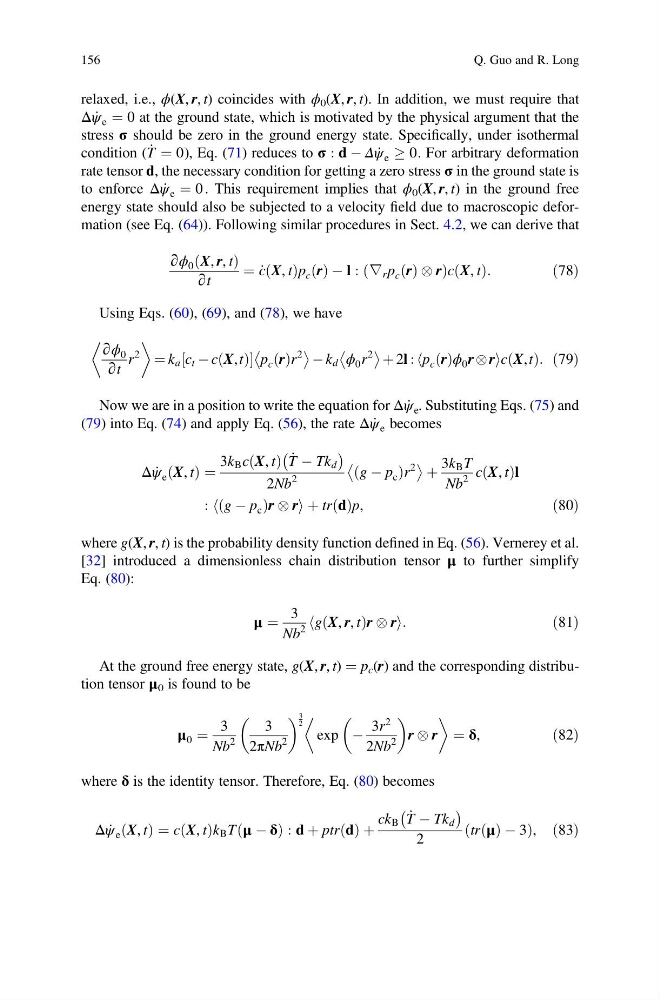
relaxed, i.e., ϕ(X, r, t) coincides with ϕ 0 (X, r, t). In addition, we must require that
Δ _
ψ e ¼ 0 at the ground state, which is motivated by the physical argument that the
stress σ should be zero in the ground energy state. Specifically, under isothermal
condition ( _
T ¼ 0), Eq. (71) reduces to σ : d À Δ _
ψ e ! 0. For arbitrary deformation
rate tensor d, the necessary condition for getting a zero stress σ in the ground state is
to enforce Δ _
ψ e ¼ 0 . This requirement implies that ϕ 0 (X, r, t) in the ground free
energy state should also be subjected to a velocity field due to macroscopic deformation (see Eq. (64)). Following similar procedures in Sect. 4.2, we can derive that
∂ϕ 0 X, r, t
ð
Þ
∂t
¼ _
c X, t
ð Þp c r
ð Þ À l : ∇ r p c r
ð Þ r
ð
Þ c X, t
ð Þ:
ð78Þ
Using Eqs. (60), (69), and (78), we have
∂ϕ 0
∂t
r
2
(
)
¼ k a c t À c X,t
ð Þ
½
p c r
ð Þr
2
À k d ϕ 0 r
2
þ 2l : p c r
ð Þϕ 0 r r
h
i c X,t
ð Þ: ð79Þ
Now we are in a position to write the equation for Δ _
ψ e . Substituting Eqs. (75) and
(79) into Eq. (74) and apply Eq. (56), the rate Δ _
ψ e becomes
Δ _
ψ e X, t
ð Þ ¼
3k B c X, t
ð Þ _
T À Tk d
À
Á
2Nb
2
g À p c
ð
Þr
2
þ
3k B T
Nb
2
c X, t
ð Þl
: g À p c
ð
Þr r
h
i þ tr d
ð Þp,
ð80Þ
where g(X, r, t) is the probability density function defined in Eq. (56). Vernerey et al.
[32] introduced a dimensionless chain distribution tensor μ to further simplify
Eq. (80):
μ ¼
3
Nb
2
g X, r, t
ð
Þr r
h
i :
ð81Þ
At the ground free energy state, g(X, r, t) ¼ p c (r) and the corresponding distribution tensor μ 0 is found to be
μ 0 ¼
3
Nb
2
3
2πNb
2
3
2
exp À
3r
2
2Nb
2
r r
(
)
¼ δ,
ð82Þ
where δ is the identity tensor. Therefore, Eq. (80) becomes
Δ _
ψ e X, t
ð Þ ¼ c X, t
ð Þk B T μ À δ
ð
Þ: d þ ptr d
ð Þ þ
ck B _
T À Tk d
À
Á
2
tr μ
ð Þ À 3
ð
Þ , ð83Þ
156
Q. Guo and R. Long
Δ _
ψ e ¼ 0 at the ground state, which is motivated by the physical argument that the
stress σ should be zero in the ground energy state. Specifically, under isothermal
condition ( _
T ¼ 0), Eq. (71) reduces to σ : d À Δ _
ψ e ! 0. For arbitrary deformation
rate tensor d, the necessary condition for getting a zero stress σ in the ground state is
to enforce Δ _
ψ e ¼ 0 . This requirement implies that ϕ 0 (X, r, t) in the ground free
energy state should also be subjected to a velocity field due to macroscopic deformation (see Eq. (64)). Following similar procedures in Sect. 4.2, we can derive that
∂ϕ 0 X, r, t
ð
Þ
∂t
¼ _
c X, t
ð Þp c r
ð Þ À l : ∇ r p c r
ð Þ r
ð
Þ c X, t
ð Þ:
ð78Þ
Using Eqs. (60), (69), and (78), we have
∂ϕ 0
∂t
r
2
(
)
¼ k a c t À c X,t
ð Þ
½
p c r
ð Þr
2
À k d ϕ 0 r
2
þ 2l : p c r
ð Þϕ 0 r r
h
i c X,t
ð Þ: ð79Þ
Now we are in a position to write the equation for Δ _
ψ e . Substituting Eqs. (75) and
(79) into Eq. (74) and apply Eq. (56), the rate Δ _
ψ e becomes
Δ _
ψ e X, t
ð Þ ¼
3k B c X, t
ð Þ _
T À Tk d
À
Á
2Nb
2
g À p c
ð
Þr
2
þ
3k B T
Nb
2
c X, t
ð Þl
: g À p c
ð
Þr r
h
i þ tr d
ð Þp,
ð80Þ
where g(X, r, t) is the probability density function defined in Eq. (56). Vernerey et al.
[32] introduced a dimensionless chain distribution tensor μ to further simplify
Eq. (80):
μ ¼
3
Nb
2
g X, r, t
ð
Þr r
h
i :
ð81Þ
At the ground free energy state, g(X, r, t) ¼ p c (r) and the corresponding distribution tensor μ 0 is found to be
μ 0 ¼
3
Nb
2
3
2πNb
2
3
2
exp À
3r
2
2Nb
2
r r
(
)
¼ δ,
ð82Þ
where δ is the identity tensor. Therefore, Eq. (80) becomes
Δ _
ψ e X, t
ð Þ ¼ c X, t
ð Þk B T μ À δ
ð
Þ: d þ ptr d
ð Þ þ
ck B _
T À Tk d
À
Á
2
tr μ
ð Þ À 3
ð
Þ , ð83Þ
156
Q. Guo and R. Long