

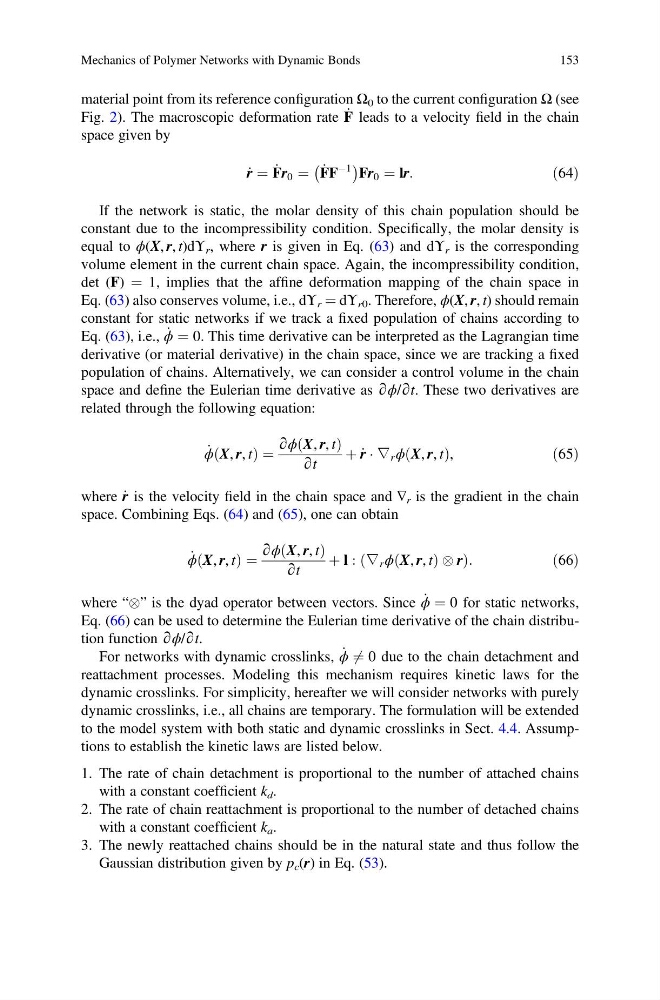
material point from its reference configuration Ω 0 to the current configuration Ω (see
Fig. 2). The macroscopic deformation rate _
F leads to a velocity field in the chain
space given by
_
r ¼ _
Fr 0 ¼ _
FF
À1
À
Á
Fr 0 ¼ lr:
ð64Þ
If the network is static, the molar density of this chain population should be
constant due to the incompressibility condition. Specifically, the molar density is
equal to ϕ(X, r, t)dΥ r , where r is given in Eq. (63) and dΥ r is the corresponding
volume element in the current chain space. Again, the incompressibility condition,
det (F) ¼ 1, implies that the affine deformation mapping of the chain space in
Eq. (63) also conserves volume, i.e., dΥ r ¼ dΥ r0 . Therefore, ϕ(X, r, t) should remain
constant for static networks if we track a fixed population of chains according to
Eq. (63), i.e., _
ϕ ¼ 0. This time derivative can be interpreted as the Lagrangian time
derivative (or material derivative) in the chain space, since we are tracking a fixed
population of chains. Alternatively, we can consider a control volume in the chain
space and define the Eulerian time derivative as ∂ϕ/∂t. These two derivatives are
related through the following equation:
_
ϕ X, r, t
ð
Þ¼
∂ϕ X, r, t
ð
Þ
∂t
þ _
r Á ∇ r ϕ X, r, t
ð
Þ,
ð65Þ
where _
r is the velocity field in the chain space and ∇ r is the gradient in the chain
space. Combining Eqs. (64) and (65), one can obtain
_
ϕ X, r, t
ð
Þ¼
∂ϕ X, r, t
ð
Þ
∂t
þ l : ∇ r ϕ X, r, t
ð
Þr
ð
Þ :
ð66Þ
where “” is the dyad operator between vectors. Since _
ϕ ¼ 0 for static networks,
Eq. (66) can be used to determine the Eulerian time derivative of the chain distribution function ∂ϕ/∂t.
For networks with dynamic crosslinks, _
ϕ 6 ¼ 0 due to the chain detachment and
reattachment processes. Modeling this mechanism requires kinetic laws for the
dynamic crosslinks. For simplicity, hereafter we will consider networks with purely
dynamic crosslinks, i.e., all chains are temporary. The formulation will be extended
to the model system with both static and dynamic crosslinks in Sect. 4.4. Assumptions to establish the kinetic laws are listed below.
1. The rate of chain detachment is proportional to the number of attached chains
with a constant coefficient k d .
2. The rate of chain reattachment is proportional to the number of detached chains
with a constant coefficient k a .
3. The newly reattached chains should be in the natural state and thus follow the
Gaussian distribution given by p c (r) in Eq. (53).
Mechanics of Polymer Networks with Dynamic Bonds
153
Fig. 2). The macroscopic deformation rate _
F leads to a velocity field in the chain
space given by
_
r ¼ _
Fr 0 ¼ _
FF
À1
À
Á
Fr 0 ¼ lr:
ð64Þ
If the network is static, the molar density of this chain population should be
constant due to the incompressibility condition. Specifically, the molar density is
equal to ϕ(X, r, t)dΥ r , where r is given in Eq. (63) and dΥ r is the corresponding
volume element in the current chain space. Again, the incompressibility condition,
det (F) ¼ 1, implies that the affine deformation mapping of the chain space in
Eq. (63) also conserves volume, i.e., dΥ r ¼ dΥ r0 . Therefore, ϕ(X, r, t) should remain
constant for static networks if we track a fixed population of chains according to
Eq. (63), i.e., _
ϕ ¼ 0. This time derivative can be interpreted as the Lagrangian time
derivative (or material derivative) in the chain space, since we are tracking a fixed
population of chains. Alternatively, we can consider a control volume in the chain
space and define the Eulerian time derivative as ∂ϕ/∂t. These two derivatives are
related through the following equation:
_
ϕ X, r, t
ð
Þ¼
∂ϕ X, r, t
ð
Þ
∂t
þ _
r Á ∇ r ϕ X, r, t
ð
Þ,
ð65Þ
where _
r is the velocity field in the chain space and ∇ r is the gradient in the chain
space. Combining Eqs. (64) and (65), one can obtain
_
ϕ X, r, t
ð
Þ¼
∂ϕ X, r, t
ð
Þ
∂t
þ l : ∇ r ϕ X, r, t
ð
Þr
ð
Þ :
ð66Þ
where “” is the dyad operator between vectors. Since _
ϕ ¼ 0 for static networks,
Eq. (66) can be used to determine the Eulerian time derivative of the chain distribution function ∂ϕ/∂t.
For networks with dynamic crosslinks, _
ϕ 6 ¼ 0 due to the chain detachment and
reattachment processes. Modeling this mechanism requires kinetic laws for the
dynamic crosslinks. For simplicity, hereafter we will consider networks with purely
dynamic crosslinks, i.e., all chains are temporary. The formulation will be extended
to the model system with both static and dynamic crosslinks in Sect. 4.4. Assumptions to establish the kinetic laws are listed below.
1. The rate of chain detachment is proportional to the number of attached chains
with a constant coefficient k d .
2. The rate of chain reattachment is proportional to the number of detached chains
with a constant coefficient k a .
3. The newly reattached chains should be in the natural state and thus follow the
Gaussian distribution given by p c (r) in Eq. (53).
Mechanics of Polymer Networks with Dynamic Bonds
153