

The simple first-order kinetic laws are adopted here to simplify the derivations.
The TNT can also accommodate more sophisticated kinetic laws such as that in
Eq. (30) of the MDT, but it would involve more complicated mathematical formulations and is not included here. Using these kinetic assumptions and the
incompressibility condition, we can write
_
ϕ X, r, t
ð
Þ¼k a c t À c X, t
ð Þ
½
p c r
ð Þ À k d ϕ X, r, t
ð
Þ,
ð67Þ
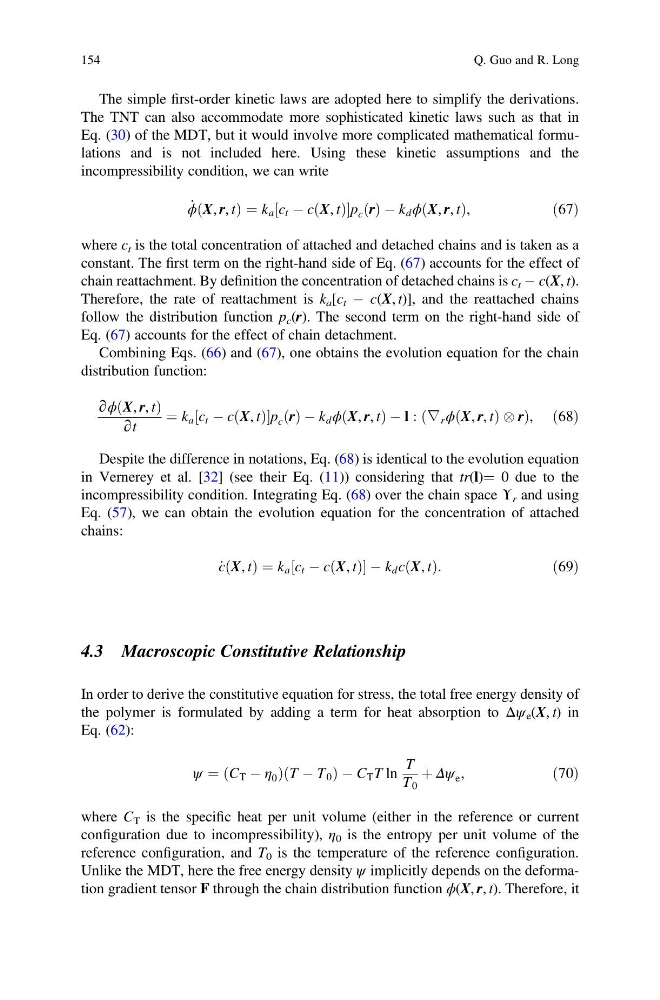
where c t is the total concentration of attached and detached chains and is taken as a
constant. The first term on the right-hand side of Eq. (67) accounts for the effect of
chain reattachment. By definition the concentration of detached chains is c t À c(X, t).
Therefore, the rate of reattachment is k a [c t À c(X, t)], and the reattached chains
follow the distribution function p c (r). The second term on the right-hand side of
Eq. (67) accounts for the effect of chain detachment.
Combining Eqs. (66) and (67), one obtains the evolution equation for the chain
distribution function:
∂ϕ X, r, t
ð
Þ
∂t
¼ k a c t À c X, t
ð Þ
½
p c r
ð Þ À k d ϕ X, r, t
ð
ÞÀl : ∇ r ϕ X, r, t
ð
Þr
ð
Þ , ð68Þ
Despite the difference in notations, Eq. (68) is identical to the evolution equation
in Vernerey et al. [32] (see their Eq. (11)) considering that tr(l)¼ 0 due to the
incompressibility condition. Integrating Eq. (68) over the chain space Υ r and using
Eq. (57), we can obtain the evolution equation for the concentration of attached
chains:
_
c X, t
ð Þ ¼ k a c t À c X, t
ð Þ
½
Àk d c X, t
ð Þ:
ð69Þ
4.3 Macroscopic Constitutive Relationship
In order to derive the constitutive equation for stress, the total free energy density of
the polymer is formulated by adding a term for heat absorption to Δψ e (X, t) in
Eq. (62):
ψ ¼ C T À η 0
ð
ÞT À T 0
ð
ÞÀC T T ln
T
T 0
þ Δψ e ,
ð70Þ
where C T is the specific heat per unit volume (either in the reference or current
configuration due to incompressibility), η 0 is the entropy per unit volume of the
reference configuration, and T 0 is the temperature of the reference configuration.
Unlike the MDT, here the free energy density ψ implicitly depends on the deformation gradient tensor F through the chain distribution function ϕ(X, r, t). Therefore, it
154
Q. Guo and R. Long
The TNT can also accommodate more sophisticated kinetic laws such as that in
Eq. (30) of the MDT, but it would involve more complicated mathematical formulations and is not included here. Using these kinetic assumptions and the
incompressibility condition, we can write
_
ϕ X, r, t
ð
Þ¼k a c t À c X, t
ð Þ
½
p c r
ð Þ À k d ϕ X, r, t
ð
Þ,
ð67Þ
where c t is the total concentration of attached and detached chains and is taken as a
constant. The first term on the right-hand side of Eq. (67) accounts for the effect of
chain reattachment. By definition the concentration of detached chains is c t À c(X, t).
Therefore, the rate of reattachment is k a [c t À c(X, t)], and the reattached chains
follow the distribution function p c (r). The second term on the right-hand side of
Eq. (67) accounts for the effect of chain detachment.
Combining Eqs. (66) and (67), one obtains the evolution equation for the chain
distribution function:
∂ϕ X, r, t
ð
Þ
∂t
¼ k a c t À c X, t
ð Þ
½
p c r
ð Þ À k d ϕ X, r, t
ð
ÞÀl : ∇ r ϕ X, r, t
ð
Þr
ð
Þ , ð68Þ
Despite the difference in notations, Eq. (68) is identical to the evolution equation
in Vernerey et al. [32] (see their Eq. (11)) considering that tr(l)¼ 0 due to the
incompressibility condition. Integrating Eq. (68) over the chain space Υ r and using
Eq. (57), we can obtain the evolution equation for the concentration of attached
chains:
_
c X, t
ð Þ ¼ k a c t À c X, t
ð Þ
½
Àk d c X, t
ð Þ:
ð69Þ
4.3 Macroscopic Constitutive Relationship
In order to derive the constitutive equation for stress, the total free energy density of
the polymer is formulated by adding a term for heat absorption to Δψ e (X, t) in
Eq. (62):
ψ ¼ C T À η 0
ð
ÞT À T 0
ð
ÞÀC T T ln
T
T 0
þ Δψ e ,
ð70Þ
where C T is the specific heat per unit volume (either in the reference or current
configuration due to incompressibility), η 0 is the entropy per unit volume of the
reference configuration, and T 0 is the temperature of the reference configuration.
Unlike the MDT, here the free energy density ψ implicitly depends on the deformation gradient tensor F through the chain distribution function ϕ(X, r, t). Therefore, it
154
Q. Guo and R. Long