

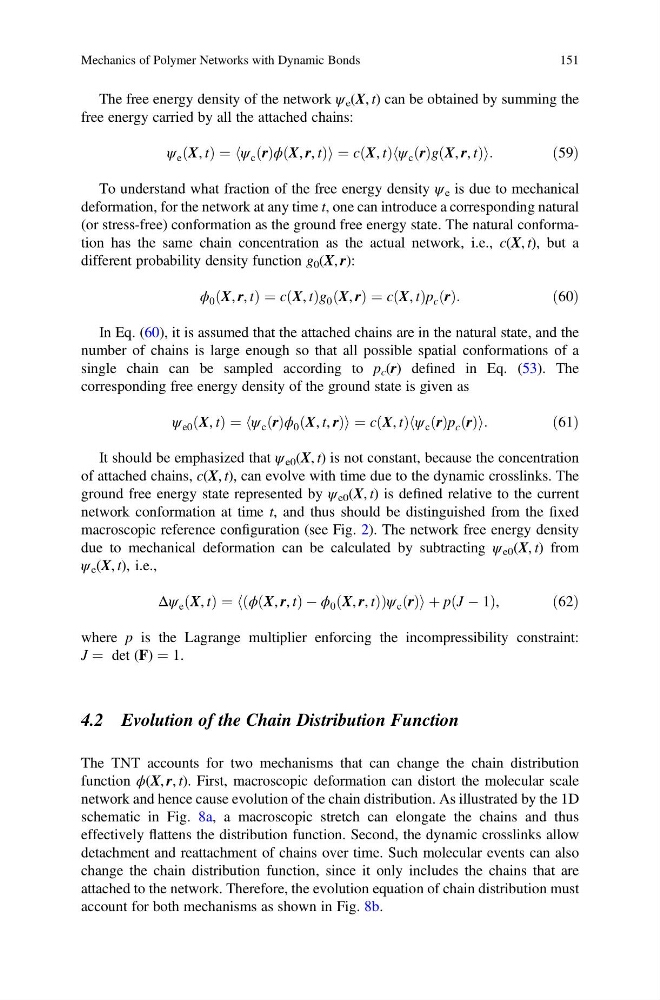
The free energy density of the network ψ e (X, t) can be obtained by summing the
free energy carried by all the attached chains:
ψ e X, t
ð Þ ¼ ψ c r
ð Þϕ X, r, t
ð
Þ
h
i ¼ c X, t
ð Þ ψ c r
ð Þg X, r, t
ð
Þ
h
i :
ð59Þ
To understand what fraction of the free energy density ψ e is due to mechanical
deformation, for the network at any time t, one can introduce a corresponding natural
(or stress-free) conformation as the ground free energy state. The natural conformation has the same chain concentration as the actual network, i.e., c(X, t), but a
different probability density function g 0 (X, r):
ϕ 0 X, r, t
ð
Þ¼c X, t
ð Þg 0 X, r
ð Þ ¼ c X, t
ð Þp c r
ð Þ:
ð60Þ
In Eq. (60), it is assumed that the attached chains are in the natural state, and the
number of chains is large enough so that all possible spatial conformations of a
single chain can be sampled according to p c (r) defined in Eq. (53). The
corresponding free energy density of the ground state is given as
ψ e0 X, t
ð Þ ¼ ψ c r
ð Þϕ 0 X, t, r
ð
Þ
h
i ¼ c X, t
ð Þ ψ c r
ð Þp c r
ð Þ
h
i :
ð61Þ
It should be emphasized that ψ e0 (X, t) is not constant, because the concentration
of attached chains, c(X, t), can evolve with time due to the dynamic crosslinks. The
ground free energy state represented by ψ e0 (X, t) is defined relative to the current
network conformation at time t, and thus should be distinguished from the fixed
macroscopic reference configuration (see Fig. 2). The network free energy density
due to mechanical deformation can be calculated by subtracting ψ e0 (X, t) from
ψ e (X, t), i.e.,
Δψ e X, t
ð Þ ¼ ϕ X, r, t
ð
ÞÀϕ 0 X, r, t
ð
Þ
ð
Þ ψ c r
ð Þ
h
i þ p J À 1
ð
Þ,
ð62Þ
where p is the Lagrange multiplier enforcing the incompressibility constraint:
J ¼ det (F) ¼ 1.
4.2 Evolution of the Chain Distribution Function
The TNT accounts for two mechanisms that can change the chain distribution
function ϕ(X, r, t). First, macroscopic deformation can distort the molecular scale
network and hence cause evolution of the chain distribution. As illustrated by the 1D
schematic in Fig. 8a, a macroscopic stretch can elongate the chains and thus
effectively flattens the distribution function. Second, the dynamic crosslinks allow
detachment and reattachment of chains over time. Such molecular events can also
change the chain distribution function, since it only includes the chains that are
attached to the network. Therefore, the evolution equation of chain distribution must
account for both mechanisms as shown in Fig. 8b.
Mechanics of Polymer Networks with Dynamic Bonds
151
free energy carried by all the attached chains:
ψ e X, t
ð Þ ¼ ψ c r
ð Þϕ X, r, t
ð
Þ
h
i ¼ c X, t
ð Þ ψ c r
ð Þg X, r, t
ð
Þ
h
i :
ð59Þ
To understand what fraction of the free energy density ψ e is due to mechanical
deformation, for the network at any time t, one can introduce a corresponding natural
(or stress-free) conformation as the ground free energy state. The natural conformation has the same chain concentration as the actual network, i.e., c(X, t), but a
different probability density function g 0 (X, r):
ϕ 0 X, r, t
ð
Þ¼c X, t
ð Þg 0 X, r
ð Þ ¼ c X, t
ð Þp c r
ð Þ:
ð60Þ
In Eq. (60), it is assumed that the attached chains are in the natural state, and the
number of chains is large enough so that all possible spatial conformations of a
single chain can be sampled according to p c (r) defined in Eq. (53). The
corresponding free energy density of the ground state is given as
ψ e0 X, t
ð Þ ¼ ψ c r
ð Þϕ 0 X, t, r
ð
Þ
h
i ¼ c X, t
ð Þ ψ c r
ð Þp c r
ð Þ
h
i :
ð61Þ
It should be emphasized that ψ e0 (X, t) is not constant, because the concentration
of attached chains, c(X, t), can evolve with time due to the dynamic crosslinks. The
ground free energy state represented by ψ e0 (X, t) is defined relative to the current
network conformation at time t, and thus should be distinguished from the fixed
macroscopic reference configuration (see Fig. 2). The network free energy density
due to mechanical deformation can be calculated by subtracting ψ e0 (X, t) from
ψ e (X, t), i.e.,
Δψ e X, t
ð Þ ¼ ϕ X, r, t
ð
ÞÀϕ 0 X, r, t
ð
Þ
ð
Þ ψ c r
ð Þ
h
i þ p J À 1
ð
Þ,
ð62Þ
where p is the Lagrange multiplier enforcing the incompressibility constraint:
J ¼ det (F) ¼ 1.
4.2 Evolution of the Chain Distribution Function
The TNT accounts for two mechanisms that can change the chain distribution
function ϕ(X, r, t). First, macroscopic deformation can distort the molecular scale
network and hence cause evolution of the chain distribution. As illustrated by the 1D
schematic in Fig. 8a, a macroscopic stretch can elongate the chains and thus
effectively flattens the distribution function. Second, the dynamic crosslinks allow
detachment and reattachment of chains over time. Such molecular events can also
change the chain distribution function, since it only includes the chains that are
attached to the network. Therefore, the evolution equation of chain distribution must
account for both mechanisms as shown in Fig. 8b.
Mechanics of Polymer Networks with Dynamic Bonds
151