

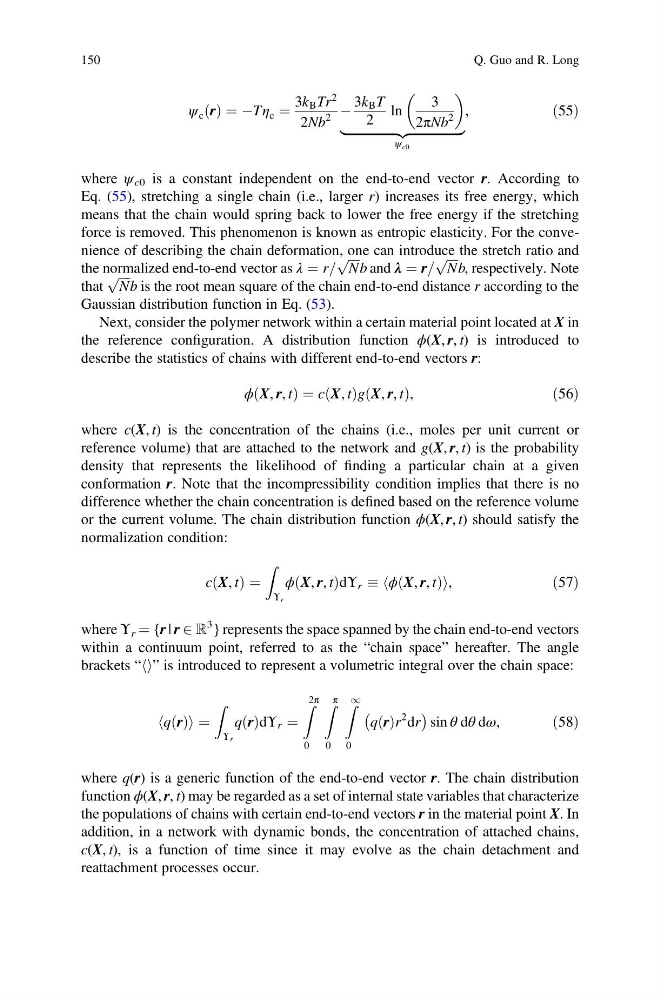
ψ c r
ð Þ ¼ ÀTη c ¼
3k B Tr
2
2Nb
2
À
3k B T
2
ln
3
2πNb
2
|fflfflfflfflfflfflfflfflfflfflfflfflfflfflfflffl{zfflfflfflfflfflfflfflfflfflfflfflfflfflfflfflffl}
ψ c0
,
ð55Þ
where ψ c0 is a constant independent on the end-to-end vector r. According to
Eq. (55), stretching a single chain (i.e., larger r) increases its free energy, which
means that the chain would spring back to lower the free energy if the stretching
force is removed. This phenomenon is known as entropic elasticity. For the convenience of describing the chain deformation, one can introduce the stretch ratio and
the normalized end-to-end vector as λ ¼ r=
ffiffiffiffi
N
p
b and λ ¼ r=
ffiffiffiffi
N
p
b, respectively. Note
that
ffiffiffiffi
N
p
b is the root mean square of the chain end-to-end distance r according to the
Gaussian distribution function in Eq. (53).
Next, consider the polymer network within a certain material point located at X in
the reference configuration. A distribution function ϕ(X, r, t) is introduced to
describe the statistics of chains with different end-to-end vectors r:
ϕ X, r, t
ð
Þ¼c X, t
ð Þg X, r, t
ð
Þ,
ð56Þ
where c(X, t) is the concentration of the chains (i.e., moles per unit current or
reference volume) that are attached to the network and g(X, r, t) is the probability
density that represents the likelihood of finding a particular chain at a given
conformation r. Note that the incompressibility condition implies that there is no
difference whether the chain concentration is defined based on the reference volume
or the current volume. The chain distribution function ϕ(X, r, t) should satisfy the
normalization condition:
c X, t
ð Þ ¼
Z
Υ r
ϕ X, r, t
ð
ÞdΥ r ϕ X, r, t
ð
Þ
h
i ,
ð57Þ
where Υ r ¼ {r | r 2 ℝ
3 } represents the space spanned by the chain end-to-end vectors
within a continuum point, referred to as the “chain space” hereafter. The angle
brackets “hi” is introduced to represent a volumetric integral over the chain space:
q r
ð Þ
h
i ¼
Z
Υ r
q r
ð ÞdΥ r ¼
Z 2π
0
Z π
0
Z 1
0
q r
ð Þr
2 dr
À
Á
sin θ dθ dω,
ð58Þ
where q(r) is a generic function of the end-to-end vector r. The chain distribution
function ϕ(X, r, t) may be regarded as a set of internal state variables that characterize
the populations of chains with certain end-to-end vectors r in the material point X. In
addition, in a network with dynamic bonds, the concentration of attached chains,
c(X, t), is a function of time since it may evolve as the chain detachment and
reattachment processes occur.
150
Q. Guo and R. Long
ð Þ ¼ ÀTη c ¼
3k B Tr
2
2Nb
2
À
3k B T
2
ln
3
2πNb
2
|fflfflfflfflfflfflfflfflfflfflfflfflfflfflfflffl{zfflfflfflfflfflfflfflfflfflfflfflfflfflfflfflffl}
ψ c0
,
ð55Þ
where ψ c0 is a constant independent on the end-to-end vector r. According to
Eq. (55), stretching a single chain (i.e., larger r) increases its free energy, which
means that the chain would spring back to lower the free energy if the stretching
force is removed. This phenomenon is known as entropic elasticity. For the convenience of describing the chain deformation, one can introduce the stretch ratio and
the normalized end-to-end vector as λ ¼ r=
ffiffiffiffi
N
p
b and λ ¼ r=
ffiffiffiffi
N
p
b, respectively. Note
that
ffiffiffiffi
N
p
b is the root mean square of the chain end-to-end distance r according to the
Gaussian distribution function in Eq. (53).
Next, consider the polymer network within a certain material point located at X in
the reference configuration. A distribution function ϕ(X, r, t) is introduced to
describe the statistics of chains with different end-to-end vectors r:
ϕ X, r, t
ð
Þ¼c X, t
ð Þg X, r, t
ð
Þ,
ð56Þ
where c(X, t) is the concentration of the chains (i.e., moles per unit current or
reference volume) that are attached to the network and g(X, r, t) is the probability
density that represents the likelihood of finding a particular chain at a given
conformation r. Note that the incompressibility condition implies that there is no
difference whether the chain concentration is defined based on the reference volume
or the current volume. The chain distribution function ϕ(X, r, t) should satisfy the
normalization condition:
c X, t
ð Þ ¼
Z
Υ r
ϕ X, r, t
ð
ÞdΥ r ϕ X, r, t
ð
Þ
h
i ,
ð57Þ
where Υ r ¼ {r | r 2 ℝ
3 } represents the space spanned by the chain end-to-end vectors
within a continuum point, referred to as the “chain space” hereafter. The angle
brackets “hi” is introduced to represent a volumetric integral over the chain space:
q r
ð Þ
h
i ¼
Z
Υ r
q r
ð ÞdΥ r ¼
Z 2π
0
Z π
0
Z 1
0
q r
ð Þr
2 dr
À
Á
sin θ dθ dω,
ð58Þ
where q(r) is a generic function of the end-to-end vector r. The chain distribution
function ϕ(X, r, t) may be regarded as a set of internal state variables that characterize
the populations of chains with certain end-to-end vectors r in the material point X. In
addition, in a network with dynamic bonds, the concentration of attached chains,
c(X, t), is a function of time since it may evolve as the chain detachment and
reattachment processes occur.
150
Q. Guo and R. Long