

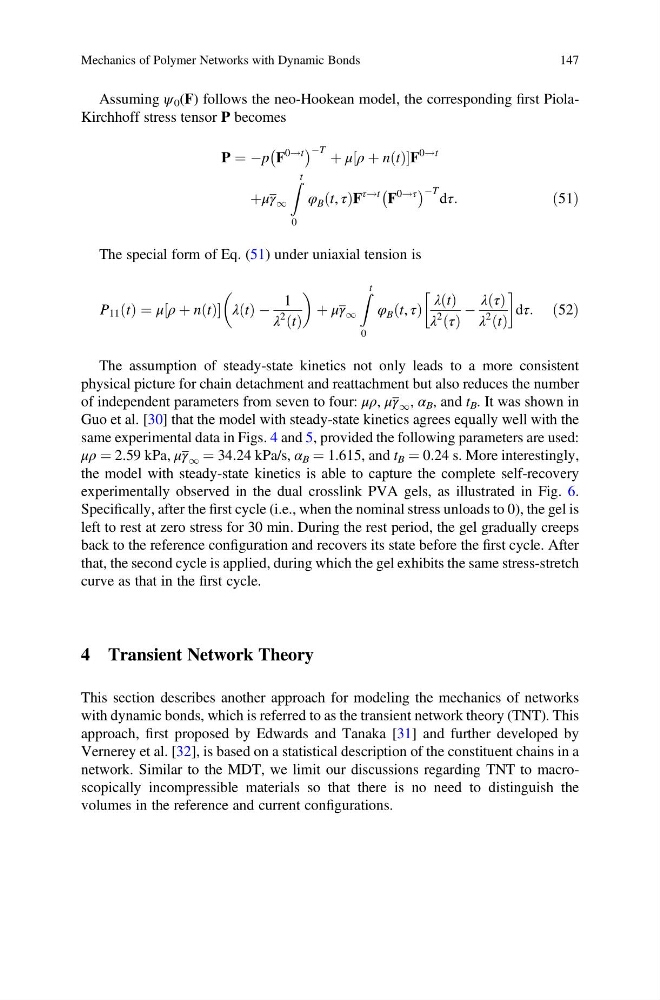
Assuming ψ 0 (F) follows the neo-Hookean model, the corresponding first PiolaKirchhoff stress tensor P becomes
P ¼ Àp F
0!t
À
Á ÀT þ μ ρ þ n t
ð Þ
½
F
0!t
þμγ 1
Z t
0
φ B t, τ
ð ÞF
τ!t F
0!τ
À
Á ÀT dτ:
ð51Þ
The special form of Eq. (51) under uniaxial tension is
P 11 t
ð Þ ¼ μ ρ þ n t
ð Þ
½
λ t
ð Þ À
1
λ
2 t
ð Þ
þ μγ 1
Z t
0
φ B t, τ
ð Þ
λ t
ð Þ
λ
2
τ
ð Þ
À
λ τ
ð Þ
λ
2 t
ð Þ
!
dτ: ð52Þ
The assumption of steady-state kinetics not only leads to a more consistent
physical picture for chain detachment and reattachment but also reduces the number
of independent parameters from seven to four: μρ, μγ 1 , α B , and t B . It was shown in
Guo et al. [30] that the model with steady-state kinetics agrees equally well with the
same experimental data in Figs. 4 and 5, provided the following parameters are used:
μρ ¼ 2.59 kPa, μγ 1 ¼ 34.24 kPa/s, α B ¼ 1.615, and t B ¼ 0.24 s. More interestingly,
the model with steady-state kinetics is able to capture the complete self-recovery
experimentally observed in the dual crosslink PVA gels, as illustrated in Fig. 6.
Specifically, after the first cycle (i.e., when the nominal stress unloads to 0), the gel is
left to rest at zero stress for 30 min. During the rest period, the gel gradually creeps
back to the reference configuration and recovers its state before the first cycle. After
that, the second cycle is applied, during which the gel exhibits the same stress-stretch
curve as that in the first cycle.
4 Transient Network Theory
This section describes another approach for modeling the mechanics of networks
with dynamic bonds, which is referred to as the transient network theory (TNT). This
approach, first proposed by Edwards and Tanaka [31] and further developed by
Vernerey et al. [32], is based on a statistical description of the constituent chains in a
network. Similar to the MDT, we limit our discussions regarding TNT to macroscopically incompressible materials so that there is no need to distinguish the
volumes in the reference and current configurations.
Mechanics of Polymer Networks with Dynamic Bonds
147
P ¼ Àp F
0!t
À
Á ÀT þ μ ρ þ n t
ð Þ
½
F
0!t
þμγ 1
Z t
0
φ B t, τ
ð ÞF
τ!t F
0!τ
À
Á ÀT dτ:
ð51Þ
The special form of Eq. (51) under uniaxial tension is
P 11 t
ð Þ ¼ μ ρ þ n t
ð Þ
½
λ t
ð Þ À
1
λ
2 t
ð Þ
þ μγ 1
Z t
0
φ B t, τ
ð Þ
λ t
ð Þ
λ
2
τ
ð Þ
À
λ τ
ð Þ
λ
2 t
ð Þ
!
dτ: ð52Þ
The assumption of steady-state kinetics not only leads to a more consistent
physical picture for chain detachment and reattachment but also reduces the number
of independent parameters from seven to four: μρ, μγ 1 , α B , and t B . It was shown in
Guo et al. [30] that the model with steady-state kinetics agrees equally well with the
same experimental data in Figs. 4 and 5, provided the following parameters are used:
μρ ¼ 2.59 kPa, μγ 1 ¼ 34.24 kPa/s, α B ¼ 1.615, and t B ¼ 0.24 s. More interestingly,
the model with steady-state kinetics is able to capture the complete self-recovery
experimentally observed in the dual crosslink PVA gels, as illustrated in Fig. 6.
Specifically, after the first cycle (i.e., when the nominal stress unloads to 0), the gel is
left to rest at zero stress for 30 min. During the rest period, the gel gradually creeps
back to the reference configuration and recovers its state before the first cycle. After
that, the second cycle is applied, during which the gel exhibits the same stress-stretch
curve as that in the first cycle.
4 Transient Network Theory
This section describes another approach for modeling the mechanics of networks
with dynamic bonds, which is referred to as the transient network theory (TNT). This
approach, first proposed by Edwards and Tanaka [31] and further developed by
Vernerey et al. [32], is based on a statistical description of the constituent chains in a
network. Similar to the MDT, we limit our discussions regarding TNT to macroscopically incompressible materials so that there is no need to distinguish the
volumes in the reference and current configurations.
Mechanics of Polymer Networks with Dynamic Bonds
147