

4.1 Statistical Description of Polymer Network
The TNT treats the mechanical response of polymeric materials as a macroscopic
average of changes in molecular conformations
2 of the polymer network within
every material point (see Fig. 7a). An amorphous polymer network consists of a
large number of crosslinked chains which may have different stretches and span all
possible directions. As a result, a statistical framework is required to formulate the
relationship between the molecular conformations of the network and the macroscopic mechanical behavior.
In this context, let us first consider a single polymer chain. Owing to constant
oscillations induced by thermal fluctuation, there exist a huge number of possible
chain conformations due to the rotation of molecular bonds on the chain. Following
Wang and Guth [10], the freely jointed chain model is adopted here to characterize
the statistics of the chain conformations. In this model, the chain is considered to be
composed of a series of segments jointed with complete freedom of rotation. The
spatial conformation of the chain can be identified by the end-to-end vector r
characterizing both the chain direction (represented by the angles θ and ω in
spherical coordinates) and the magnitude r ¼ |r| (or end-to-end distance), as illustrated in Fig. 7b. Assuming that the end-to-end distance of the chain is much smaller
than its contour length, the Gaussian statistical method is applied to yield the
following distribution law of the chain conformations [1]:
2 Note that the term “conformation” refers to the spatial state of a polymer chain, while “configuration” refers to the macroscopic deformation state of a network.
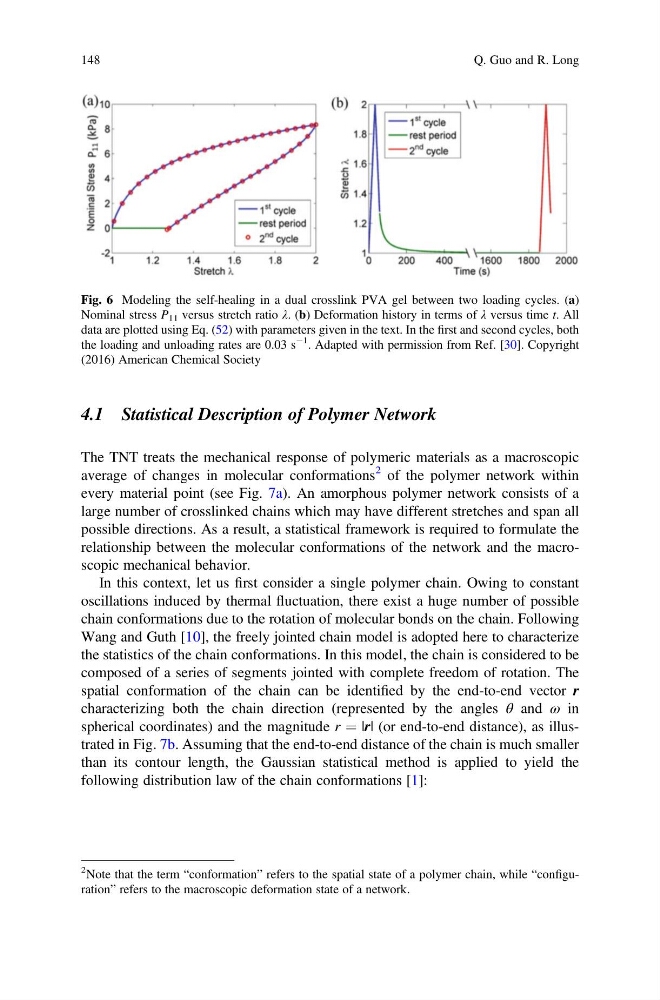
Fig. 6 Modeling the self-healing in a dual crosslink PVA gel between two loading cycles. (a)
Nominal stress P 11 versus stretch ratio λ. (b) Deformation history in terms of λ versus time t. All
data are plotted using Eq. (52) with parameters given in the text. In the first and second cycles, both
the loading and unloading rates are 0.03 s
À1
. Adapted with permission from Ref. [30]. Copyright
(2016) American Chemical Society
148
Q. Guo and R. Long
The TNT treats the mechanical response of polymeric materials as a macroscopic
average of changes in molecular conformations
2 of the polymer network within
every material point (see Fig. 7a). An amorphous polymer network consists of a
large number of crosslinked chains which may have different stretches and span all
possible directions. As a result, a statistical framework is required to formulate the
relationship between the molecular conformations of the network and the macroscopic mechanical behavior.
In this context, let us first consider a single polymer chain. Owing to constant
oscillations induced by thermal fluctuation, there exist a huge number of possible
chain conformations due to the rotation of molecular bonds on the chain. Following
Wang and Guth [10], the freely jointed chain model is adopted here to characterize
the statistics of the chain conformations. In this model, the chain is considered to be
composed of a series of segments jointed with complete freedom of rotation. The
spatial conformation of the chain can be identified by the end-to-end vector r
characterizing both the chain direction (represented by the angles θ and ω in
spherical coordinates) and the magnitude r ¼ |r| (or end-to-end distance), as illustrated in Fig. 7b. Assuming that the end-to-end distance of the chain is much smaller
than its contour length, the Gaussian statistical method is applied to yield the
following distribution law of the chain conformations [1]:
2 Note that the term “conformation” refers to the spatial state of a polymer chain, while “configuration” refers to the macroscopic deformation state of a network.
Fig. 6 Modeling the self-healing in a dual crosslink PVA gel between two loading cycles. (a)
Nominal stress P 11 versus stretch ratio λ. (b) Deformation history in terms of λ versus time t. All
data are plotted using Eq. (52) with parameters given in the text. In the first and second cycles, both
the loading and unloading rates are 0.03 s
À1
. Adapted with permission from Ref. [30]. Copyright
(2016) American Chemical Society
148
Q. Guo and R. Long