

assumption that the chain kinetics is independent of macroscopic deformation or
stress is retained. More importantly, it is assumed that after a transient period
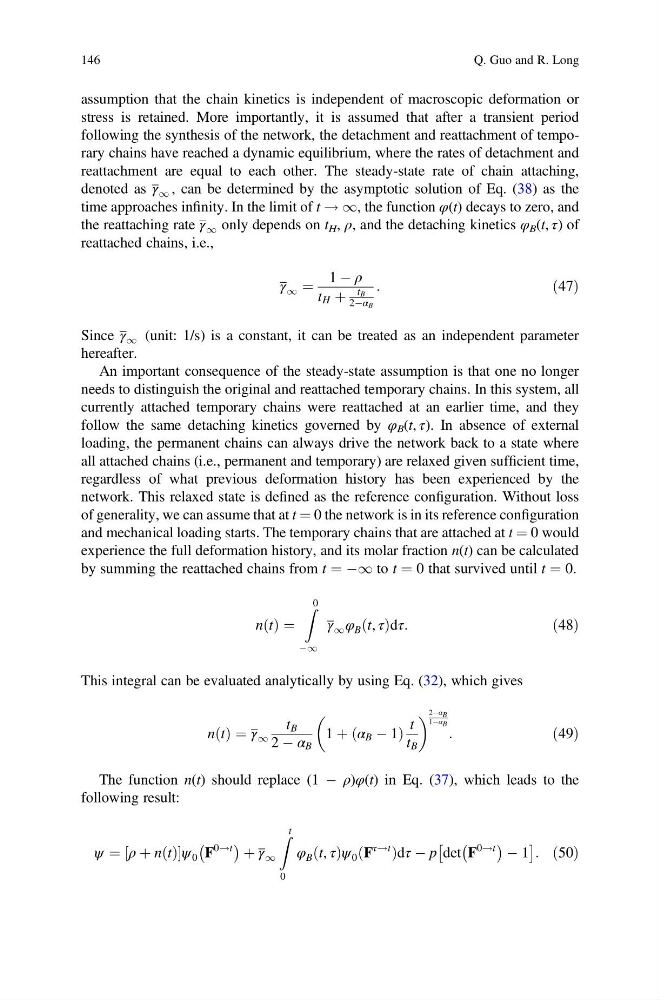
following the synthesis of the network, the detachment and reattachment of temporary chains have reached a dynamic equilibrium, where the rates of detachment and
reattachment are equal to each other. The steady-state rate of chain attaching,
denoted as γ 1 , can be determined by the asymptotic solution of Eq. (38) as the
time approaches infinity. In the limit of t ! 1, the function φ(t) decays to zero, and
the reattaching rate γ 1 only depends on t H , ρ, and the detaching kinetics φ B (t, τ) of
reattached chains, i.e.,
γ 1 ¼
1 À ρ
t H þ
t B
2Àα B
:
ð47Þ
Since γ 1 (unit: 1/s) is a constant, it can be treated as an independent parameter
hereafter.
An important consequence of the steady-state assumption is that one no longer
needs to distinguish the original and reattached temporary chains. In this system, all
currently attached temporary chains were reattached at an earlier time, and they
follow the same detaching kinetics governed by φ B (t, τ). In absence of external
loading, the permanent chains can always drive the network back to a state where
all attached chains (i.e., permanent and temporary) are relaxed given sufficient time,
regardless of what previous deformation history has been experienced by the
network. This relaxed state is defined as the reference configuration. Without loss
of generality, we can assume that at t ¼ 0 the network is in its reference configuration
and mechanical loading starts. The temporary chains that are attached at t ¼ 0 would
experience the full deformation history, and its molar fraction n(t) can be calculated
by summing the reattached chains from t ¼ À1 to t ¼ 0 that survived until t ¼ 0.
n t
ð Þ ¼
Z 0
À1
γ 1 φ B t, τ
ð Þdτ:
ð48Þ
This integral can be evaluated analytically by using Eq. (32), which gives
n t
ð Þ ¼ γ 1
t B
2 À α B
1 þ α B À 1
ð
Þ
t
t B
2Àα B
1Àα B :
ð49Þ
The function n(t) should replace (1 À ρ)φ(t) in Eq. (37), which leads to the
following result:
ψ ¼ ρ þ n t
ð Þ
½
ψ 0 F
0!t
À
Á þ γ 1
Z t
0
φ B t, τ
ð Þψ 0 F
τ!t
ð
Þdτ À p det F
0!t
À
Á À 1
Â
Ã
: ð50Þ
146
Q. Guo and R. Long
stress is retained. More importantly, it is assumed that after a transient period
following the synthesis of the network, the detachment and reattachment of temporary chains have reached a dynamic equilibrium, where the rates of detachment and
reattachment are equal to each other. The steady-state rate of chain attaching,
denoted as γ 1 , can be determined by the asymptotic solution of Eq. (38) as the
time approaches infinity. In the limit of t ! 1, the function φ(t) decays to zero, and
the reattaching rate γ 1 only depends on t H , ρ, and the detaching kinetics φ B (t, τ) of
reattached chains, i.e.,
γ 1 ¼
1 À ρ
t H þ
t B
2Àα B
:
ð47Þ
Since γ 1 (unit: 1/s) is a constant, it can be treated as an independent parameter
hereafter.
An important consequence of the steady-state assumption is that one no longer
needs to distinguish the original and reattached temporary chains. In this system, all
currently attached temporary chains were reattached at an earlier time, and they
follow the same detaching kinetics governed by φ B (t, τ). In absence of external
loading, the permanent chains can always drive the network back to a state where
all attached chains (i.e., permanent and temporary) are relaxed given sufficient time,
regardless of what previous deformation history has been experienced by the
network. This relaxed state is defined as the reference configuration. Without loss
of generality, we can assume that at t ¼ 0 the network is in its reference configuration
and mechanical loading starts. The temporary chains that are attached at t ¼ 0 would
experience the full deformation history, and its molar fraction n(t) can be calculated
by summing the reattached chains from t ¼ À1 to t ¼ 0 that survived until t ¼ 0.
n t
ð Þ ¼
Z 0
À1
γ 1 φ B t, τ
ð Þdτ:
ð48Þ
This integral can be evaluated analytically by using Eq. (32), which gives
n t
ð Þ ¼ γ 1
t B
2 À α B
1 þ α B À 1
ð
Þ
t
t B
2Àα B
1Àα B :
ð49Þ
The function n(t) should replace (1 À ρ)φ(t) in Eq. (37), which leads to the
following result:
ψ ¼ ρ þ n t
ð Þ
½
ψ 0 F
0!t
À
Á þ γ 1
Z t
0
φ B t, τ
ð Þψ 0 F
τ!t
ð
Þdτ À p det F
0!t
À
Á À 1
Â
Ã
: ð50Þ
146
Q. Guo and R. Long