

uniaxial tensile tests, was able to predict the frequency dependence of storage and
loss moduli measured in oscillatory rheological tests.
3.4 Steady-State Kinetics
Although the kinetic relations described in Sect. 3.2 can capture well the experimental data of dual crosslink PVA gels, the underlying physics is not completely
clear. First, Eqs. (31) and (32) state that the original temporary chains and the
reattached temporary chains are governed by different detaching kinetics. If we
start from the initial state (t ¼ 0) and consider the limit of t approaching infinity,
most of the original temporary chains would be detached, and only part of the
temporary chains would be reattached. Moreover, the reattached temporary chains
are different from the original temporary chains. Both implications suggest that the
network can never recover its initial state, unless some additional molecular mechanisms exist as discussed in Long et al. [25]. Second, the detaching kinetics of
temporary chains was assumed to be independent of the macroscopic deformation,
which implies that the temporary chains can still undergo detachment even in the
absence of external loading. This implication also puts the existence of an initial state
where all the temporary chains are attached in question.
Motivated by the inconsistencies described above, Guo et al. [30] proposed a
refined model for the kinetics of chain detachment and reattachment. The
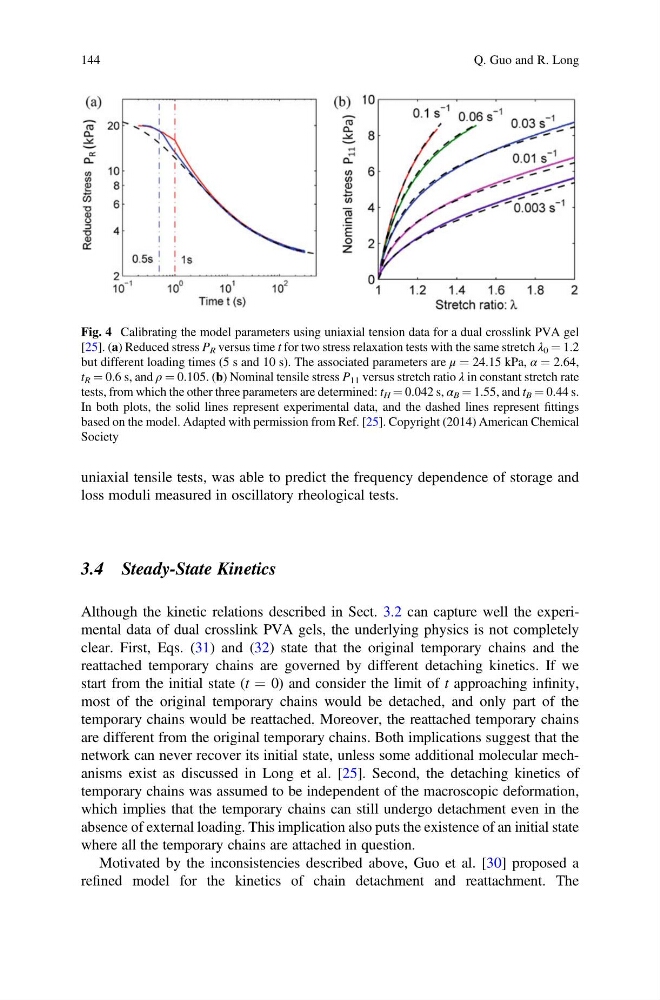
Fig. 4 Calibrating the model parameters using uniaxial tension data for a dual crosslink PVA gel
[25]. (a) Reduced stress P R versus time t for two stress relaxation tests with the same stretch λ 0 ¼ 1.2
but different loading times (5 s and 10 s). The associated parameters are μ ¼ 24.15 kPa, α ¼ 2.64,
t R ¼ 0.6 s, and ρ ¼ 0.105. (b) Nominal tensile stress P 11 versus stretch ratio λ in constant stretch rate
tests, from which the other three parameters are determined: t H ¼ 0.042 s, α B ¼ 1.55, and t B ¼ 0.44 s.
In both plots, the solid lines represent experimental data, and the dashed lines represent fittings
based on the model. Adapted with permission from Ref. [25]. Copyright (2014) American Chemical
Society
144
Q. Guo and R. Long
loss moduli measured in oscillatory rheological tests.
3.4 Steady-State Kinetics
Although the kinetic relations described in Sect. 3.2 can capture well the experimental data of dual crosslink PVA gels, the underlying physics is not completely
clear. First, Eqs. (31) and (32) state that the original temporary chains and the
reattached temporary chains are governed by different detaching kinetics. If we
start from the initial state (t ¼ 0) and consider the limit of t approaching infinity,
most of the original temporary chains would be detached, and only part of the
temporary chains would be reattached. Moreover, the reattached temporary chains
are different from the original temporary chains. Both implications suggest that the
network can never recover its initial state, unless some additional molecular mechanisms exist as discussed in Long et al. [25]. Second, the detaching kinetics of
temporary chains was assumed to be independent of the macroscopic deformation,
which implies that the temporary chains can still undergo detachment even in the
absence of external loading. This implication also puts the existence of an initial state
where all the temporary chains are attached in question.
Motivated by the inconsistencies described above, Guo et al. [30] proposed a
refined model for the kinetics of chain detachment and reattachment. The
Fig. 4 Calibrating the model parameters using uniaxial tension data for a dual crosslink PVA gel
[25]. (a) Reduced stress P R versus time t for two stress relaxation tests with the same stretch λ 0 ¼ 1.2
but different loading times (5 s and 10 s). The associated parameters are μ ¼ 24.15 kPa, α ¼ 2.64,
t R ¼ 0.6 s, and ρ ¼ 0.105. (b) Nominal tensile stress P 11 versus stretch ratio λ in constant stretch rate
tests, from which the other three parameters are determined: t H ¼ 0.042 s, α B ¼ 1.55, and t B ¼ 0.44 s.
In both plots, the solid lines represent experimental data, and the dashed lines represent fittings
based on the model. Adapted with permission from Ref. [25]. Copyright (2014) American Chemical
Society
144
Q. Guo and R. Long