

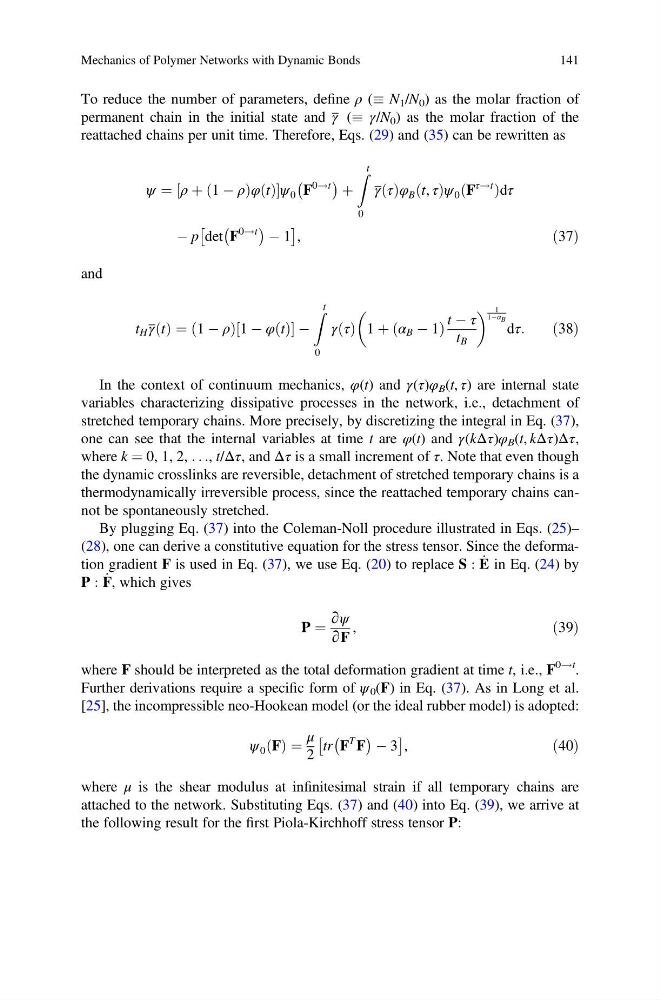
To reduce the number of parameters, define ρ ( N 1 /N 0 ) as the molar fraction of
permanent chain in the initial state and γ ( γ/N 0 ) as the molar fraction of the
reattached chains per unit time. Therefore, Eqs. (29) and (35) can be rewritten as
ψ ¼ ρ þ 1 À ρ
ð
Þφ t
ð Þ
½
ψ 0 F
0!t
À
Á þ
Z t
0
γ τ
ð Þφ B t, τ
ð Þψ 0 F
τ!t
ð
Þdτ
À p det F
0!t
À
Á À 1
Â
Ã
,
ð37Þ
and
t H γ t
ð Þ ¼ 1 À ρ
ð
Þ1 À φ t
ð Þ
½
À
Z t
0
γ τ
ð Þ 1 þ α B À 1
ð
Þ
t À τ
t B
1
1Àα B
dτ:
ð38Þ
In the context of continuum mechanics, φ(t) and γ(τ)φ B (t, τ) are internal state
variables characterizing dissipative processes in the network, i.e., detachment of
stretched temporary chains. More precisely, by discretizing the integral in Eq. (37),
one can see that the internal variables at time t are φ(t) and γ(kΔτ)φ B (t, kΔτ)Δτ,
where k ¼ 0, 1, 2, . . ., t/Δτ, and Δτ is a small increment of τ. Note that even though
the dynamic crosslinks are reversible, detachment of stretched temporary chains is a
thermodynamically irreversible process, since the reattached temporary chains cannot be spontaneously stretched.
By plugging Eq. (37) into the Coleman-Noll procedure illustrated in Eqs. (25)–
(28), one can derive a constitutive equation for the stress tensor. Since the deformation gradient F is used in Eq. (37), we use Eq. (20) to replace S : _
E in Eq. (24) by
P : _
F, which gives
P ¼
∂ψ
∂F
,
ð39Þ
where F should be interpreted as the total deformation gradient at time t, i.e., F
0!t .
Further derivations require a specific form of ψ 0 (F) in Eq. (37). As in Long et al.
[25], the incompressible neo-Hookean model (or the ideal rubber model) is adopted:
ψ 0 F
ð Þ ¼
μ
2
tr F
T F
À
Á À 3
Â
Ã
,
ð40Þ
where μ is the shear modulus at infinitesimal strain if all temporary chains are
attached to the network. Substituting Eqs. (37) and (40) into Eq. (39), we arrive at
the following result for the first Piola-Kirchhoff stress tensor P:
Mechanics of Polymer Networks with Dynamic Bonds
141
permanent chain in the initial state and γ ( γ/N 0 ) as the molar fraction of the
reattached chains per unit time. Therefore, Eqs. (29) and (35) can be rewritten as
ψ ¼ ρ þ 1 À ρ
ð
Þφ t
ð Þ
½
ψ 0 F
0!t
À
Á þ
Z t
0
γ τ
ð Þφ B t, τ
ð Þψ 0 F
τ!t
ð
Þdτ
À p det F
0!t
À
Á À 1
Â
Ã
,
ð37Þ
and
t H γ t
ð Þ ¼ 1 À ρ
ð
Þ1 À φ t
ð Þ
½
À
Z t
0
γ τ
ð Þ 1 þ α B À 1
ð
Þ
t À τ
t B
1
1Àα B
dτ:
ð38Þ
In the context of continuum mechanics, φ(t) and γ(τ)φ B (t, τ) are internal state
variables characterizing dissipative processes in the network, i.e., detachment of
stretched temporary chains. More precisely, by discretizing the integral in Eq. (37),
one can see that the internal variables at time t are φ(t) and γ(kΔτ)φ B (t, kΔτ)Δτ,
where k ¼ 0, 1, 2, . . ., t/Δτ, and Δτ is a small increment of τ. Note that even though
the dynamic crosslinks are reversible, detachment of stretched temporary chains is a
thermodynamically irreversible process, since the reattached temporary chains cannot be spontaneously stretched.
By plugging Eq. (37) into the Coleman-Noll procedure illustrated in Eqs. (25)–
(28), one can derive a constitutive equation for the stress tensor. Since the deformation gradient F is used in Eq. (37), we use Eq. (20) to replace S : _
E in Eq. (24) by
P : _
F, which gives
P ¼
∂ψ
∂F
,
ð39Þ
where F should be interpreted as the total deformation gradient at time t, i.e., F
0!t .
Further derivations require a specific form of ψ 0 (F) in Eq. (37). As in Long et al.
[25], the incompressible neo-Hookean model (or the ideal rubber model) is adopted:
ψ 0 F
ð Þ ¼
μ
2
tr F
T F
À
Á À 3
Â
Ã
,
ð40Þ
where μ is the shear modulus at infinitesimal strain if all temporary chains are
attached to the network. Substituting Eqs. (37) and (40) into Eq. (39), we arrive at
the following result for the first Piola-Kirchhoff stress tensor P:
Mechanics of Polymer Networks with Dynamic Bonds
141