

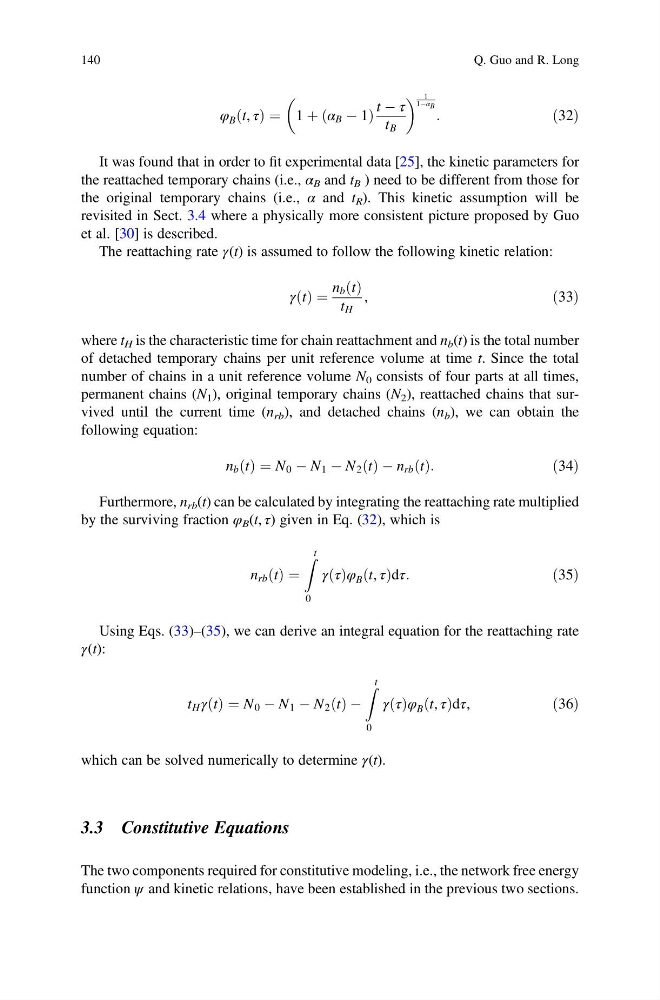
φ B t, τ
ð Þ ¼ 1 þ α B À 1
ð
Þ
t À τ
t B
1
1Àα B :
ð32Þ
It was found that in order to fit experimental data [25], the kinetic parameters for
the reattached temporary chains (i.e., α B and t B ) need to be different from those for
the original temporary chains (i.e., α and t R ). This kinetic assumption will be
revisited in Sect. 3.4 where a physically more consistent picture proposed by Guo
et al. [30] is described.
The reattaching rate γ(t) is assumed to follow the following kinetic relation:
γ t
ð Þ ¼
n b t
ð Þ
t H
,
ð33Þ
where t H is the characteristic time for chain reattachment and n b (t) is the total number
of detached temporary chains per unit reference volume at time t. Since the total
number of chains in a unit reference volume N 0 consists of four parts at all times,
permanent chains (N 1 ), original temporary chains (N 2 ), reattached chains that survived until the current time (n rb ), and detached chains (n b ), we can obtain the
following equation:
n b t
ð Þ ¼ N 0 À N 1 À N 2 t
ð Þ À n rb t
ð Þ:
ð34Þ
Furthermore, n rb (t) can be calculated by integrating the reattaching rate multiplied
by the surviving fraction φ B (t, τ) given in Eq. (32), which is
n rb t
ð Þ ¼
Z t
0
γ τ
ð Þφ B t, τ
ð Þdτ:
ð35Þ
Using Eqs. (33)–(35), we can derive an integral equation for the reattaching rate
γ(t):
t H γ t
ð Þ ¼ N 0 À N 1 À N 2 t
ð Þ À
Z t
0
γ τ
ð Þφ B t, τ
ð Þdτ,
ð36Þ
which can be solved numerically to determine γ(t).
3.3 Constitutive Equations
The two components required for constitutive modeling, i.e., the network free energy
function ψ and kinetic relations, have been established in the previous two sections.
140
Q. Guo and R. Long
ð Þ ¼ 1 þ α B À 1
ð
Þ
t À τ
t B
1
1Àα B :
ð32Þ
It was found that in order to fit experimental data [25], the kinetic parameters for
the reattached temporary chains (i.e., α B and t B ) need to be different from those for
the original temporary chains (i.e., α and t R ). This kinetic assumption will be
revisited in Sect. 3.4 where a physically more consistent picture proposed by Guo
et al. [30] is described.
The reattaching rate γ(t) is assumed to follow the following kinetic relation:
γ t
ð Þ ¼
n b t
ð Þ
t H
,
ð33Þ
where t H is the characteristic time for chain reattachment and n b (t) is the total number
of detached temporary chains per unit reference volume at time t. Since the total
number of chains in a unit reference volume N 0 consists of four parts at all times,
permanent chains (N 1 ), original temporary chains (N 2 ), reattached chains that survived until the current time (n rb ), and detached chains (n b ), we can obtain the
following equation:
n b t
ð Þ ¼ N 0 À N 1 À N 2 t
ð Þ À n rb t
ð Þ:
ð34Þ
Furthermore, n rb (t) can be calculated by integrating the reattaching rate multiplied
by the surviving fraction φ B (t, τ) given in Eq. (32), which is
n rb t
ð Þ ¼
Z t
0
γ τ
ð Þφ B t, τ
ð Þdτ:
ð35Þ
Using Eqs. (33)–(35), we can derive an integral equation for the reattaching rate
γ(t):
t H γ t
ð Þ ¼ N 0 À N 1 À N 2 t
ð Þ À
Z t
0
γ τ
ð Þφ B t, τ
ð Þdτ,
ð36Þ
which can be solved numerically to determine γ(t).
3.3 Constitutive Equations
The two components required for constitutive modeling, i.e., the network free energy
function ψ and kinetic relations, have been established in the previous two sections.
140
Q. Guo and R. Long