

ψ ¼
N 1 þ N 2 t
ð Þ
N 0
ψ 0 F
0!t
À
Á þ
Z t
0
γ τ
ð Þφ B t, τ
ð Þ
N 0
ψ 0 F
τ!t
ð
Þdτ
À p det F
0!t
À
Á À 1
Â
Ã
,
ð29Þ
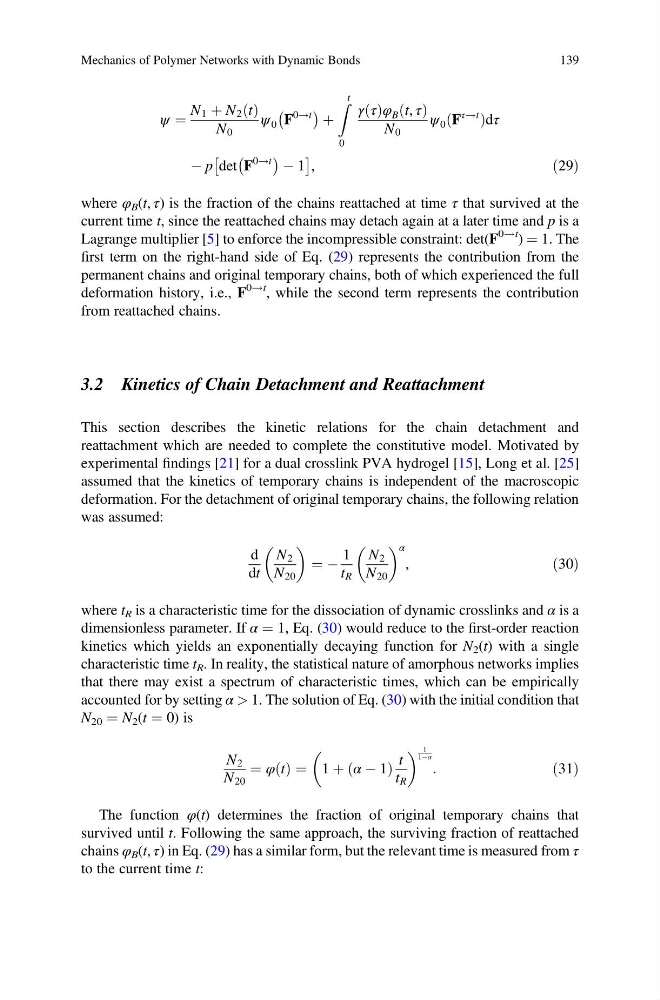
where φ B (t, τ) is the fraction of the chains reattached at time τ that survived at the
current time t, since the reattached chains may detach again at a later time and p is a
Lagrange multiplier [5] to enforce the incompressible constraint: det(F
0!t
) ¼ 1. The
first term on the right-hand side of Eq. (29) represents the contribution from the
permanent chains and original temporary chains, both of which experienced the full
deformation history, i.e., F
0!t , while the second term represents the contribution
from reattached chains.
3.2 Kinetics of Chain Detachment and Reattachment
This section describes the kinetic relations for the chain detachment and
reattachment which are needed to complete the constitutive model. Motivated by
experimental findings [21] for a dual crosslink PVA hydrogel [15], Long et al. [25]
assumed that the kinetics of temporary chains is independent of the macroscopic
deformation. For the detachment of original temporary chains, the following relation
was assumed:
d
dt
N 2
N 20
¼ À
1
t R
N 2
N 20
α
,
ð30Þ
where t R is a characteristic time for the dissociation of dynamic crosslinks and α is a
dimensionless parameter. If α ¼ 1, Eq. (30) would reduce to the first-order reaction
kinetics which yields an exponentially decaying function for N 2 (t) with a single
characteristic time t R . In reality, the statistical nature of amorphous networks implies
that there may exist a spectrum of characteristic times, which can be empirically
accounted for by setting α > 1. The solution of Eq. (30) with the initial condition that
N 20 ¼ N 2 (t ¼ 0) is
N 2
N 20
¼ φ t
ð Þ ¼ 1 þ α À 1
ð
Þ
t
t R
1
1Àα :
ð31Þ
The function φ(t) determines the fraction of original temporary chains that
survived until t. Following the same approach, the surviving fraction of reattached
chains φ B (t, τ) in Eq. (29) has a similar form, but the relevant time is measured from τ
to the current time t:
Mechanics of Polymer Networks with Dynamic Bonds
139
N 1 þ N 2 t
ð Þ
N 0
ψ 0 F
0!t
À
Á þ
Z t
0
γ τ
ð Þφ B t, τ
ð Þ
N 0
ψ 0 F
τ!t
ð
Þdτ
À p det F
0!t
À
Á À 1
Â
Ã
,
ð29Þ
where φ B (t, τ) is the fraction of the chains reattached at time τ that survived at the
current time t, since the reattached chains may detach again at a later time and p is a
Lagrange multiplier [5] to enforce the incompressible constraint: det(F
0!t
) ¼ 1. The
first term on the right-hand side of Eq. (29) represents the contribution from the
permanent chains and original temporary chains, both of which experienced the full
deformation history, i.e., F
0!t , while the second term represents the contribution
from reattached chains.
3.2 Kinetics of Chain Detachment and Reattachment
This section describes the kinetic relations for the chain detachment and
reattachment which are needed to complete the constitutive model. Motivated by
experimental findings [21] for a dual crosslink PVA hydrogel [15], Long et al. [25]
assumed that the kinetics of temporary chains is independent of the macroscopic
deformation. For the detachment of original temporary chains, the following relation
was assumed:
d
dt
N 2
N 20
¼ À
1
t R
N 2
N 20
α
,
ð30Þ
where t R is a characteristic time for the dissociation of dynamic crosslinks and α is a
dimensionless parameter. If α ¼ 1, Eq. (30) would reduce to the first-order reaction
kinetics which yields an exponentially decaying function for N 2 (t) with a single
characteristic time t R . In reality, the statistical nature of amorphous networks implies
that there may exist a spectrum of characteristic times, which can be empirically
accounted for by setting α > 1. The solution of Eq. (30) with the initial condition that
N 20 ¼ N 2 (t ¼ 0) is
N 2
N 20
¼ φ t
ð Þ ¼ 1 þ α À 1
ð
Þ
t
t R
1
1Àα :
ð31Þ
The function φ(t) determines the fraction of original temporary chains that
survived until t. Following the same approach, the surviving fraction of reattached
chains φ B (t, τ) in Eq. (29) has a similar form, but the relevant time is measured from τ
to the current time t:
Mechanics of Polymer Networks with Dynamic Bonds
139