

deformation history F(t). For example, a temporary chain reattached at time τ
experiences the deformation history from its birth at τ to the current time t (t ! τ),
which is denoted as F
τ ! t
. The case of τ ¼ 0 corresponds to the permanent chains
and the temporary chains that existed in the initial state.
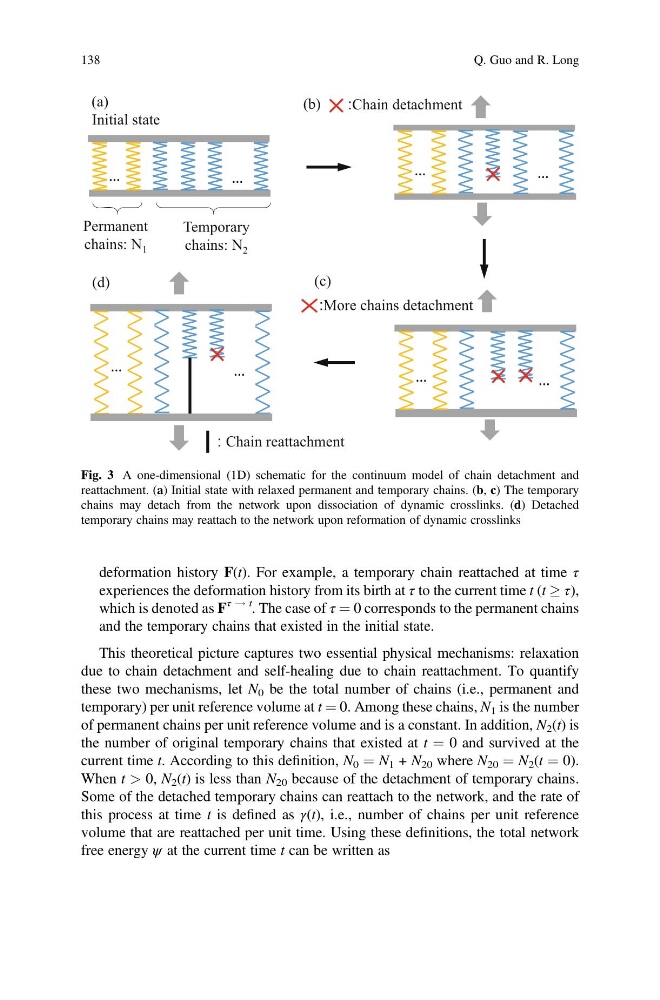
This theoretical picture captures two essential physical mechanisms: relaxation
due to chain detachment and self-healing due to chain reattachment. To quantify
these two mechanisms, let N 0 be the total number of chains (i.e., permanent and
temporary) per unit reference volume at t ¼ 0. Among these chains, N 1 is the number
of permanent chains per unit reference volume and is a constant. In addition, N 2 (t) is
the number of original temporary chains that existed at t ¼ 0 and survived at the
current time t. According to this definition, N 0 ¼ N 1 + N 20 where N 20 ¼ N 2 (t ¼ 0).
When t > 0, N 2 (t) is less than N 20 because of the detachment of temporary chains.
Some of the detached temporary chains can reattach to the network, and the rate of
this process at time t is defined as γ(t), i.e., number of chains per unit reference
volume that are reattached per unit time. Using these definitions, the total network
free energy ψ at the current time t can be written as
…
…
Permanent
chains: N 1
Temporary
chains: N 2
…
…
:Chain detachment
…
…
:More chains detachment
…
…
: Chain reattachment
Initial state
(a)
(b)
(c)
(d)
Fig. 3 A one-dimensional (1D) schematic for the continuum model of chain detachment and
reattachment. (a) Initial state with relaxed permanent and temporary chains. (b, c) The temporary
chains may detach from the network upon dissociation of dynamic crosslinks. (d) Detached
temporary chains may reattach to the network upon reformation of dynamic crosslinks
138
Q. Guo and R. Long
experiences the deformation history from its birth at τ to the current time t (t ! τ),
which is denoted as F
τ ! t
. The case of τ ¼ 0 corresponds to the permanent chains
and the temporary chains that existed in the initial state.
This theoretical picture captures two essential physical mechanisms: relaxation
due to chain detachment and self-healing due to chain reattachment. To quantify
these two mechanisms, let N 0 be the total number of chains (i.e., permanent and
temporary) per unit reference volume at t ¼ 0. Among these chains, N 1 is the number
of permanent chains per unit reference volume and is a constant. In addition, N 2 (t) is
the number of original temporary chains that existed at t ¼ 0 and survived at the
current time t. According to this definition, N 0 ¼ N 1 + N 20 where N 20 ¼ N 2 (t ¼ 0).
When t > 0, N 2 (t) is less than N 20 because of the detachment of temporary chains.
Some of the detached temporary chains can reattach to the network, and the rate of
this process at time t is defined as γ(t), i.e., number of chains per unit reference
volume that are reattached per unit time. Using these definitions, the total network
free energy ψ at the current time t can be written as
…
…
Permanent
chains: N 1
Temporary
chains: N 2
…
…
:Chain detachment
…
…
:More chains detachment
…
…
: Chain reattachment
Initial state
(a)
(b)
(c)
(d)
Fig. 3 A one-dimensional (1D) schematic for the continuum model of chain detachment and
reattachment. (a) Initial state with relaxed permanent and temporary chains. (b, c) The temporary
chains may detach from the network upon dissociation of dynamic crosslinks. (d) Detached
temporary chains may reattach to the network upon reformation of dynamic crosslinks
138
Q. Guo and R. Long