

η g ¼ _
η À ∇ X Á À
Q
T
! 0,
ð22Þ
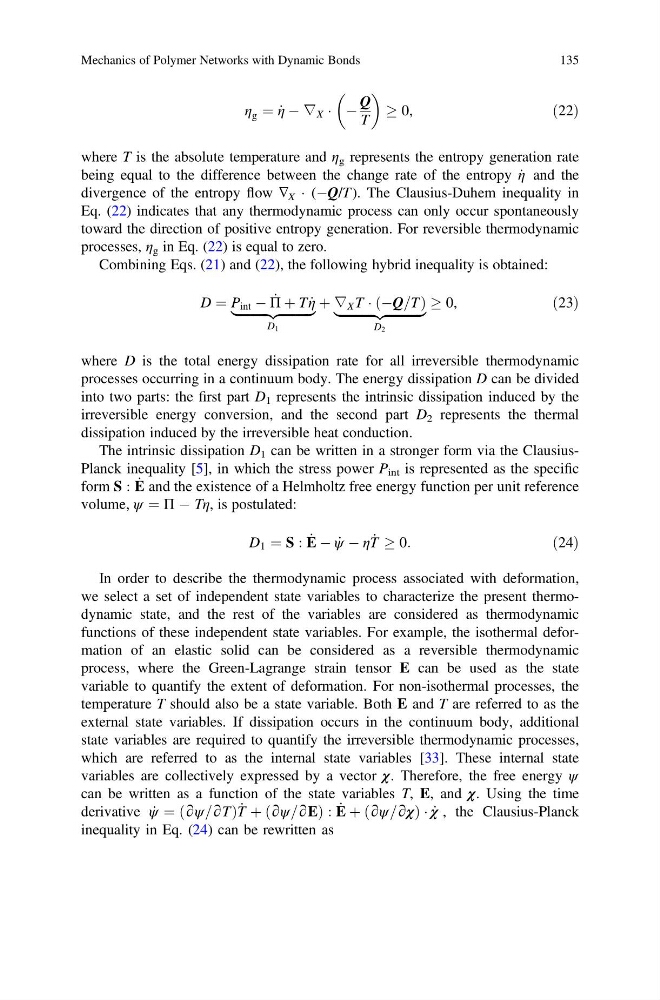
where T is the absolute temperature and η g represents the entropy generation rate
being equal to the difference between the change rate of the entropy _
η and the
divergence of the entropy flow ∇ X Á (ÀQ/T ). The Clausius-Duhem inequality in
Eq. (22) indicates that any thermodynamic process can only occur spontaneously
toward the direction of positive entropy generation. For reversible thermodynamic
processes, η g in Eq. (22) is equal to zero.
Combining Eqs. (21) and (22), the following hybrid inequality is obtained:
D ¼ P int À _
Π þ T _
η
|fflfflfflfflfflfflfflfflffl ffl{zfflfflfflfflfflfflfflfflffl ffl}
D 1
þ ∇ X T Á ÀQ=T
ð
Þ
|fflfflfflfflfflfflfflfflfflfflffl{zfflfflfflfflfflfflfflfflfflfflffl}
D 2
! 0,
ð23Þ
where D is the total energy dissipation rate for all irreversible thermodynamic
processes occurring in a continuum body. The energy dissipation D can be divided
into two parts: the first part D 1 represents the intrinsic dissipation induced by the
irreversible energy conversion, and the second part D 2 represents the thermal
dissipation induced by the irreversible heat conduction.
The intrinsic dissipation D 1 can be written in a stronger form via the ClausiusPlanck inequality [5], in which the stress power P int is represented as the specific
form S : _
E and the existence of a Helmholtz free energy function per unit reference
volume, ψ ¼ Π À Tη, is postulated:
D 1 ¼ S : _
E À _
ψ À η _
T ! 0:
ð24Þ
In order to describe the thermodynamic process associated with deformation,
we select a set of independent state variables to characterize the present thermodynamic state, and the rest of the variables are considered as thermodynamic
functions of these independent state variables. For example, the isothermal deformation of an elastic solid can be considered as a reversible thermodynamic
process, where the Green-Lagrange strain tensor E can be used as the state
variable to quantify the extent of deformation. For non-isothermal processes, the
temperature T should also be a state variable. Both E and T are referred to as the
external state variables. If dissipation occurs in the continuum body, additional
state variables are required to quantify the irreversible thermodynamic processes,
which are referred to as the internal state variables [33]. These internal state
variables are collectively expressed by a vector χ . Therefore, the free energy ψ
can be written as a function of the state variables T, E, and χ . Using the time
derivative _
ψ ¼ ∂ψ=∂T
ð
Þ _
T þ ∂ψ=∂E
ð
Þ: _
E þ ∂ψ=∂χ
ð
ÞÁ_ χ , the Clausius-Planck
inequality in Eq. (24) can be rewritten as
Mechanics of Polymer Networks with Dynamic Bonds
135
η À ∇ X Á À
Q
T
! 0,
ð22Þ
where T is the absolute temperature and η g represents the entropy generation rate
being equal to the difference between the change rate of the entropy _
η and the
divergence of the entropy flow ∇ X Á (ÀQ/T ). The Clausius-Duhem inequality in
Eq. (22) indicates that any thermodynamic process can only occur spontaneously
toward the direction of positive entropy generation. For reversible thermodynamic
processes, η g in Eq. (22) is equal to zero.
Combining Eqs. (21) and (22), the following hybrid inequality is obtained:
D ¼ P int À _
Π þ T _
η
|fflfflfflfflfflfflfflfflffl ffl{zfflfflfflfflfflfflfflfflffl ffl}
D 1
þ ∇ X T Á ÀQ=T
ð
Þ
|fflfflfflfflfflfflfflfflfflfflffl{zfflfflfflfflfflfflfflfflfflfflffl}
D 2
! 0,
ð23Þ
where D is the total energy dissipation rate for all irreversible thermodynamic
processes occurring in a continuum body. The energy dissipation D can be divided
into two parts: the first part D 1 represents the intrinsic dissipation induced by the
irreversible energy conversion, and the second part D 2 represents the thermal
dissipation induced by the irreversible heat conduction.
The intrinsic dissipation D 1 can be written in a stronger form via the ClausiusPlanck inequality [5], in which the stress power P int is represented as the specific
form S : _
E and the existence of a Helmholtz free energy function per unit reference
volume, ψ ¼ Π À Tη, is postulated:
D 1 ¼ S : _
E À _
ψ À η _
T ! 0:
ð24Þ
In order to describe the thermodynamic process associated with deformation,
we select a set of independent state variables to characterize the present thermodynamic state, and the rest of the variables are considered as thermodynamic
functions of these independent state variables. For example, the isothermal deformation of an elastic solid can be considered as a reversible thermodynamic
process, where the Green-Lagrange strain tensor E can be used as the state
variable to quantify the extent of deformation. For non-isothermal processes, the
temperature T should also be a state variable. Both E and T are referred to as the
external state variables. If dissipation occurs in the continuum body, additional
state variables are required to quantify the irreversible thermodynamic processes,
which are referred to as the internal state variables [33]. These internal state
variables are collectively expressed by a vector χ . Therefore, the free energy ψ
can be written as a function of the state variables T, E, and χ . Using the time
derivative _
ψ ¼ ∂ψ=∂T
ð
Þ _
T þ ∂ψ=∂E
ð
Þ: _
E þ ∂ψ=∂χ
ð
ÞÁ_ χ , the Clausius-Planck
inequality in Eq. (24) can be rewritten as
Mechanics of Polymer Networks with Dynamic Bonds
135