

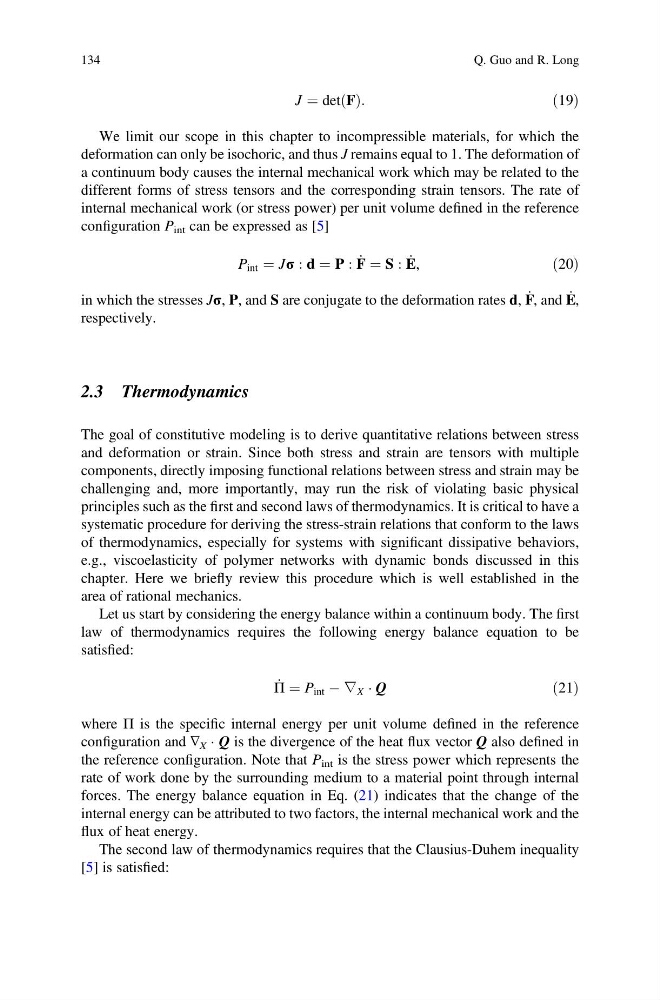
J ¼ det F
ð Þ:
ð19Þ
We limit our scope in this chapter to incompressible materials, for which the
deformation can only be isochoric, and thus J remains equal to 1. The deformation of
a continuum body causes the internal mechanical work which may be related to the
different forms of stress tensors and the corresponding strain tensors. The rate of
internal mechanical work (or stress power) per unit volume defined in the reference
configuration P int can be expressed as [5]
P int ¼ Jσ : d ¼ P : _
F ¼ S : _
E,
ð20Þ
in which the stresses Jσ, P, and S are conjugate to the deformation rates d, _
F, and _
E,
respectively.
2.3 Thermodynamics
The goal of constitutive modeling is to derive quantitative relations between stress
and deformation or strain. Since both stress and strain are tensors with multiple
components, directly imposing functional relations between stress and strain may be
challenging and, more importantly, may run the risk of violating basic physical
principles such as the first and second laws of thermodynamics. It is critical to have a
systematic procedure for deriving the stress-strain relations that conform to the laws
of thermodynamics, especially for systems with significant dissipative behaviors,
e.g., viscoelasticity of polymer networks with dynamic bonds discussed in this
chapter. Here we briefly review this procedure which is well established in the
area of rational mechanics.
Let us start by considering the energy balance within a continuum body. The first
law of thermodynamics requires the following energy balance equation to be
satisfied:
_
Π ¼ P int À ∇ X Á Q
ð21Þ
where Π is the specific internal energy per unit volume defined in the reference
configuration and ∇ X Á Q is the divergence of the heat flux vector Q also defined in
the reference configuration. Note that P int is the stress power which represents the
rate of work done by the surrounding medium to a material point through internal
forces. The energy balance equation in Eq. (21) indicates that the change of the
internal energy can be attributed to two factors, the internal mechanical work and the
flux of heat energy.
The second law of thermodynamics requires that the Clausius-Duhem inequality
[5] is satisfied:
134
Q. Guo and R. Long
ð Þ:
ð19Þ
We limit our scope in this chapter to incompressible materials, for which the
deformation can only be isochoric, and thus J remains equal to 1. The deformation of
a continuum body causes the internal mechanical work which may be related to the
different forms of stress tensors and the corresponding strain tensors. The rate of
internal mechanical work (or stress power) per unit volume defined in the reference
configuration P int can be expressed as [5]
P int ¼ Jσ : d ¼ P : _
F ¼ S : _
E,
ð20Þ
in which the stresses Jσ, P, and S are conjugate to the deformation rates d, _
F, and _
E,
respectively.
2.3 Thermodynamics
The goal of constitutive modeling is to derive quantitative relations between stress
and deformation or strain. Since both stress and strain are tensors with multiple
components, directly imposing functional relations between stress and strain may be
challenging and, more importantly, may run the risk of violating basic physical
principles such as the first and second laws of thermodynamics. It is critical to have a
systematic procedure for deriving the stress-strain relations that conform to the laws
of thermodynamics, especially for systems with significant dissipative behaviors,
e.g., viscoelasticity of polymer networks with dynamic bonds discussed in this
chapter. Here we briefly review this procedure which is well established in the
area of rational mechanics.
Let us start by considering the energy balance within a continuum body. The first
law of thermodynamics requires the following energy balance equation to be
satisfied:
_
Π ¼ P int À ∇ X Á Q
ð21Þ
where Π is the specific internal energy per unit volume defined in the reference
configuration and ∇ X Á Q is the divergence of the heat flux vector Q also defined in
the reference configuration. Note that P int is the stress power which represents the
rate of work done by the surrounding medium to a material point through internal
forces. The energy balance equation in Eq. (21) indicates that the change of the
internal energy can be attributed to two factors, the internal mechanical work and the
flux of heat energy.
The second law of thermodynamics requires that the Clausius-Duhem inequality
[5] is satisfied:
134
Q. Guo and R. Long