

_
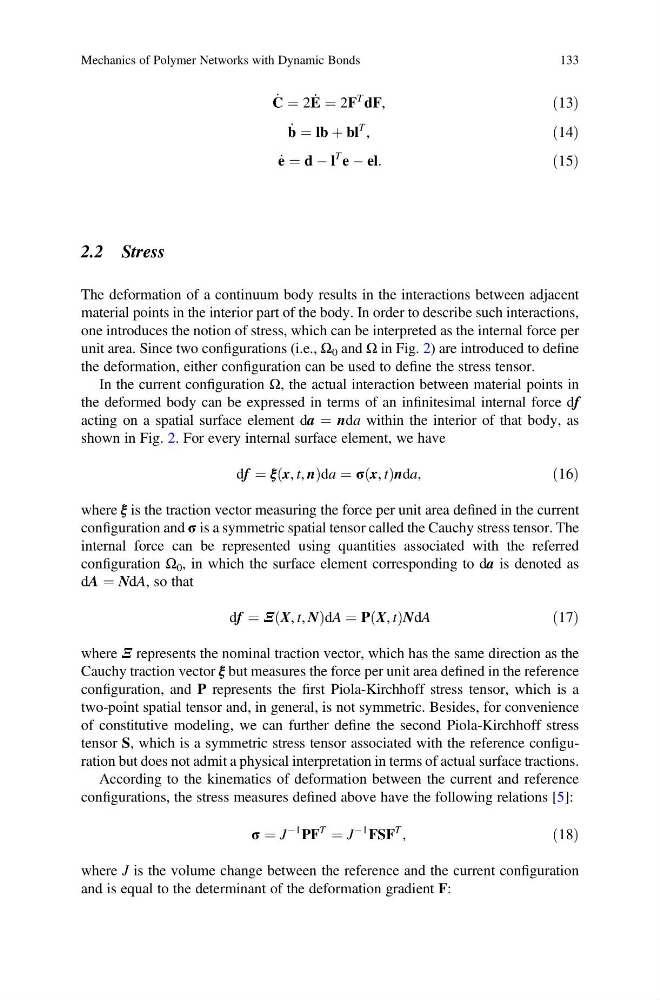
C ¼ 2 _
E ¼ 2F
T dF,
ð13Þ
_
b ¼ lb þ bl
T ,
ð14Þ
_
e ¼ d À l
T e À el:
ð15Þ
2.2 Stress
The deformation of a continuum body results in the interactions between adjacent
material points in the interior part of the body. In order to describe such interactions,
one introduces the notion of stress, which can be interpreted as the internal force per
unit area. Since two configurations (i.e., Ω 0 and Ω in Fig. 2) are introduced to define
the deformation, either configuration can be used to define the stress tensor.
In the current configuration Ω, the actual interaction between material points in
the deformed body can be expressed in terms of an infinitesimal internal force df
acting on a spatial surface element da ¼ nda within the interior of that body, as
shown in Fig. 2. For every internal surface element, we have
df ¼ ξ x, t, n
ð
Þda ¼ σ x, t
ð Þnda,
ð16Þ
where ξ is the traction vector measuring the force per unit area defined in the current
configuration and σ is a symmetric spatial tensor called the Cauchy stress tensor. The
internal force can be represented using quantities associated with the referred
configuration Ω 0 , in which the surface element corresponding to da is denoted as
dA ¼ NdA, so that
df ¼ Ξ X, t, N
ð
ÞdA ¼ P X, t
ð ÞNdA
ð17Þ
where Ξ represents the nominal traction vector, which has the same direction as the
Cauchy traction vector ξ but measures the force per unit area defined in the reference
configuration, and P represents the first Piola-Kirchhoff stress tensor, which is a
two-point spatial tensor and, in general, is not symmetric. Besides, for convenience
of constitutive modeling, we can further define the second Piola-Kirchhoff stress
tensor S, which is a symmetric stress tensor associated with the reference configuration but does not admit a physical interpretation in terms of actual surface tractions.
According to the kinematics of deformation between the current and reference
configurations, the stress measures defined above have the following relations [5]:
σ ¼ J
À1 PF
T
¼ J
À1 FSF
T ,
ð18Þ
where J is the volume change between the reference and the current configuration
and is equal to the determinant of the deformation gradient F:
Mechanics of Polymer Networks with Dynamic Bonds
133
C ¼ 2 _
E ¼ 2F
T dF,
ð13Þ
_
b ¼ lb þ bl
T ,
ð14Þ
_
e ¼ d À l
T e À el:
ð15Þ
2.2 Stress
The deformation of a continuum body results in the interactions between adjacent
material points in the interior part of the body. In order to describe such interactions,
one introduces the notion of stress, which can be interpreted as the internal force per
unit area. Since two configurations (i.e., Ω 0 and Ω in Fig. 2) are introduced to define
the deformation, either configuration can be used to define the stress tensor.
In the current configuration Ω, the actual interaction between material points in
the deformed body can be expressed in terms of an infinitesimal internal force df
acting on a spatial surface element da ¼ nda within the interior of that body, as
shown in Fig. 2. For every internal surface element, we have
df ¼ ξ x, t, n
ð
Þda ¼ σ x, t
ð Þnda,
ð16Þ
where ξ is the traction vector measuring the force per unit area defined in the current
configuration and σ is a symmetric spatial tensor called the Cauchy stress tensor. The
internal force can be represented using quantities associated with the referred
configuration Ω 0 , in which the surface element corresponding to da is denoted as
dA ¼ NdA, so that
df ¼ Ξ X, t, N
ð
ÞdA ¼ P X, t
ð ÞNdA
ð17Þ
where Ξ represents the nominal traction vector, which has the same direction as the
Cauchy traction vector ξ but measures the force per unit area defined in the reference
configuration, and P represents the first Piola-Kirchhoff stress tensor, which is a
two-point spatial tensor and, in general, is not symmetric. Besides, for convenience
of constitutive modeling, we can further define the second Piola-Kirchhoff stress
tensor S, which is a symmetric stress tensor associated with the reference configuration but does not admit a physical interpretation in terms of actual surface tractions.
According to the kinematics of deformation between the current and reference
configurations, the stress measures defined above have the following relations [5]:
σ ¼ J
À1 PF
T
¼ J
À1 FSF
T ,
ð18Þ
where J is the volume change between the reference and the current configuration
and is equal to the determinant of the deformation gradient F:
Mechanics of Polymer Networks with Dynamic Bonds
133